
About Nicolas Melo
Lived 1550 – 1614 (aged 63–64). Nicolas Melo was a Spanish missionary.
Nicolás de Melo (born Nicolás Morán Antúnez, 1548 – January 28, 1615) was a Portuguese Augustinian friar and missionary, whose life was marked by his extensive travels and martyrdom during his mission in Russia. He is recognized for his efforts in diplomatic and religious missions, particularly in Safavid Iran, and is venerated by some as a martyr due to his persecution and eventual death at the hands of anti-Catholic forces.
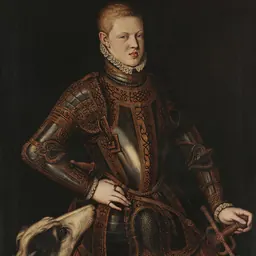
Early life Nicolás de Melo was born around 1548 in Corichán, Portugal (or Belmonte) to Francisco de Antúnez and Isabel Morán. It is unknown when he changed his surname. Although of modest origins, some sources claim that he was of noble birth. As a young man, Melo served King Sebastian of Portugal and later a merchant in Seville (according to Tomas Marquez ) before eventually joining the Augustinian Order in Mexico in 1577, where he took his vows in Puebla. After studying theology and grammar, he embarked on missionary work in the Philippines in 1582. Melo engaged in missionary work in the southern Visayan Islands (especially Panay Island), ministering Aklan and Hamtic, but he later moved to the Tagalog region near Manila. He was eventually appointed as the novice master of the Augustinian monastery in Manila by the provincial superior of the Augustinian Order in the Philippines. This appointment was due to his rapid mastery of local languages and his significant missionary accomplishments, as well as his naturally good and devout character.
In 1596, a meeting of the Augustinian Order was held in Manila. During this meeting, two priests, Juan Tamayo and Diego de Guevara, were selected as representatives of the province to be sent to the general chapter in Rome. They set sail from Manila in the summer of that year, traveling via Mexico and the Atlantic Ocean to reach Rome. However, their ship was struck by a storm and drifted ashore in Tosa Province of Japan. The ship's captain made inappropriate remarks, which led to the confiscation of their cargo and, eventually, the reissuance of the ban on Christianity by Toyotomi Hideyoshi, culminating in the martyrdom of 26 Christians in Nagasaki. This incident later came to be known as San Felipe Incident. This led to Melo being appointed as their successor next year and entrusted with a mission to accompany friars to Macau and Malacca, as there was no bishop in the Philippines at that time to ordain new priests. He was appointed Procurator General for Augustinian Province of the Most Holy Name of Jesus of the Philippines on 29 August 1597, with a mission to the Curia in Rome and the Spanish Court. Shirley had Melo imprisoned, confiscating his letters and possessions. According to various accounts, including that of Don Juan of Persia, Shirley attempted to kill Melo multiple times during their journey down the Volga River, but the friar was saved by the intervention of Safavid officials who had befriended him.
In Moscow, Melo was placed under arrest again, and Sherley accused him of various crimes. Shirley accuses Melo of violating Christian morals in his memoirs, even claiming that he slept with prostitutes while in Isfahan. According to Arnulf Hartmann, these were defamatory rumors spread by an Armenian priest who was translating for Melo in Hormuz and wanted to be a member of the embassy. During interrogations by Russian officials, Sherley allegedly struck Melo, further solidifying his hostile intent. Despite these actions, Melo continued to conduct his religious duties, including baptizing Lucia - the daughter (or granddaughter) of a Milanese doctor called Paolo Cittadini
Arrest After five months of imprisonment in Moscow, Melo was deported to the Solovetsky Monastery in Northern Russia, a harsh prison during the reign of Boris Godunov. News reached to Iranian embassy when they were in Port of Arkhangelsk in July 1601. He remained there for six years under brutal conditions, enduring starvation, extreme cold, and physical abuse. Melo's suffering continued through the turbulent political landscape of Russia, which saw the rise and fall of several rulers.
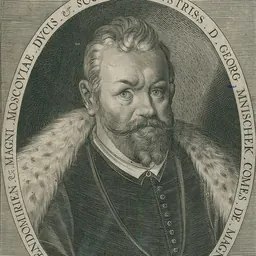
In July 1605, three months after Boris Godunov died suddenly, False Dmitry took the throne in Moscow as the new Tsar. According to "Diary of Marina Mniszech", which was written by a Polish secretary of Marina Mniszech Melo was in contact with Dmitry's supporters. After gaining temporary freedom during the rule of False Dmitry, thanks to John Thaddeus of Saint Eliseus, a Carmelite friar who was sent by Clement VIII He was also in contact with Jerzy Mniszech, father of Marina Mniszech, who was now a widow. Meanwhile, his Japanese companion, Fr. Nicolás de San Agustín, was eventually killed in September 1611, executed by beheading in Nizhny Novgorod.
He soon was freed by Ivan Zarutsky. Melo became the chaplain to Marina Mniszech, following her to Astrakhan by 1613. According to Pierling, Marina and her son Ivan Dmitriyevich were accompanied by three Catholic priests. These included Father Antonius of the Bernardine Order, who had shared Marina's fate since her arrival in Moscow, John Thaddeus of the Carmelite Order, who had been in Safavid Iran on a mission and had now returned via the Caspian Sea, and Nicolas Melo, who had joined them from Nizhny Novgorod. At this time, Barbara Cazanowsky, a Polish noblewoman who had accompanied Marina from Poland, converted to Catholicism and joined the Augustinian Order under Melo's guidance.
In 1614, new tsar Mikhail Romanov's troops sailed down the Volga, approaching Astrakhan, seeing young Ivan as a potential rival. Zarutsky and Mniszech found themselves in a precarious situation and sent emissaries to appeal for assistance from Shah Abbas, seeking permission for asylum. However, in May 1614, Zarutsky, Marina, and several hundred Cossacks fled from Astrakhan, traveling along the northern coast of the Caspian Sea and entering the Ural River. On an island known as "Bear Island", Zarutsky's forces were surrounded by Romanov troops. On June 25, the Cossacks surrendered, handing over their leader Zarutsky and Marina with her son Ivan to the government troops.
Death John Thaddeus returned to Iran, departing from Astrakhan on the feast of Saint Simon and Saint Jude, October 28, 1613. This was the last time he saw de Melo. According to account of Thaddeus by August 1615, some Russian envoys who arrived in Isfahan and some Iranian merchants who came from Astrakhan told him with certainty that Melo had been burned alive, along with Barbara Cazanowsky, a venerable Polish Catholic matron and aunt of Marina Mniszech. Thaddeus placed great trust in the Russian envoys' report, particularly since one of them had hosted him in his home and seemed entirely trustworthy.
The death of Nicolás de Melo was widely regarded as a martyrdom, and he was considered a Beatus and Venerable by contemporaries such as Luis Piñeiro and Georges Maigret. Antonio de Gouvea collected testimonies regarding Melo's martyrdom and sent them to church authorities in Portugal and Rome. Despite early efforts to initiate his beatification process, it was never formally completed.
Don’t just read it —
keep it.
Full-length biographies made to live with: read them, listen on the way to work, watch them tonight.
- E-book
- Audio
- Video
Instant download · yours to keep · every purchase keeps this site free
Important facts
People in Nicolas Melo's life
Named in this biography and alive at the same time





Related people
Same field, nearest in time


Contemporaries
People whose lives overlapped Nicolas Melo's

Frequently asked questions
Who was Nicolas Melo?
Spanish Augustine missionary in Russia
When was Nicolas Melo born?
Nicolas Melo was born in 1550 in Belmonte.
When did Nicolas Melo die?
Nicolas Melo died in 1614.
What was Nicolas Melo's occupation?
Nicolas Melo was a missionary.
What nationality was Nicolas Melo?
Nicolas Melo was Spanish.
Sources & further reading
Cite this page
APA: Biography.guide. (2026). Nicolas Melo. https://biography.guide/nicolas-melo/
MLA: "Nicolas Melo." Biography.guide, https://biography.guide/nicolas-melo/.
Chicago: "Nicolas Melo." Biography.guide. https://biography.guide/nicolas-melo/.
Data last updated: 2026-09-26 · Spot an error? Report a correction.
Page generated 2026-09-27 05:15 UTC