
Nicolas Flamel
French scrivener
About Nicolas Flamel
Lived 1330 – 1418 (aged 87–88). Nicolas Flamel was a French scribe, amanuensis, donor, bookseller, alchemist and scrivener.
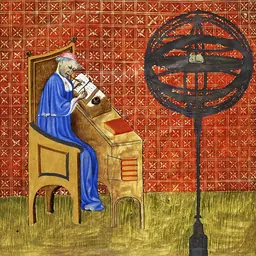
Nicolas Flamel (; 1330 – 22 March 1418) was a French , a draftsman of public documents such as contracts, letters, agreements and requests, at a time when few people could write and read. He and his wife also ran a school that taught this trade.
Long after his death, Flamel developed a reputation as an alchemist thought to have created and discovered the philosopher's stone and to have thereby achieved immortality. These legendary accounts first appeared in the 17th century. According to texts ascribed to Flamel almost 200 years after his death, he had learned alchemical secrets from a Jewish converso on the road to Santiago de Compostela. He has since appeared as a legendary alchemist in various fictional works.
In modern historical publications Flamel is also often referred to as a copyist of manuscripts and a book seller, but research by M. and R. Rouse has demonstrated that this is not correct and that the very few historical documents that refer to him in this capacity do so mistakenly or are later forgeries.
Life
The historical Flamel lived in Paris in the 14th and 15th centuries, and his life is well documented thanks to many surviving sources that mention him. He ran two shops as a scribe and married Perenelle before 1373. She brought the wealth of two previous husbands to the marriage. The couple owned several properties and contributed financially to churches, sometimes by commissioning sculptures. Later in life, they were noted for their wealth and philanthropy.
Flamel lived into his 80s, and in 1410 designed his own tombstone, which was carved with the images of Jesus Christ, Saint Peter and Saint Paul. The tombstone is preserved at the Musée de Cluny in Paris. Records show that Flamel died in 1418. He was buried in Paris at the end of the nave of the former Church of Saint-Jacques-de-la-Boucherie. His will, dated 22 November 1416, indicates that he was generous but that he did not have the extraordinary wealth of later alchemical legend. There is no indication that the real Flamel of history was involved in alchemy, pharmacy or medicine.
House in Paris One of Flamel's houses still stands in Paris, at 51 rue de Montmorency. It is the oldest stone house in the city. There is an old inscription on the wall, which states, "We, plowmen and women living at the porch of this house, built in 1407, are requested to say every day an 'Our Father' and an 'Ave Maria' praying God that His grace forgive poor and dead sinners." As of 2008, the ground floor housed a restaurant. A Paris street near the Tour Saint-Jacques, the rue Nicolas Flamel, has been named after him; it intersects with the rue Pernelle, named after his wife. It is a collection of designs purportedly commissioned by Flamel for a tympanum at the Cimetière des Innocents in Paris, long disappeared at the time the work was published. In the publisher's introduction, Flamel's search for the philosopher's stone was described. According to that introduction, Flamel had made it his life's work to understand the text of a mysterious 21-page book he had purchased in 1357, at the cost of two florins. The introduction claims that, around 1378, he traveled to Spain for assistance with translation. On the way back, he reported that he met a sage, who identified Flamel's book as being a copy of the original The Book of Abraham the Jew. With this knowledge, over the next few years, Flamel and his wife allegedly decoded enough of the book to successfully replicate its recipe for the philosopher's stone, producing first silver in 1382 and then gold. Also, Flamel is said to have studied some texts in Hebrew.
The validity of this story was first questioned in 1761 by Etienne Villain. He claimed that the source of the Flamel legend was P. Arnauld de la Chevalerie, publisher of Exposition of the Hieroglyphical Figures, who wrote the book under the pseudonym Eiranaeus Orandus. Other writers have defended the legendary account of Flamel's life, which has been embellished by stories of sightings in the 17th and 18th centuries and expanded in fictitious works ever since.
Flamel had achieved legendary status within the circles of alchemy by the mid 17th century, with references in Isaac Newton's journals to "the Caduceus, the Dragons of Flammel". Interest in Flamel revived in the 19th century: Victor Hugo mentioned him in The Hunchback of Notre-Dame, Erik Satie was intrigued by Flamel, and Albert Pike refers to Nicholas Flamel in his book Morals and Dogma of the Scottish Rite of Freemasonry. Flamel's reputation as an alchemist was further bolstered in the late 20th century by his depiction as the creator of the titular alchemical substance in the best-selling novel Harry Potter and the Philosopher's Stone and its film adaptation. He also appears in the 2018 spinoff film Fantastic Beasts: The Crimes of Grindelwald, where he is portrayed by Brontis Jodorowsky. He is due to appear in the upcoming Harry Potter TV series, where he will be portrayed by Lambert Wilson.
Works ascribed to Flamel
Le Livre des figures hiéroglyphiques (The Book of hieroglyphic figures), first published in Trois traictez de la philosophie naturelle, Paris, Veuve Guillemot, 1612 Le sommaire philosophique (The Philosophical summary), first published in De la transformation métallique, Paris, Guillaume Guillard, 1561 Le Livre des laveures (The Book of washing), manuscript BnF MS. Français 19978 Le Bréviaire de Flamel (Flamel's breviary), manuscript BnF MS. Français 14765
In popular culture
Flamel has been portrayed in popular fiction as a legendary figure who holds the key to immortality or the philosopher's stone. In Victor Hugo's novel Notre Dame de Paris (1831), the tragic main character Claude Frollo is a young priest and alchemist who spends much of his time studying the carvings in Les Innocents, trying to fathom Flamel's secrets. In the tale "Empty Bottles" of the book Twilight Land by Howard Pyle In Harry Potter and Fantastic Beasts (1997–2022) Fullmetal Alchemist (2001–2010) The Secrets of the Immortal Nicholas Flamel (2007–2012) As Above, So Below (2014) In Dan Brown's novel The Da Vinci Code as one of the members of the Priory of Sion. The works of Nicolas Flamel are central to several missions found in the 2014 video game Assassin's Creed: Unity. Nicolas Flamel has also appeared in the video game Steelrising with regards to his legendary Philosopher Stone. Nicolas Flamel has also appeared in the video game Full Metal Daemon: Muramasa, sharing his knowledge and the Philosopher Stone. Nicolas Flamel was also mentioned in the television series The Librarians being referenced as an immortal being that was able to be injured but could not die. Nicolas Flamel was also mentioned in the sequel television series The Librarians: The Next Chapter being referenced as the author of the fictional work "Creatures of the Night".
Don’t just read it —
keep it.
Full-length biographies made to live with: read them, listen on the way to work, watch them tonight.
- E-book
- Audio
- Video
Instant download · yours to keep · every purchase keeps this site free
Important facts
Family & relationships
Related people
Same field, nearest in time





Contemporaries
People whose lives overlapped Nicolas Flamel's

Frequently asked questions
Who was Nicolas Flamel?
French scrivener
When was Nicolas Flamel born?
Nicolas Flamel was born in 1330 in Pontoise.
When did Nicolas Flamel die?
Nicolas Flamel died on 22 March 1418 in Paris.
What was Nicolas Flamel's occupation?
Nicolas Flamel was a scribe, amanuensis, donor, bookseller, alchemist and scrivener.
What nationality was Nicolas Flamel?
Nicolas Flamel was French.
Sources & further reading
Cite this page
APA: Biography.guide. (2026). Nicolas Flamel. https://biography.guide/nicolas-flamel/
MLA: "Nicolas Flamel." Biography.guide, https://biography.guide/nicolas-flamel/.
Chicago: "Nicolas Flamel." Biography.guide. https://biography.guide/nicolas-flamel/.
Data last updated: 2026-09-20 · Spot an error? Report a correction.
Page generated 2026-09-27 05:25 UTC