
Nicholas Owen
Jesuit lay brother and martyr
About Nicholas Owen
Lived 1550 – 1606 (aged 55–56). Nicholas Owen was a British carpenter.
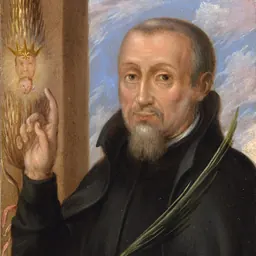
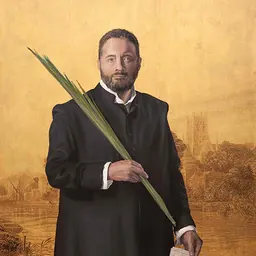
Nicholas Owen, S.J., (c. 1562 – 1/2 March 1606) was an English Jesuit lay brother who was the principal builder of priest holes during the reigns of Queen Elizabeth I and James I of England. Owen built many priest holes in the buildings of English Catholics from 1588 until his final arrest in 1606, when he was tortured to death by prison authorities in the Tower of London. Owen is honoured as a martyr by the Catholic Church and was canonized by Pope Paul VI in 1970.
Life Nicholas Owen was born around 1562 in Oxford, England, into a devoutly Catholic family and grew up during the Penal Laws. His father, Walter Owen, was a carpenter and Nicholas was apprenticed as a joiner in February 1577, acquiring the skills that he would use to build hiding places. Two of his older brothers became priests.
Owen served as a servant of Edmund Campion, who was arrested by priest hunters in 1581, and was himself arrested for protesting Campion's innocence. Upon his release, he entered the service of Henry Garnet, a Jesuit, around 1588. For the next 18 years, Owen built hiding places for Catholic priests in the homes of Catholic families. He frequently travelled from one house to another under the name of "Little John" and accepted only the necessities of life as payment before he started off for a new project. He also used the aliases "Little Michael", "Andrewes" and "Draper". During the daytime, he would work as a travelling carpenter to deflect suspicion. Sometimes, he built a more easily discovered outer hiding place, which concealed an inner hiding place. The location of the secret room was known to only himself and the owner of the house. One certain example of his work survives, at Broad Oaks Manor and it is extremely likely that Baddesley Clinton is the unidentified house in which seven priests hid in one of his hides during a search in 1591, as the hide and the house match the description perfectly. He was arrested in 1594 and tortured at the Poultry Compter but revealed nothing. He was released after a wealthy Catholic family paid a fine on his behalf, the jailers believing that he was merely the insignificant friend of some priests. He resumed his work and was involved in the famous escape of John Gerard from the Tower of London in 1597.
In early 1606, Owen was arrested a final time at Hindlip Hall in Worcestershire, starved, with Ralph Ashley, out of one of his own hides after four days, the two having had nothing to eat but an apple. and died in the night between 1 and 2 March 1606. Gerard wrote of him: I verily think no man can be said to have done more good of all those who laboured in the English vineyard. He was the immediate occasion of saving the lives of many hundreds of persons, both ecclesiastical and secular. Catholic stage magicians who practice Gospel Magic consider St. Nicholas Owen the patron saint of illusionists and escapologists, due to his facility at using trompe-l'œil when creating his hideouts.
There are Catholic churches dedicated to Saint Nicholas Owen in Little Thornton, Lancashire and Burton Latimer, Northamptonshire.
The Catholic school academy company that serves the Kidderminster, Hagley and Stourbridge areas near Harvington Hall is named in his honour.
Portrayals in fiction Owen is portrayed, as a minor character, in Robert Hugh Benson's novel Come Rack! Come Rope! (1912), where he is named "Hugh Owen". One of his priest holes plays a key role in the Catherine Aird mystery novel A Most Contagious Game (1967). A priest hole attributed to him is also part of Peter Carey's novel Parrot and Olivier in America (2010). Owen and his work play a key role in The House of a Hundred Whispers by Graham Masterton, published in 2020 by Head of Zeus Ltd. Owen is also a minor character in Leonard Tourney's novel Catesby's Ghost: A Mystery of Shakespeare (2022). Owen has a minor role in Botany Manor, published by Whitethorn Games in 2024.
Don’t just read it —
keep it.
Full-length biographies made to live with: read them, listen on the way to work, watch them tonight.
- E-book
- Audio
- Video
Instant download · yours to keep · every purchase keeps this site free
Important facts
People in Nicholas Owen's life
Named in this biography and alive at the same time


Related people
Same field, nearest in time




Contemporaries
People whose lives overlapped Nicholas Owen's





Frequently asked questions
Who was Nicholas Owen?
Jesuit lay brother and martyr
When was Nicholas Owen born?
Nicholas Owen was born in 1550 in Oxford.
When did Nicholas Owen die?
Nicholas Owen died on 2 March 1606 in London.
What was Nicholas Owen's occupation?
Nicholas Owen was a carpenter.
What nationality was Nicholas Owen?
Nicholas Owen was British.
Sources & further reading
· DBpedia: Nicholas Owen (Jesuit)
Cite this page
APA: Biography.guide. (2026). Nicholas Owen. https://biography.guide/nicholas-owen/
MLA: "Nicholas Owen." Biography.guide, https://biography.guide/nicholas-owen/.
Chicago: "Nicholas Owen." Biography.guide. https://biography.guide/nicholas-owen/.
Data last updated: 2026-09-20 · Spot an error? Report a correction.
Page generated 2026-09-27 05:25 UTC