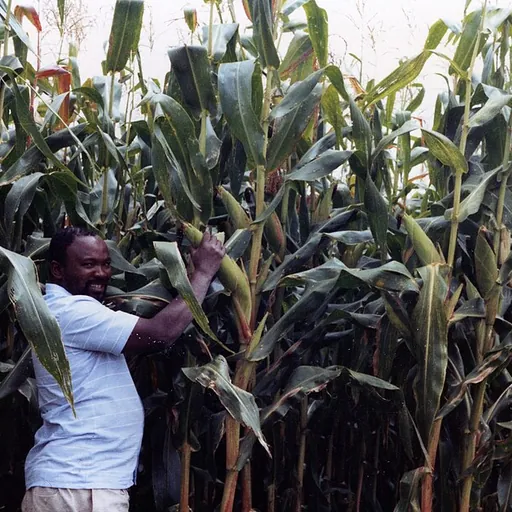
About Nicholas Mukomberanwa
Lived 1940 – 2002 (aged 61–62). Nicholas Mukomberanwa was a Zimbabwean sculptor and artist.
Nicholas Mukomberanwa (1940–12 November 2002), was a Zimbabwean sculptor and art teacher. He was among the most famous protégés of the Workshop School at the National Gallery of Zimbabwe. He was a mentor to the Mukomberanwa Family of sculptors. Mukomberanwa married his first wife, sculptor Grace, in 1965 and they had eight children.
Nicholas attended Zvishavani Primary School while his father worked at the nearby King Asbestos Mines. Art was not taught at school but by the time he was 15 Nicholas had produced his first sculpture in clay. By the age of 17 he was accepted at St Benedicts Mission, Chiendambuya, where he was recognised as skilled in painting and drawing and so was encouraged to move to the Serima Mission, Masvingo Province. There, Father Groeber encouraged sculpting and the craft of woodcarving and Nicholas encountered a blend of traditional Christian iconography and tribal African pieces. thumb An early Mukomberanwa carving showing the architectural influence of his training at SerimaMukomberanwa was heavily influenced by the drawing, patterning, and carving lessons he learned from Groeber and the school's art teacher Cornelius Manguma. Mukomberanwa produced his first art works while at the school, producing six carvings for the Serima church. These include four cement angels in the tower, as well as two wood angels for the chapel. Nicholas Mukomberanwa's first carvings. Serima Mission, 1959. However, after a productive year at Serima, Mukomberanwa was expelled and moved to Salisbury (now Harare), taking a job as an officer in the British South Africa Police, where he remained for 15 years (1962–76).
Nicholas was still drawing for recreation and in 1962 he met Frank McEwen, then director of the National Gallery of Rhodesia (today the National Gallery of Zimbabwe), who encouraged him to take up stone carving. McEwen provided materials and training in a workshop in the Gallery basement, and soon Mukomberanwa was sculpting in his free time, producing his first stone piece The Thief McEwan helped get this piece and others international exposure abroad.
In 1968, Ulli Beier wrote "Mukomberanwa’s sculpture is full of ideas and inventions, he has a great variety of attitudes and expressions and he likes to portray whole clusters of intertwined figures. He works in many different stones, continuously using textures and colours. The mood of his sculptures is always meditative, sometimes religious, and they are of a very high quality."
In 1969, Frank McEwen's wife Mary (née McFadden) established Vukutu, a sculptural farm near Nyanga, and in 1970 McEwen arranged for Nicholas to have a sabbatical from the police and spend 6 months there working on large pieces of black Penhalonga serpentine that would form part of the Musée Rodin exhibition. He eventually quit his job in the police to become a sculpture full-time
In the period 1965–1980, Nicholas's work, together with the works from other leading members from the Workshop School such as Sylvester Mubayi, Joram Mariga and Joseph Ndandarika were an integral part of the Shona Sculpture Movement. The "first generation" of new Shona sculptors were given international exposure despite the sanctions being imposed on Southern Rhodesia thanks to McEwen. Three of the early works three by Nicholas and the works of many of the first generation artists, are now in the McEwen bequest to the British Museum.
By the end of the millennium, Mukomberanwa's reputation was further enhanced by the many exhibitions in which his work was displayed. Some of these are listed below. Later in his career, he slowed his production of art to enjoy farming and cattle ranching on the Ruwa farm. He produced less, creating more personal sculptures and slowing down the pace of his life considerably.
1974 African Artist Festival, Chicago, USA 1978 God's Men and beasts, Goodman Gallery, Johannesburg, South Africa 1981 Art in Action Festival, Waterperry, UK 1981 Art from Africa, Commonwealth Institute, London, UK 1983 Stein Skulpturen aus Zimbabwe, Frankfurt, Germany 1984 Shona Sculpture, Pulchri Studio, The Hague, Netherlands 1984 Plazzotta Studio, Chelsea, London, UK 1985 Kunstschaetze aus Zimbabwe, Frankfurt, Germany 1985 Zimbabwean Stone Sculpture, Kresge Art Museum, Michigan State University, USA 1985 and 1987 Contemporary Stone Sculpture, Irving Sculpture Gallery, Sydney, Australia 1986 Africa Centre, London, London, UK 1986-8 Soul in Stone, Perth, Sydney, Melbourne and Canberra, Australia 1986 Moderne Skulpturen aus Zimbabwe, Vienna, Austria 1987 Contemporary Stone Sculpture from Zimbabwe, Barbican Centre, London, UK 1987 Zimbabwe Heritage, UNESCO, Paris, France 1987 African Influence Gallery, Boston, USA 1989 Zimbabwe op de Berg, Foundation Beelden op de Berg, Wageningen, The Netherlands 1989 Shona Sculpture, Robert Steele Gallery, Adelaide, Australia 1990 Honorable Mention, African Sculpture Exhibition, Venice Biennale, Italy 1990 Contemporary African Artists - Changing Tradition, Studio Museum New York City, USA 1990 Contemporary Stone Carving from Zimbabwe, Yorkshire Sculpture Park, UK 1990 One-Person Exhibition, Auckland, New Zealand 1990 Stone Sculpture from Zimbabwe, Millesgården Museum, Stockholm, Sweden 1992 Shona Sculpture International Symposium, Tokyo, Japan 1993 Nicholas and Family, Chapungu Sculpture Park, Harare, Zimbabwe 2000 Chapungu: Custom and Legend – A Culture in Stone, Kew Gardens, UK 2004 Retrospective, Zuva Gallery, Scottsdale, Arizona, USA
Exhibition pieces Some of Mukomberanwa's exhibition pieces, such as The Greedy One (1985) and The Corrupting Power of Money (1985), have toured worldwide; for example to the Yorkshire Sculpture Park in 1990, where the works on display included examples from all the artists who had contributed to the 1971 Musée Rodin exhibition. The catalogue "Chapungu: Culture and Legend – A Culture in Stone" for the exhibition at Kew Gardens in 2000 depicts Nicholas's sculptures My Experience (Springstone, 1992) on p. 58-59, Man in a Trance (Springstone, 1987) on p. 92-93, Women of Wisdom (Opal stone, 1987) on p. 102-103 and The Corrupting Power of Money (Limestone, 1985) on p. 114-115.
International exhibitions (institutions holding Nicholas’s work) Mukomberanwa's works are in the collections are at the National Gallery of Zimbabwe in Zimbabwe as well as the Museum of Modern Art, New York; the Field Museum of Natural History, Chicago, the Indianapolis Museum of Art and the British Museum.
Accolades and awards In 1989 Nicholas was the overall winner in the annual Nedlaw / Baringa exhibition at the National Gallery of Zimbabwe for his piece "Street Beggar" and was chosen with Tapfuma Gutsa and Henry Munyaradzi to represent Zimbabwe in the New York exhibition "Contemporary African Artists - Changing Tradition". Mukomberanwa died suddenly on 12 November 2002. All of his children became sculptors: his sons Anderson, Malachia, Tendai, Lawrence, and Taguma; and his daughters Netsai and Ennica. Another son, his eighth child, had tragically been drowned. .... a sage, a sculptor, a father to me, a father-figure to many, many sculptors working in stone in Zimbabwe. Although gone, he remains with us because his wisdom guides the sculptures we make, and the actions we take.
Don’t just read it —
keep it.
Full-length biographies made to live with: read them, listen on the way to work, watch them tonight.
- E-book
- Audio
- Video
Instant download · yours to keep · every purchase keeps this site free
Important facts
Family & relationships
People in Nicholas Mukomberanwa's life
Named in this biography and alive at the same time







Related people
Same field, nearest in time



Contemporaries
People whose lives overlapped Nicholas Mukomberanwa's


Frequently asked questions
Who was Nicholas Mukomberanwa?
Sculptor in stone, from Zimbabwe (1940–2002)
When was Nicholas Mukomberanwa born?
Nicholas Mukomberanwa was born in 1940 in Buhera.
When did Nicholas Mukomberanwa die?
Nicholas Mukomberanwa died on 12 November 2002 in Harare.
What was Nicholas Mukomberanwa's occupation?
Nicholas Mukomberanwa was a sculptor and artist.
What nationality was Nicholas Mukomberanwa?
Nicholas Mukomberanwa was Zimbabwean.
Sources & further reading
· Wikipedia: Nicholas Mukomberanwa
· DBpedia: Nicholas Mukomberanwa
Cite this page
APA: Biography.guide. (2026). Nicholas Mukomberanwa. https://biography.guide/nicholas-mukomberanwa/
MLA: "Nicholas Mukomberanwa." Biography.guide, https://biography.guide/nicholas-mukomberanwa/.
Chicago: "Nicholas Mukomberanwa." Biography.guide. https://biography.guide/nicholas-mukomberanwa/.
Data last updated: 2026-09-22 · Spot an error? Report a correction.
Portrait: Wikimedia Commons · author & licence
Page generated 2026-09-27 05:04 UTC