
About Nicholas de Balmyle
Lived 1201 – 1319 (aged 117–118). Nicholas de Balmyle was a catholic priest, judge and catholic bishop.
Nicholas de Balmyle (d. 1319 × 1320), also called Nicholas of St Andrews, was a Scottish administrator and prelate in the late 13th century and early 14th century. A graduate of an unknown university, he served his earliest years as a clergyman at St Andrews, moving on to hold churches in Lothian as well as deputising (as Official) to two archdeacons of Lothian.
In the late summer and in the autumn of 1296, between the death of Bishop William Fraser and the arrival of the new Bishop of St Andrews William de Lamberton, Nicholas was placed in charge of the diocese of St Andrews as Official. Nicholas thereafter can be found exercising a senior role in Scottish affairs, and by early 1301 he was Chancellor of Scotland. In his late 60s or (more probably) his 70s by this stage, Nicholas was an extremely old man, yet in 1307 he became Bishop of Dunblane. He held this position until his death in either 1319 or 1320.
Background and early life Modern ruins of St Andrews Cathedral. Although it is not known where Nicholas attended university, it is known that much of his early life was spent in and around this location. It is highly unlikely that Nicholas was born later than the 1230s, as he was styled Magister by 1259, indicating that by that date he possessed a Master's degree.
Until 1295, Nicholas was referred to as Nicholas of St Andrews (de Sancto Andrea), but in February of that year he began to be called de Balmyle, one source referring to him as de Balmyll dictus de Sancto Andrea (de Balmyle called de Sanctoandrea). It is probable that he adopted de Sancto Andrea when he finished training at St Andrews and went elsewhere, and that he dropped it in 1295 when he moved back.
Early career As a graduate, Nicholas is first found active at St Andrews in the entourage of Gamelin, Bishop of St Andrews, in 1259. Nicholas is found as Official in a document dating certainly between 1273 and 1285, a document which can probably be more precisely dated to between 1283 and 1285.
He was pastor of the church of Calder Comitis, Midlothian, by September 1296. Both churches were indirectly under the patronage of the Bishop of St Andrews, William Fraser. The rector of Haddington was St Andrews Cathedral Priory and although the church of Calder Comitis was normally under the patronage of the Mormaer of Fife, at that point in time the wardship of the young mormaer's lands was being held by the Bishop of St Andrews. The latter was the legal process by which Edward I, King of the English, mediated the succession dispute to the Scottish throne, the result of which Balliol was selected by King Edward to be king on condition of open subordination. He is found witnessing a charter at Newbattle Abbey on 20 November 1293, as Archdeacon William Frere's Official, and on 20 December is mentioned by Frere as a commissary of the Official of the diocese of St Andrews appointed to adjudicate on 4 January 1294, a case involving Kelso Abbey.
In the following year, William Fraser, the Bishop of St Andrews, died, and it was Nicholas who was chosen to be Official of the diocese and to administer it during the vacancy. He performed this function until the return to Scotland from France of the new bishop, William de Lamberton.
After his return in August 1299, Lamberton was Guardian of Scotland and Nicholas became his close associate. Nicholas can be seen to have benefited as a result. He became Chancellor of Scotland by 30 January 1301. Balmyle's pension for being Chancellor was to be paid by Arbroath Abbey, for which the abbey later fell into arrears.
Later in the year, in April, he was one of four Scottish envoys sent to Canterbury for abortive talks with the English and French.
Nicholas may have remained as Chancellor until 1305.
Episcopal election Dunblane Cathedral, the seat (cathedra) of Nicholas' bishopric, as it is today. Following the death of his namesake Nicholas, Bishop of Dunblane (and former Abbot of Arbroath), Nicholas de Balmyle was among the canons of Dunblane with the responsibility of selecting a successor. Bishop Nicholas had died sometime between 1306 (after his last attestation on 26 January) and late 1307. The election was done by compromissarii (a short-list of canons delegated to perform election), with John, Abbot of Arbroath excluded from the vote, perhaps because of his known pro-English tendencies.
The seven compromissarii were the dean (name not known), Maurice, Abbot of Inchaffray, William, Abbot of Lindores, Michael, Abbot of Cambuskenneth, William de Eaglesham, Henry de Stirling, and Nicholas de Balmyle. They were instructed to elect from among themselves, and their decision was the promotion of Nicholas de Balmyle. Nicholas, Bishop-elect of Dunblane, travelled to the Apostolic See along with proctors of the cathedral chapter. After the election was confirmed by Pope Clement V, Nicholas was consecrated by Nicholas, Cardinal-Bishop of Ostia at Poitiers on 11 December 1307. The usual secular patron of the diocese was the Earl of Strathearn, but Malise III, Earl of Strathearn was at that stage a prisoner-exile at Rochester in England, thus allowing Robert to take his place.
Bishop of Dunblane When Nicholas returned to Scotland, and the exact nature of his activities over the next few years, remain unclear matters. His episcopal rank makes it likely that he attended the parliaments and took part in the affairs of the kingdom during the early years of his episcopate, but direct proof is lacking.
He witnessed a charter of Cambuskenneth Abbey along with John de Kininmund, Bishop of Brechin, on 12 September 1311.
It is not known exactly when Bishop Nicholas died. The see of Dunblane is first known to have been vacant on 30 January 1320 and Bishop Nicholas' last appearance in the records was witnessing a charter of Coupar Angus Abbey at Arbroath on 8 February 1319: his death therefore fell between these two points.
Don’t just read it —
keep it.
Full-length biographies made to live with: read them, listen on the way to work, watch them tonight.
- E-book
- Audio
- Video
Instant download · yours to keep · every purchase keeps this site free
Important facts
People in Nicholas de Balmyle's life
Named in this biography and alive at the same time


Related people
Same field, nearest in time
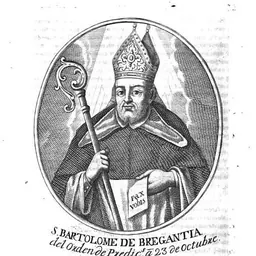

Contemporaries
People whose lives overlapped Nicholas de Balmyle's



Frequently asked questions
Who was Nicholas de Balmyle?
Roman Catholic bishop
When was Nicholas de Balmyle born?
Nicholas de Balmyle was born in 1201.
When did Nicholas de Balmyle die?
Nicholas de Balmyle died on 8 February 1319.
What was Nicholas de Balmyle's occupation?
Nicholas de Balmyle was a catholic priest, judge and catholic bishop.
Sources & further reading
· Wikipedia: Nicholas de Balmyle
· DBpedia: Nicholas de Balmyle
Cite this page
APA: Biography.guide. (2026). Nicholas de Balmyle. https://biography.guide/nicholas-de-balmyle/
MLA: "Nicholas de Balmyle." Biography.guide, https://biography.guide/nicholas-de-balmyle/.
Chicago: "Nicholas de Balmyle." Biography.guide. https://biography.guide/nicholas-de-balmyle/.
Data last updated: 2026-09-25 · Spot an error? Report a correction.
Page generated 2026-09-27 05:12 UTC