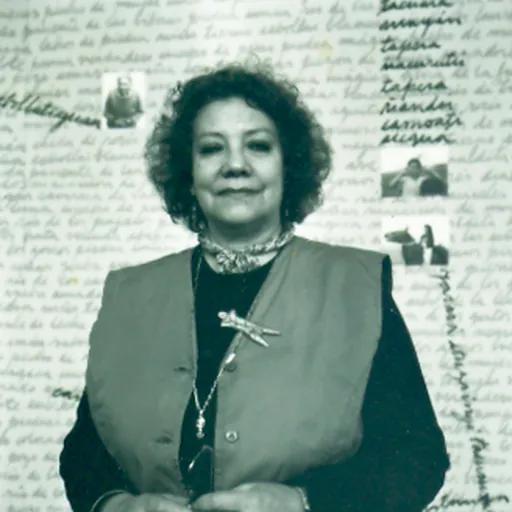
About Nelbia Romero
Lived 1938 – 2015 (aged 76). Nelbia Romero was an Uruguayan visual artist.
Nelbia Romero Cabrera (8 December 1938 – 3 April 2015) was a Uruguayan visual artist. She began her career in drawing and engraving and later incorporated other artistic languages, such as photography, installation, and performance. Her work was marked by themes of politics and protest. She was an active participant in the . She received a Guggenheim Fellowship in 1994 and was granted the Figari Award in 2006 for her artistic career.
Biography Childhood Nelbia Romero was born on 8 December 1938 in the town of Durazno, Uruguay. She was the eldest daughter of a family of rural landowners. Her parents, Apolinaria Cabrera and Conrado Romero, settled in the city for her birth, where later the youngest daughter of the marriage and her only sister, María Teresa, was born.
Romero's upbringing alternated between the city and the countryside, where she spent her vacations. Her father, a landowner and local political figure, socially active and atheist, shared with his eldest daughter an interest in music and history, passing along his concern for social justice.
Training Romero completed elementary school and secondary studies at the school of the Immaculate Conception of Durazno. She left without finishing her preparatory architecture studies in 1959 to enter the Durazno Workshop of Plastic Arts. Claudio Silveira Silva, her teacher for two years, strongly influenced her vocation and encouraged her to move to Montevideo to continue her studies at the (ENBA). Supported by her father, she moved to the country's capital in 1962, abandoning marriage plans. In fact, at the end of the decade, in 1988, she retired from the Engraving Club after promoting an unsuccessful attempt at renewal with Ana Tiscornia.
Second stage Romero's work took a new direction in the 1980s with the incorporation of audiovisual language and the use of her body as a plastic element. In turn, her work was increasingly committed to the personal and social consequences of the recent past. In an interview with , she said:
Quote|In the 80s I started with other types of searches linked not only to the formal problem, but to other things that mattered to me. Before the dictatorship, it existed as a privilege to elaborate in the artistic field. That privilege stopped being the first thing, and I felt responsible for my work. The dictatorship also gave us to reset and rethink our proposals. The need to arise with the pain I felt began to appear truly – through my face – looking for who I was in that historical moment. The faces appear half covered, half veiled, painting my face, also in black and white. It was something very profound, very meaningful. The way to say "here I am".
She continued working in the same direction by producing a performance, Uru-gua-y, in 1990, followed by two installations in 1992; Más allá de las palabras ("Beyond words") and Garra Charrúa, which uses, among a heterogeneity of elements, large amounts of text written in Spanish and Guarani, rescuing the linguistic heritage of that nation, present in everyday speech today. This work was presented in Montevideo, in Havana, and at the Ludwig Forum für Internationale Kunst (Germany).
In Bye Bye Yaugurú, a 1995 installation presented at the in Montevideo, Romero continued to work on the issue of national identity from a critical perspective. The central element of the work is a map of Uruguay represented in various ways in combination with other elements. It questions the "scientific" reading of the reality that cartography tries to show, highlighting the arbitrariness of the historical tracing of the borders that underpin nationalism.
In the following years she continued to develop her work in installations and performances, at the same time that she intensified her teaching and curatorial activity. In the 2000s she exhibited several times at the national and international level, sending her work to the Havana Biennial and to the .
Romero was also the author of texts, presentations, and talks on printmaking and on topics related to Uruguayan identity.
Awards and recognitions In 1994 Romero received a Guggenheim Fellowship, and in 2009 the Parliament granted her a gracious pension for being considered a prominent figure in Uruguayan art. In 2005 she received the Figari Award granted by the Central Bank of Uruguay.
Works 1983, Sal-si-puedes (installation) 1992, Más allá de las palabras (installation) 1992, Garra Charrúa (installation) 1994, Homenaje a la mujer indígena (performance) 1994, Materias pendientes I, II, and III (installation) 1995, Bye, bye, Yaugurú (installation) 1998, De la vaca inexistente del escudo, a su mesa (performance) 2003, Lunfardeces (sonic installation)
Don’t just read it —
keep it.
Full-length biographies made to live with: read them, listen on the way to work, watch them tonight.
- E-book
- Audio
- Video
Instant download · yours to keep · every purchase keeps this site free
Important facts
People in Nelbia Romero's life
Named in this biography and alive at the same time


Related people
Same field, nearest in time


Contemporaries
People whose lives overlapped Nelbia Romero's



Frequently asked questions
Who was Nelbia Romero?
Uruguayan installation and performance artist
When was Nelbia Romero born?
Nelbia Romero was born on 8 December 1938 in Durazno, Durazno Department.
When did Nelbia Romero die?
Nelbia Romero died on 3 April 2015 in Montevideo.
What was Nelbia Romero's occupation?
Nelbia Romero was a visual artist.
What nationality was Nelbia Romero?
Nelbia Romero was Uruguayan.
Sources & further reading
Cite this page
APA: Biography.guide. (2026). Nelbia Romero. https://biography.guide/nelbia-romero/
MLA: "Nelbia Romero." Biography.guide, https://biography.guide/nelbia-romero/.
Chicago: "Nelbia Romero." Biography.guide. https://biography.guide/nelbia-romero/.
Data last updated: 2026-09-22 · Spot an error? Report a correction.
Portrait: Wikimedia Commons · author & licence
Page generated 2026-09-27 04:58 UTC