
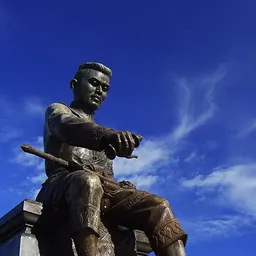
Nawrahta Minsaw
King of Lan Na
About Nawrahta Minsaw
Lived 1551 – 1607 (aged 55–56).
Governor of Tharrawaddy Now known as Tharrawaddy Min (, ; "Lord of Tharrawaddy"), the prince made his mark in a 1576–1577 military campaign that would push him to the forefront of the most powerful princes at the Pegu court. On 26 November 1576, the prince received a seemingly futile assignment to lead a search operation of a fugitive chief of Mogaung in the northern Kachin Hills. For the first eight months, the campaign was on track to be yet another futile operation. His army (16,000 troops, 1300 horses, 130 elephants), made up of conscripts from Upper Burma and Shan States, had fruitlessly combed the remote northern hills at the foot of the Himalayas. But he did not give up even when the rainy season of 1577 came. His persistence paid off. One of his battalions finally caught the top commanders of the fugitive chief, and the captured men gave up the location where the chief was hiding. The prince brought the fugitive chief before the king on 30 September 1577.
The success of the operation won the young prince plaudits of the king. He was given an upgraded title of Anawrahta Minsaw . From then on, he would be known by abridged versions of the title: either as Nawrahta Minsaw or Nawrahta Saw.
King of Lan Na
Accession and early reign
His star continued to rise. On 28 January 1579, he was appointed the next viceroy of Lan Na to succeed Queen Visuddhadevi, who had died a month earlier. The appointment certainly was a significant matter. The king regarded Lan Na as the most important of all his vassal states, and selected Nawrahta from a list of candidates after careful deliberation with his court. The king impressed upon Nawrahta the importance of the appointment, highlighting that Lan Na was larger than Ava, Toungoo, and Prome; that it was strategically located among mainland Burma, the Shan states, Siam, Lan Xang and Annam; that it had a large population and plenty of natural resources; and that he was to obey Nanda, the heir-apparent. Although he was the first Burmese-born ruler on the Chiang Mai throne, he did not face any serious issues governing the Tai Yuan-speaking former sovereign kingdom. The royal couple, at least according to reporting in the chronicle Zinme Yazawin, was accepted by the local populace.
Military assistance to Nanda The initial tranquility however was to give way to increasingly more turbulent times after King Bayinnaung's death in October 1581. Nawrahta pledged loyalty to the new king. Nawrahta like other vassal rulers, who governed what used to be sovereign states as recently as only a few decades ago, adopted a "wait-and-see attitude" with Nanda, an experienced military commander in his own right.
Sanda (1582–1583) In the following years, he would be repeatedly asked to contribute to Nanda's manic efforts to maintain the extremely overextended empire intact. The first major assignment came in September 1582. Two small northernmost Shan states (in present-day Dehong and Baoshan prefectures in Yunnan, China) never sent obligatory tribute to the new king. Nanda ordered Nawrahta and Thado Dhamma Yaza II to lead a two-pronged invasion. The combined army of 16000 men, 1600 horses and 100 elephants spent five months at Sanda before finally taking the town. The two commanders brought the rebel chief before the king on 9 April 1583.
Ava (1584) But the calm was temporary. About three months later, Viceroy Thado Minsaw of Ava sent secret embassies to Prome, Toungoo and Chiang Mai to raise simultaneous rebellions. Nawrahta like the viceroys of Toungoo and Prome sided with Nanda and secretly forwarded the news to Nanda. In March 1584, as ordered by Nanda, Nawrahta marched with an army from Lan Na to Ava. But his army did not see any combat as Nanda defeated Thado Minsaw in single combat on 24 April 1584.
Siam (1584–1595) The peace was shorter still. Nine days later on 3 May 1584, Siam revolted. In the next nine years, Nanda would launch five disastrous campaigns against the "proud kingdom" of Siam, which had been preparing for the eventual showdown with Pegu since Bayinnaung's death.
Though he never went on campaign himself, Nawrahta dutifully contributed manpower to the war effort.
CampaignDuration# of Lan Na regiments of the totalTotal strength of RBANotes 1st invasion of Siam 1584 none 11,000 Hastily planned invasion from Lower Burma 2nd invasion 1586 7 out of 19 12,000 Invasion from Lan Na to northern Siam 3rd invasion 1586–1587 4 out of 24 25,000 Two-pronged invasion from Lower Burma and Lan Na 4th invasion 1590–1591 3 out of 19 20,000 Invasion from Lan Na to northern Siam 5th invasion 1592–1593 4 out of 29 24,000 Two-pronged invasion from Lower Burma and Lan Na 1st Siamese invasion of Burma 1594–1595 unspecified 8000 Sent troops to break the Siamese siege of Pegu
The declining share of Lan Na manpower may have been a sign of his increasing disillusionment with the war, and/or his increasing inability to control his own vassal states. At least to 1592–1593, his vassals in Nan, Phrae and Chiang Rai were still loyal to Nawrahta. Indeed, the vassal rulers were the ones who went to the front. After the 1592–1593 invasion, Nanda's position with the vassal rulers rapidly deteriorated, as did Nawrahta's position with his own vassals. When Nanda asked for help to break the Siamese siege of Pegu in December 1594, Nawrahta faced great difficulty in rounding up the troops. It was only in April 1595 that troops from Toungoo and Lan Na arrived and broke the siege.
War with Lan Xang (1595–1596) By then, the once mighty Toungoo Empire was in a free fall. Nokeo Koumane, the ruler of Lan Xang, revolted. The rebellion was more of a problem for Chiang Mai than for Pegu. Whereas Nanda had all but given up defending the empire, Nawrahta had to deal with an aggressive Nokeo who had designs on Lan Na itself. Nokeo quickly gained the allegiance of the ruler of Nan, Cao Cetabut, who joined him in rebellion. In response, Nawrahta marched to Nan where he was met by combined Lan Xang–Nan forces at the mouth of the Ngao River near the city of Nan. There, on 25 November 1595, Nawrahta defeated the enemy, driving back Cetabut and Nokeo to Lan Xang. Fortunately for Nawrahta, Nokeo died shortly after, and Lan Xang's threat to Lan Na's eastern frontier ended for the time being. Nawrahta appointed Pana Khaek as the new governor of Nan. Although he was only one of two rulers formally declaring independence—Minye Thihathu II of Toungoo was the other—all other rulers essentially broke away as well. The Toungoo Empire was no more.
For Nawrahta, being independent simply meant he could devote his scarce manpower toward defending Lan Na from Lan Xang's and Siam's designs. For the next several years, he would struggle mightily to keep Lan Na independent. Here, Lan Na and Lan Xang chronicles (the Chiang Mai Chronicle, the Nan Chronicle, and the Lan Xang Chronicle), and the Siamese Ayutthaya Chronicle give widely divergent accounts. Ayutthaya reports Lan Na being pulled into Siam's orbit while Lan Na and Lan Xang chronicles speak of Lan Xang–Nan alliance's campaigns in Lan Na and barely mention Siam's role. The Lan Xang army retreated from Chiang Mai on 11 July 1599but retained control of Nan.
Problems continued to mount for Nawrahta. In 1601/02, Ram Decho, ruler of Chiang Saen, revolted and his rebellion spread to much of Lan Na. He even attacked Lan Xang's vassal Nan but was driven back. Now, Lan Xang forces went on a major counterattack, taking Ram Decho's territories. Ram Decho is not heard from again in the chronicles. By then, Nawrahta's territory was down to central and northwestern Lan Na (Chiang Mai, Phayao and Fang). Chiang Mai forces had regained Nan by 16 May 1603. They also caught Cetabut who was executed on 3 June 1603.
Siamese chronicle account Lanna envoy (under the rule of Nawrahta Minsaw) presenting royal tribute to King Naresuan at Ayutthaya in 1596. Painted by Luang Phitsanukam (Lek) according to the royal decree of king Chulalongkorn in 1887. The Ayutthaya Chronicle paints a completely different picture. In early 1599, Nawrahta was under siege by Lan Xang–Nan forces, and requested military help from Siam. King Naresuan sent an army led by Prince Surasi. The Siamese army marched past Chiang Mai to Chiang Rai and Chiang Saen where they installed Ram Decho, a Chiang Mai native, as the ruler there. Ram Decho emerged as the main rival to Nawrahta. In response, Naresuan sent his brother Ekathotsarot to Lan Na to sort things out there. These were hallmarks of what vassal rulers of the era would have done. Furthermore, the chronicles indicate that Naresuan's successor Ekathotsarot continued to be the overlord of Lan Na at least to Nawrahta's death in 1607/08 when Ekathotsarot unsuccessfully tried to place his nominee Tu Laung on the throne.
Summary Although various chronicle accounts differ greatly and have many contradictions among them, they all agree that Nawrahta's independent reign of Lan Na was at peace for at most two years between 1597 and 1599. From 1599 onward, he had to deal with two major foreign-backed rebellions in Nan (by Lan Xang) and in Chiang Rai/Chiang Saen (by Siam). He twice survived Lan Xang's sieges of Chiang Mai (1599 and 1602–1603). Despite his best efforts to stay independent, according to Siamese and Burmese chronicles, he became a vassal of Siam. Ayutthaya does not give an actual date as to when the submission took place—only that it happened some time after 1600/01.
Last years By late 1603, Nawrahta had regained control of all of Lan Na, albeit as a vassal of Siam. Its eastern flank was now quiet as the new regime in Vientiane abandoned Lan Xang's designs on Lan Na. But just as one threat ended, a new potential threat arrived in the north. In November 1603, Nyaungyan, one of Nawrahta's many half brothers, invaded Mone, the Shan state immediately north of Lan Na, and had acquired the major Shan state and its tributary nearby minor states by March 1604. Siam viewed this as a direct threat to Lan Na. Naresuan and the Siamese army arrived at Lan Na in the dry season of 1604–1605. But the invasion never took place as the Siamese king fell ill and died in April 1605. His death was followed by a power struggle between his two eldest sons. Thirteen months after Nawrahta's death, in late 1608/early 1609, Tu Laung died outside the city, and his Siamese army retreated. The following is a translation by Ni Ni Myint of one of his more famous poems about Hsinbyushin Medaw.
None there be in the thousand lands Though should I search Let alone an equal I will find none To match a strand of her hair Fragrant as attar of jasmine Sweet-voiced, pleasant of expression Generous of thought, lovely of disposition My heap of life The warm nest of my sight
Family Nawrahta Minsaw had one daughter and three sons by the chief queen Hsinbyushin Medaw, and five daughters and two sons by minor queens.
His children by the chief queen were:
Don’t just read it —
keep it.
Full-length biographies made to live with: read them, listen on the way to work, watch them tonight.
- E-book
- Audio
- Video
Instant download · yours to keep · every purchase keeps this site free
Important facts
Family & relationships
People in Nawrahta Minsaw's life
Named in this biography and alive at the same time

Contemporaries
People whose lives overlapped Nawrahta Minsaw's





Frequently asked questions
Who was Nawrahta Minsaw?
King of Lan Na
When was Nawrahta Minsaw born?
Nawrahta Minsaw was born in 1551 in Taungoo.
When did Nawrahta Minsaw die?
Nawrahta Minsaw died in 1607 in Chiang Mai.
Sources & further reading
Cite this page
APA: Biography.guide. (2026). Nawrahta Minsaw. https://biography.guide/nawrahta-minsaw/
MLA: "Nawrahta Minsaw." Biography.guide, https://biography.guide/nawrahta-minsaw/.
Chicago: "Nawrahta Minsaw." Biography.guide. https://biography.guide/nawrahta-minsaw/.
Data last updated: 2026-09-20 · Spot an error? Report a correction.
Page generated 2026-09-27 05:20 UTC