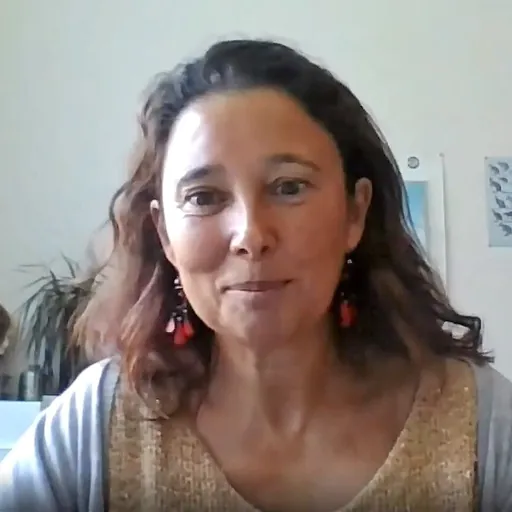
About Natacha Aguilar de Soto
Natacha Aguilar de Soto was a Spanish marine biologist and university teacher, known for Cetacean research.
Natacha Aguilar de Soto is a Spanish marine biologist at the University of La Laguna (ULL), Tenerife, Canary Islands. and has been a Marie Skłodowska-Curie Research Fellow at ULL and at the Center for Research in Ecological Modeling (CREEM) of the University of St. Andrews (SMRU). Aguilar de Soto joined the University of La Laguna as a student , began a long-term research study observing Blainville's and Cuvier's beaked whales in 2002
Aguilar de Soto was the project manager of the SOUNDMAR project (2010–2013) at ULL, under a Marie Skłodowska-Curie Action funded by the European Union. She was the project manager of the ECOSOUND project (2015–2017) at the Center for Research in Ecological Modeling (CREEM) of the University of St. Andrews (SMRU) which was established in 2003 for the study, conservation and protection of marine mammals in the Canary Islands region.
She is a founder of CETAVIST, the Cetacean and Seabird Sighting Network of the Canary Islands, which was organized in 2012 to involve citizen scientists. Volunteers observers for CETAVIST travel on passenger ferries. Between December 2012 and October 2016, they carried out 1,300 surveys of cetaceans and seabirds.
Aguilar de Soto has participated in expert groups examining the impact of marine noise, including ACCOBAMS (Agreement on the Conservation of Cetaceans of the Black Sea, Mediterranean Sea and Contiguous Atlantic Area), ASCOBANS (Agreement on the Conservation of Small Cetaceans of the Baltic, North East Atlantic, Irish and North Seas), and OSPAR (Convention for the Protection of the Marine Environment of the North-East Atlantic). and in mitigation initiatives for the Canary Islands New Zealand, Australia, and others. In 2019, Aguilar de Soto was named a "Hope Spot Champion" as part of a campaign to make Tenerife-La Gomera a "Hope Spot" at the center of an enlarged marine protected area. and cetacean collisions with boats.
The Canary Islands provide a home to at least twenty-six species of cetaceans, including Blainville's beaked whale (Mesoplodon densirostris), True's beaked whale (Mesoplodon mirus), Gervais's beaked whale (Mesoplodon europaeus), Cuvier's beaked whale (Ziphius cavirostris), and northern bottlenose whale (Hyperoodon ampullatus). In 2004, a moratorium on the use of naval sonar within of the Canary Islands was established by the Spanish Ministry of Defense, an action in accordance with resolutions by ACCOBAMS and others.
In 2003 Aguilar de Soto began a long-term research study observing Blainville's and Cuvier's beaked whales in the waters off El Hierro (Canary Islands). Researchers carried out seasonal monitoring of cetaceans using non-invasive DTAGs, developed at Woods Hole Oceanographic Institution (WHOI). The tags attach using suction cups which eventually fall off. They record sound and motion and transmit data back to researchers. The objective of this work was to better understand the behavior, social structure and population distribution of beaked whales. The combination of recorded whale "clicks" and "buzzes" with speed, orientation, and depth data from the DTAGs revealed an unsuspected picture of how the whales hunt. Described in the Journal of Animal Ecology (2008), pilot whales make high-speed dives to pursue large deep-dwelling prey and then return to the surface to breathe and rest. Aguilar de Soto's research on these "cheetahs of the deep sea" is causing scientists to rethink their understanding of diving and feeding behaviors. It may influence policies for the management of whale-watching and shipping.
With the R.V. Cornide de Saavedra, Aguilar de Soto helped to evaluate the effects of a submarine volcanic eruption off El Hierro Island, occurring from 10 October 2011 to 5 March 2012.
Also in 2012, Aguilar de Soto co-authored an article in Marine Mammal Science discussing the acoustic camouflage of Blainville's beaked whales. Blainville's beaked whales avoid detection from killer whales by maintaining complete silence during ascents and at less than below the surface. Vocalizations consistent with echolocation and communication occur only in the latter part of descents and the deepest phase of dives, in which social group members synchronize their movement.
With Andrea Fais and other researchers from multiple international centers, Aguilar de Soto carried out a complete acoustic sampling of sperm whales, in the deep waters off the Canary Islands. the scientists estimated that the current population of sperm whales in Canary waters was around 224 individuals. They compared that data with strandings involved in collisions with ships. Data from the CetAVist project between 2012 and 2015 indicated that the Canary Islands is one of the places in the world with the most records of stranding of cetaceans due to collision with ships. In addition, the study highlighted that the mortality of sperm whales due to collisions may exceed the natural growth capacity of the species in the archipelago, leading to a decline in population. As a result of this study, a number of steps were recommended to address this issue. Some recommendations have been implemented, such as the inclusion of relevant information in the training of ship captains who study at the ULL Nautical Engineering School.
Frame from first underwater footage of True's beaked whales, PeerJ, 7 March 2017.
In 2017, Aguilar de Soto coauthored a study on the family of beaked whales (Ziphiidae). It includes the first known underwater video recording of living True's beaked whales (Mesoplodon mirus), one of the least known and rarely seen beaked whales in the world. The recording was made off the coast of the Azores from a small inflatable boat as part of the Master Mind student program. The teacher and students did not recognize the species or realize that it was a historical first. The presence of True's beaked whales in the footage was later confirmed by Aguilar de Soto.
Selected publications
Aguilar de Soto, N. (2006). Comportamiento Acústico y de Buceo del Calderón Globicephala macrorhynchus y del Zifio de Blainville Mesoplodon Densirostris en las Islas Canarias. Implicaciones Sobre los Efectos del Ruido Antrópico y Las Colisiones con Embarcaciones. Ph.D. thesis. San Cristóbal de La Laguna: Universidad de La Laguna.
Don’t just read it —
keep it.
Full-length biographies made to live with: read them, listen on the way to work, watch them tonight.
- E-book
- Audio
- Video
Instant download · yours to keep · every purchase keeps this site free
Important facts
Related people
Same field, nearest in time




Frequently asked questions
Who was Natacha Aguilar de Soto?
Spanish marine biologist
What was Natacha Aguilar de Soto's occupation?
Natacha Aguilar de Soto was a marine biologist and university teacher.
What was Natacha Aguilar de Soto known for?
Natacha Aguilar de Soto was known for Cetacean research.
What nationality was Natacha Aguilar de Soto?
Natacha Aguilar de Soto was Spanish.
Sources & further reading
· Wikipedia: Natacha Aguilar de Soto
· DBpedia: Natacha Aguilar de Soto
Cite this page
APA: Biography.guide. (2026). Natacha Aguilar de Soto. https://biography.guide/natacha-aguilar-de-soto/
MLA: "Natacha Aguilar de Soto." Biography.guide, https://biography.guide/natacha-aguilar-de-soto/.
Chicago: "Natacha Aguilar de Soto." Biography.guide. https://biography.guide/natacha-aguilar-de-soto/.
Data last updated: 2026-09-20 · Spot an error? Report a correction.
Portrait: Wikimedia Commons · author & licence
Page generated 2026-09-27 04:58 UTC