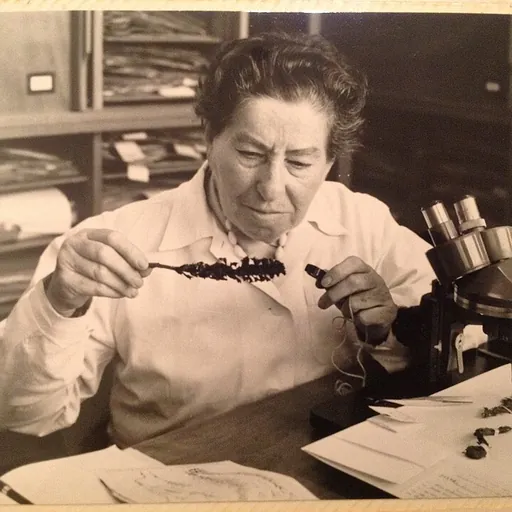
Naomi Feinbrun-Dothan
Botanist and university teacher
About Naomi Feinbrun-Dothan
Lived 1900 – 1995 (aged 94). Naomi Feinbrun-Dothan was a Russian, Romanian and Israeli botanist, botanical collector, university teacher and scientific collector, known for Genetics, Phytogeography and Taxonomy (biology).
Naomi Feinbrun-Dothan (; 17 April 1900 – 8 March 1995) was a Russian-born Israeli botanist, who became part of the academic staff at the Hebrew University of Jerusalem. She studied the flora of Israel and published dozens of articles and several analytical flora books. Just after her 91st birthday, she received the 1991 Israel Prize for her unique contribution to the Land of Israel studies.
She is the botanical author of Allium truncatum, Allium dumetorum, and Iris regis-uzziae.
Biography Naomi Feinbrun was born in Moscow in 1900. Her parents, Rachel and Aharon Feinbrun, belonged to Hovevei Zion and her father was also a member of the 'Benei Zion' association in Moscow. She had an older sister, Shulamit, and two younger brothers, Miron and Moshe.
The family lived in Kishinev, Bessarabia. She went to an elementary school where she was taught Hebrew and a Jewish girls’ high school in Kishinev. In 1907, the family moved to Moscow. After finishing high school in 1918, she went to Moscow University. In 1920, the family moved back to Bessarabia. She carried on her studies at the University of Cluj, in the Romanian province of Transylvania. In 1923, she received her first degree in botany. She then became a teacher at a Jewish girls high school, teaching natural sciences. Since Naomi was 24, she could not use her parents’ familial immigration certificate. Instead a relative helped her by testifying to the authorities that she had been a high-school student at the Herzliya Hebrew Gymnasium in Tel Aviv before leaving for Moscow for a few years. After receiving a recommendation from Rachel Katznelson, Feinbrun started work as a teacher at a school in Tel Adashim in the Jezreel Valley. She then accepted the part-time post of guest researcher. During this time, she studied English mostly using G. E. Posts's book, 'Flora of Syria, Palestine and Sinai' (Beirut 1898). The first series issued in 1930 is entitled Flora exsiccata Palaestinae a sectione botanica Universitatis Hebraicae Hierosolymitanae edita. In 1931, they produced the first analytical flora book (written in Hebrew). It was later reprinted in English in 1965.
The university had started as a research facility without formal teaching. The teaching of sciences started in the early 1930s. In the Department of Botany, genetics was chosen to be one of the six major subjects on the curriculum. Due to Feinbrun's cytology work with Hannan Oppenheitmer (who was engaged in physiological botany in Rehovot Campus of the university) she began teaching genetics.
In 1933, Feinbrun joined a delegation of seven Hebrew University scientists who were invited to Iraq by the Iraqi Ministry of Agriculture. Their main purpose was to conduct a survey of the forests of Kurdistan - preparing an inventory of trees and presenting a proposal for afforestation and for preserving the forests. Other research expeditions in which Feinbrun participated were to Transjordan, the Sinai Peninsula, Lebanon, Cyprus and, in 1944, to the eastern desert in Egypt. at the Sorbonne University in Paris. When she returned to Palestine she began teaching genetics and cytology. Until the 1950s she was the only one who taught a course in genetics at the Hebrew University. In which Feinbrun and her colleagues used to publish their works. The first issue of the journal included a 'phytographic' map based on the three researchers’ many field trips.
In 1938, at the age of 44, Dr. Alexander Eig died. After his death, his two assistants, Michael Zohary and Naomi Feinbrun, continued his work of documenting the flora of Palestine and cultivating the Mount Scopus Botanical Garden.
After 1947, when the state of Israel was established, she and her brothers 'Hebraized' their family name, and she became Naomi Feinbrun-Dothan.
Between 1966 and 1986 she co-authored with Prof. Michael Zohary the four volumes of Flora Palaestina. These books include analytical keys, botanical descriptions, and full page illustrations of the native and naturalized plant species of the region.
In the 1970s, several bulbs of an unknown Colchicum were given to her to study. She identified it as a Greek species called Colchicum bowlesianum. Later the bulbs were re-investigated by Karin Persson and were then classed as a separate species. She described the bulbs as a new species in the 'Israeli Journal of Plant Science'. She named it Colchicum feinbruniae after Prof. Feinbrun.
In 1991, she wrote with Avinoam Danin, a new and updated analytical flora book.
Awards and recognition In 1986, she was awarded a gold medal from 'Optima' (Organization for the Phyto-Taxonomic Investigation of the Mediterranean area), the International Organization of Mediterranean botanists in recognition of the completion of this landmark publication.
In recognition of her botanical achievements, she was awarded the Israel Prize (Land of Israel Studies) in 1991.
Her memory lives on in a number of plants named in her honor by colleagues in Israel and abroad, among them Astragalus feinbruniae (1970), Bellevalia feinbruniae (1970) and Colchicum feinbruniae (1992).
Don’t just read it —
keep it.
Full-length biographies made to live with: read them, listen on the way to work, watch them tonight.
- E-book
- Audio
- Video
Instant download · yours to keep · every purchase keeps this site free
Important facts
People in Naomi Feinbrun-Dothan's life
Named in this biography and alive at the same time


Related people
Same field, nearest in time


Contemporaries
People whose lives overlapped Naomi Feinbrun-Dothan's



Frequently asked questions
Who was Naomi Feinbrun-Dothan?
botanist and university teacher (1900-1995)
When was Naomi Feinbrun-Dothan born?
Naomi Feinbrun-Dothan was born on 17 April 1900 in Moscow.
When did Naomi Feinbrun-Dothan die?
Naomi Feinbrun-Dothan died on 8 March 1995 in Jerusalem.
What was Naomi Feinbrun-Dothan's occupation?
Naomi Feinbrun-Dothan was a botanist, botanical collector, university teacher and scientific collector.
What was Naomi Feinbrun-Dothan known for?
Naomi Feinbrun-Dothan was known for Genetics, Phytogeography and Taxonomy (biology).
What nationality was Naomi Feinbrun-Dothan?
Naomi Feinbrun-Dothan was Russian, Romanian and Israeli.
Sources & further reading
· Wikipedia: Naomi Feinbrun-Dothan
· DBpedia: Naomi Feinbrun-Dothan
Cite this page
APA: Biography.guide. (2026). Naomi Feinbrun-Dothan. https://biography.guide/naomi-feinbrun-dothan/
MLA: "Naomi Feinbrun-Dothan." Biography.guide, https://biography.guide/naomi-feinbrun-dothan/.
Chicago: "Naomi Feinbrun-Dothan." Biography.guide. https://biography.guide/naomi-feinbrun-dothan/.
Data last updated: 2026-09-21 · Spot an error? Report a correction.
Portrait: Wikimedia Commons · author & licence
Page generated 2026-09-27 04:59 UTC