
About Nancy Mounir
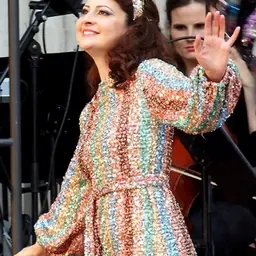
Nancy Mounir was an Egyptian performing artist and musician.
Nancy Mounir is an Egyptian independent music ian, producer and violin player. After having performed with other musical artists in Egypt, she became known for the research and recording for her 2022 debut album Nozhet El Nofous (Promenade of Souls), where she blended her own music with historical recordings of popular female singers of the 1920s music scene in Cairo.
Life and work Born in the Mediterranean metropolis Alexandria, Mounir later moved to Egypt's capital city Cairo. Apart from the violin, she plays several other instruments and her music spans different genres, ranging from popular and classical Arabic music to contemporary heavy metal genres and electronic performances. In an in-depth review of her debut album, she was called "a veteran of the independent music scene in Egypt." Apart from her own musical performances, she has composed and arranged music for films and theatre plays. Among her collaborations with other musical artists, Mounir was one of the members of the Egyptian metal band Massive Scar Era and co-produced Dina El Wedidi's album Turning back.
For her debut album Nozhet El Nofous (نزهة النفوس – Promenade of Souls), released in 2022, Mounir spent years of research on biographies and music of popular female Egyptian singers in the 1920s such as Mounira El Mahdeya, Hayat Sabri and Fatma Serry, who were popular Egyptian musical stars before the era of Umm Kulthum. Apart from these artists' musical careers, Mounir was interested in their musical tuning systems, which have not been part of the dominant musical scales in the Arabic mainstream music since the 1930s.
Arabic microtonal scales or maqamat are a mainly melodic system of tonal-spatial rather than rhythmic structure. According to Mounir, the gender and artistic choices were reasons why such female singers were excluded from the influential 1932 Congress of Arab Music in Cairo. Attended by prominent Arab and Western musicians and musicologists, this congress lead to a standardisation of Arabic music under the influence of Western musical traditions, where microtones were integrated into their nearest quarter tone. Qualifying these singers as "musical rebels", Mounir aimed to study their "passions, desires and afterlives in contemporary Egyptian society". Further, she said "Microtones are used in rituals all over the world. I believe that we were born to sing in microtones. Every ethnicity develops them in their own logic and through different trajectories." Under the English title Those who were not invited, Mounir and fellow international musicians were invited to present the music and historical film sequences of Nozhet El Nofous as a video performance at the Berlin Jazz Festival 2022.
Don’t just read it —
keep it.
Full-length biographies made to live with: read them, listen on the way to work, watch them tonight.
- E-book
- Audio
- Video
Instant download · yours to keep · every purchase keeps this site free
Important facts
Related people
Same field, nearest in time




Frequently asked questions
Who was Nancy Mounir?
Egyptian musician and producer
What was Nancy Mounir's occupation?
Nancy Mounir was a performing artist and musician.
What nationality was Nancy Mounir?
Nancy Mounir was Egyptian.
Sources & further reading
Cite this page
APA: Biography.guide. (2026). Nancy Mounir. https://biography.guide/nancy-mounir/
MLA: "Nancy Mounir." Biography.guide, https://biography.guide/nancy-mounir/.
Chicago: "Nancy Mounir." Biography.guide. https://biography.guide/nancy-mounir/.
Data last updated: 2026-09-20 · Spot an error? Report a correction.
Page generated 2026-09-27 05:28 UTC