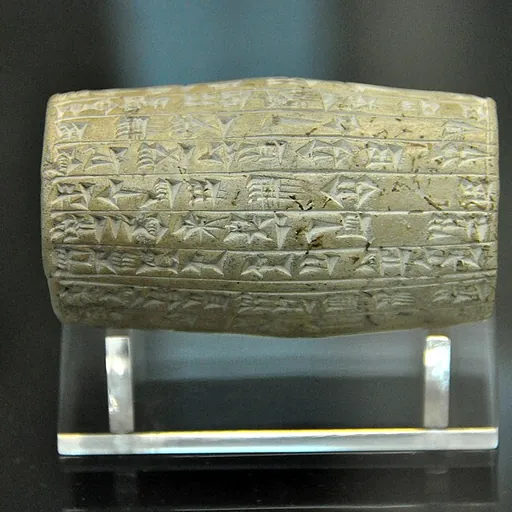
About Nabopolassar
Nabopolassar was a sovereign.
Nabopolassar (, meaning "Nabu, protect the son") was the founder and first king of the Neo-Babylonian Empire, ruling from his coronation as king of Babylon in 626 BC to his death in 605 BC. Though initially only aimed at restoring and securing the independence of Babylonia, Nabopolassar's uprising against the Neo-Assyrian Empire, which had ruled Babylonia for more than a century, eventually led to the complete destruction of the Assyrian Empire and the rise of the Neo-Babylonian Empire in its place.
Of unclear, possibly Chaldean, origin and potentially connected to a powerful political family in the southern city of Uruk, Nabopolassar revolted against the Neo-Assyrian king Sinsharishkun at an opportune moment when Babylonia was already plagued by political instability. Though the advantage shifted back and forth dramatically several times, Nabopolassar managed to decisively push the Assyrians out of Babylonia after nearly ten years of fighting. Subsequent campaigns were intended to hinder the possibility of an Assyrian campaign directed at Babylonia through securing the border, but the intervention of the eastern Median Empire under Cyaxares in Nabopolassar's favor shifted the goals and the possibilities of the war.
In 614 BC, the Medes brutally sacked the city of Assur, the religious and ceremonial heart of Assyria, and in 612 BC the Medes and Babylonians assaulted Nineveh, Assyria's capital. As with Assur before it, Nineveh was brutally sacked, with its inhabitants, including children, slaughtered en masse and the entire city being burned to the ground. Sinsharishkun probably died in its defense. Other Assyrian cities, such as Nimrud, were also assaulted and sacked much in the same way. The brutality of the Medes, including their habit of sacking even the religious temples, was so excessive that it shocked the Babylonians; contemporary Babylonian chronicles, otherwise hostile to the Assyrians, lament the sackings with sorrow and remorse. Nabopolassar's own attitude towards Assyria is unclear; in some inscriptions he is careful to ascribe his victory and its aftermath to divine intervention to rid himself of the blame, while in others he openly boasts of the destruction.
The Neo-Babylonian Empire's claim to succeed the Neo-Assyrian Empire was immediately challenged by Egypt under Pharaoh Necho II, who fought for several years to restore the Assyrians, whom he was allied to, until he was defeated at the Battle of Carchemish in 605 BC. Upon his death that same year, Nabopolassar was succeeded by his son Nebuchadnezzar II. As the founder of the Neo-Babylonian Empire, Nabopolassar was long remembered by the Babylonians after his death, even beyond the fall of his empire less than a century later. In the Hellenistic period, several centuries later, Nabopolassar's legend was still remembered, with Babylonian authors casting him as a champion ordered by Marduk, Babylon's chief deity, to avenge their homeland, and as a symbol against the domination of foreign empires over Babylon.
Background
Origin and ancestry
Nabopolassar's origins are unclear. In his own inscriptions, he refers to himself as a mâr lā mammâna ("son of a nobody"), a striking descriptor that is not known from any other Mesopotamian king. The two other Neo-Babylonian kings who had no blood connection to previous royalty; Neriglissar (560–556 BC) and Nabonidus (556–539 BC), nevertheless mentioned the names of their fathers and wrote about them with pride in their inscriptions. On account of a lack of sources in regards to his true origins, subsequent historians have variously identified Nabopolassar as a Chaldean, an Assyrian or a Babylonian. Although no evidence conclusively confirms him as being of Chaldean origin, the term "Chaldean dynasty" is frequently used by modern historians for the royal family he founded, and the term "Chaldean Empire" remains in use as an alternate historiographical name for the Neo-Babylonian Empire. Several near-contemporary texts, such as the Uruk prophecy, describe Nabopolassar as a "king of the sea", i.e. of southernmost Babylonia, suggesting that his origin was south of Babylon itself. The Assyrians also ascribed him a southern origin; a letter from the Neo-Assyrian king Sinsharishkun (627–612 BC) describes Nabopolassar as "of the lower sea", i.e. southernmost Mesopotamia.
Connection to Uruk
Regardless of his ethnic origin, Nabopolassar appears to have been strongly connected to the city of Uruk, located south of Babylon, possibly having been a member of its ruling elite prior to becoming Babylon's king. In a 1998 paper, the Assyriologist Paul-Alain Beaulieu mentioned that there was a growing body of evidence that Nabopolassar's family originated in Uruk, and also presented evidence that several of Nebuchadnezzar II's (Nabopolassar's son and successor) daughters lived in the city. In 2007, the Assyriologist Michael Jursa advanced the theory that Nabopolassar was a member of a prominent political family in Uruk, whose members are attested since the reign of Esarhaddon (681–669 BC). To support his theory, Jursa points to a letter from the time of Sinsharishkun, ABL 469, which discusses how the grave and body of Kudurru, a deceased governor of Uruk, was desecrated due to the anti-Assyrian activities of Kudurru's two sons, Nabu-shumu-ukin and a son whose name is mostly missing. The desecration went so far as to drag Kudurru's body through the streets of Uruk. Kudurru can be identified with Nebuchadnezzar (Nabû-kudurri-uṣur, "Kudurru" simply being a common and shortened nickname), a prominent official in Uruk who served as its governor under Ashurbanipal (669–631 BC) in the 640s BC.
In Assyrian tradition, the desecration of a dead body showed that the deceased individual and their surviving family were traitors and enemies of the state, and that they had to be completely eradicated. The desecration of the body itself functioned as a means to punish an enemy even after their death. The name of the son whose name is unpreserved in the letter ended with either ahi, nâsir or uṣur, and the remaining traces can fit with the name Nabû-apla-uṣur, meaning that Nabopolassar could be the other son mentioned in the letter and thus a son of Kudurru. Strengthening the case that Kudurru was Nabopolassar's father is the name of Nabopolassar's son, also Nebuchadnezzar. At this time, Nebuchadnezzar was a very rare name in Babylonia. Since the Babylonians employed papponymy, it is possible that Nabopolassar would have named his son after his father. Before becoming king after Nabopolassar's death, Nebuchadnezzar II served as the high priest of the Eanna temple in Uruk, often attested there under the nickname Kudurru, further linking Nabopolassar's dynasty both to Uruk and to Kudurru. Additionally, the name of Kudurru's second son, Nabu-shumu-ukin, is also the name of a prominent general under Nabopolassar (a role not unlikely to be filled by a family member) and the name of one of Nebuchadnezzar II's sons (possibly another example of a name honoring a relative).
The ancient author Berossus, a native Babylonian historian active in Hellenistic times, centuries after Nabopolassar, described Nabopolassar as a general of Sinsharishkun, who betrayed the Assyrian king. Berossus is not typically considered reliable, but there was ample Assyrian influence within the Neo-Babylonian Empire, with there being considerable continuity within military and court administration. Jursa does not consider this surprising; Nabopolassar's ancestors, such as Kudurru, had been pro-Assyrian in their policies (Kudurru even having been appointed by Ashurbanipal himself); Kudurru even fought in Ashurbanipal's civil war against his brother Shamash-shum-ukin (designated by their father Esarhaddon as king of Babylon), aiding in the defeat of the latter. Kudurru's support for Assyria could explain Nabopolassar's unwillingness to mention his father in his inscriptions, and the desecration of his father's body additionally meant that Nabopolassar in a literal sense no longer had a father.
The Babylonian problem The so-called "Chronicle of Nabopolassar". The cuneiform inscriptions on this clay tablet narrate the chronicle of the years 608-605 BC. After the fall of Nineveh, Naboplolassar vied with Egypt to control Assyria's western territories. His death stopped the campaign and sent his son Nebuchadnezzar II back to Babylon to claim the throne In the latter part of the Neo-Assyrian king Ashurbanipal's (pictured) reign, when Babylonia was governed by his appointed vassal king Kandalanu, Assyria and Babylonia enjoyed a long period of peace. Nabopolassar's revolt began in the period of turmoil following the deaths of both Ashurbanipal and Kandalanu. In the middle of the seventh century BC, the Neo-Assyrian Empire ruled the entire Near East. Due to their powerful standing army and their sophisticated administration, the Assyrians had managed to create the best organized and largest empire that the world had yet seen. Though Babylonia in the south had also once been a large kingdom, it had typically been weaker than its northern neighbor due to internal divisions and the lack of a well-organized army. The population of Babylonia was divided into various ethnic groups with different priorities and ideals. Though old native Babylonians ruled most of the cities, such as Kish, Ur, Uruk, Borsippa, Nippur, and Babylon itself, the Chaldean tribes, led by chieftains who often squabbled with each other, dominated most of the southernmost land. The Arameans lived on the fringes of settled land and were notorious for plundering surrounding territories. Because of the infighting of these three major groups, Babylonia often represented an appealing target for Assyrian campaigns. The two kingdoms had competed since the rise of the Middle Assyrian Empire in the 14th century BC, and in the 8th century BC, the Assyrians consistently gained the upper hand. Babylon's internal and external weakness led to its conquest by the Assyrian king Tiglath-Pileser III in 729 BC.
During the expansion of Assyria into a major empire, the Assyrians had conquered various neighboring kingdoms, either annexing them as Assyrian provinces or turning them into vassal states. Because the Assyrians venerated the long history and culture of Babylon, it was preserved as a full kingdom, either ruled by an appointed client king, or by the Assyrian king in a personal union. The relationship between Assyria and Babylonia was similar to the relationship between Greece and Rome in later centuries; much of Assyria's culture, texts and traditions had been imported from the south. Assyria and Babylonia also shared the same language (Akkadian). The relationship between Assyria and Babylon was emotional in a sense; Neo-Assyrian inscriptions implicitly gender the two countries, calling Assyria the metaphorical "husband" and Babylon its "wife". In the words of the Assyriologist Eckart Frahm, "the Assyrians were in love with Babylon, but also wished to dominate her". Though Babylon was respected as the well-spring of civilization, it was expected to remain passive in political matters, something that Assyria's "Babylonian bride" repeatedly refused to be.
The Assyrians attempted various strategies to appease their Babylonian subjects throughout the eighth and seventh centuries BC; ranging from violent subjugation through war to direct rule either by the Assyrian king or by a representative (sometimes a relative such as a son or brother). Though there was some success in pacifying the urban population of Babylonians, the Arameans and Chaldeans remained unconvinced and repeatedly rebelled whenever they saw an opportunity. Despite the enormous effort spent in keeping the region, Babylonia was seen as too important economically and strategically to allow to secede, but no matter what the Assyrians attempted, rebellion and civil war was the inevitable result each time. Prolonged Assyrian control of Babylonia proved so impossible that modern researchers have dubbed it the "Babylonian problem".
In 631 BC, the long-ruling Assyrian king Ashurbanipal died and in 627 BC, he was followed in death by his appointed vassal ruler of Babylonia, Kandalanu. Their deaths ended an about 20-year long period of relative peace and stability. Ashurbanipal was first succeeded by his son Ashur-etil-ilani, but he died in 627 BC at around the same time as Kandalanu, leading to Ashurbanipal's other son, Sinsharishkun, assuming the kingship of Assyria. Although it has been suggested by several historians, there is no evidence to prove the idea that Ashur-etil-ilani was deposed in a coup by his brother. Sinsharishkun's inscriptions state that he was selected for the kingship from among several of "his equals" (i.e., his brothers) by the gods. Almost immediately after Sinsharishkun's rise to the throne, the general Sin-shumu-lishir rebelled. Sin-shumu-lishir took some cities in northern Babylonia, including Nippur and Babylon and ruled there for three months before Sinsharishkun defeated him. Though both of them exercised control there, it is unclear if Sinsharishkun and Sin-shumu-lishir actually claimed the title "king of Babylon" (or only used "king of Assyria"), meaning that Babylonia could have experienced an interregnum of sorts. Modern historians typically include both Sin-shumu-lishir and Sinsharishkun in lists of Babylonian kings, as did some ancient Babylonian king lists.
Don’t just read it —
keep it.
Full-length biographies made to live with: read them, listen on the way to work, watch them tonight.
- E-book
- Audio
- Video
Instant download · yours to keep · every purchase keeps this site free
Important facts
Family & relationships
Related people
Same field, nearest in time



Frequently asked questions
Who was Nabopolassar?
King of Babylon (626-605 a.c)
When did Nabopolassar die?
Nabopolassar died in 605 BC.
What was Nabopolassar's occupation?
Nabopolassar was a sovereign.
What nationality was Nabopolassar?
Nabopolassar's recorded nationality: Babylonia.
Sources & further reading
Cite this page
APA: Biography.guide. (2026). Nabopolassar. https://biography.guide/nabopolassar/
MLA: "Nabopolassar." Biography.guide, https://biography.guide/nabopolassar/.
Chicago: "Nabopolassar." Biography.guide. https://biography.guide/nabopolassar/.
Data last updated: 2026-09-24 · Spot an error? Report a correction.
Portrait: Wikimedia Commons · author & licence
Page generated 2026-09-27 05:09 UTC