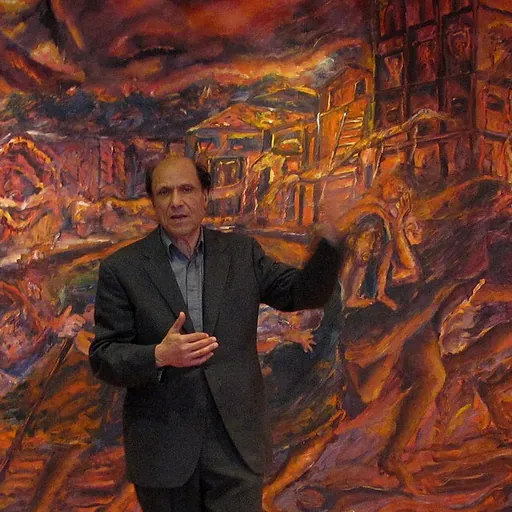
About Nabil Kanso
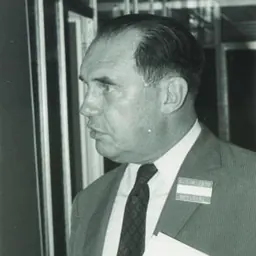
Lived 1946 – 2019 (aged 72–73). Nabil Kanso was an American painter.
Life and work
Early life Nabil Kanso was born in Beirut, Lebanon on September 26, 1940, the sixth of eight children to parents Melhem Kanso and Munira Saab. His father was a successful linen merchant from Mukhtara. In 1958, a political crisis in Lebanon forced his school to close, and Kanso left the country. He attended Regent Street Polytechnic, and after graduation, moved to New York City. In 1966, he enrolled at New York University where he studied art history, philosophy and political science, receiving a B.A. in 1970 and an M.A. in 1971. He began painting in 1967.
1970–1979 In 1971, Kanso held his first one-man show at the 76th Street Gallery exhibiting 80 paintings and drawings in pastel, oil, and watercolor, with subjects including tropical landscapes, figures, and nude fantasies. Between 1971 and the end of 1972 he held a series of solo shows at the gallery. Although the exhibitions drew attention and reviews, the gallery went out of business in 1974, and many of Kanso's works from the period were placed in storage and eventually sold off or destroyed.
1980–2007 In 1980, Kanso established a studio in Atlanta and held several exhibitions. In 1984, he went to Venezuela where his works were shown in Maracaibo (1985), Caracas (1987), and Mérida (1987–88). Kanso displayed his works by covering the entire walls of the exhibition space with his paintings, which he called "the moving murals.
Among the works of this period are the series South Africa (1980), Apocalyptic Riders (1980), DreamVision (1980–81), Lebanon (1982–83), Apocalypse (1984), Warring Wings (1984–85), Othello (1985), the Cluster Paintings (1986–1988), Leaves from the Theatre of War (1980s), The Dance of Salome (1988 and 1995), America 500 Years (1989–1991), Kuwait 1990–91, Living Memory (1993–94), Bosnia (1995–96), Portraits (1997–1999), Iraq (2004–2006).
Lebanese Civil War and Kanso Critics have connected apocalyptic themes in Kanso's work to the Lebanese Civil War.
His Kuwait paintings show women suffering by losing a child becoming victims of war. "The victims," an art critic writes, "are the newborn torn out of wombs or clinging to mothers fleeing natural catastrophes or political disasters." It is noted by some critics that motherhood is important with Kanso's women; you see mothers at the moment of birth and in death holding children in their arms. The bars that recur from one work to another are sometimes placed at the opening of the woman's womb. The children suffer with their mothers as fire, storms, or ice intensifies the human situation. People of different religions are united in suffering and passion in these works of art. "Kanso declares war on war," reads a headline article on his Gulf War exhibition in Kuwait. The paintings show the whole gamut of human suffering and pain. The tortured language itself makes his work a universal manifestation of solidarity and protest against the proliferation of war.
The emotionally steering images draw the interest and involvement of the public in witnessing the violent events in scenes filled with pathos and tensions that reach extreme intensity. His paintings transmit images of the palpable reality of a world where pain, suffering, brutality, and destruction are everywhere. "They provide," a critics notes "a powerful indictment and denunciation of wars in the Middle East and Central America. Hence the mural-scale format enveloping an enormous space in projecting harrowing images as a consequence of war."
He expresses a juncture between his supercharged psyche and our anxiety and fear, provoking the explosion we see and feel in his paintings. "Meanwhile," a critic notes, "the world debates on perpetual small wars undermining the planet with ongoing disasters. The destruction and devastation of war are shown to us in the images of Nabil Kanso who Venezuelans came to know him as the Painter of the Apocalypse." He faithfully expresses orphanage, rage and the importance of living. Kanso's mural-scale paintings have been compared to Goya's 'Horror of War' and Picasso's Guernica. One critic wrote, "To stand in the central space surrounded by Nabil Kanso's 12-foot-high paintings is as close as you get to being in the middle of a fire. Using lurid oranges, yellows and reds, Kanso fills every inch of canvas with visions of violence and human suffering that rival medieval descriptions of Hell." Some critics have noted that "Kanso's highly expressive personal style evokes experiences and visions that reveal the inner essence of a reality lying beyond its external aspects". It is further noted that the battle against large formats cannot be won but with a strong determination and an absolute mastery of technique. These are inseparable and preconceived. The dynamic handling of the pictorial layout has a total identification with Kanso's topical matter. His powerful themes could in no way be handled with softer and milder style designed to make them palatable. By way of parallelism, Kanso's work is a harmony of style and subject matter.
The Split of Life paintings
Main article The Split of Life
The Split of life paintings comprise approximately 80 mural-size paintings executed between 1974 and 1994, and were the main focus of Kanso's work during the 15-year Lebanese Civil War that broke out in 1975. The works are characterized by the consistency and relatedness of their subjects and themes dealing with violence and war. In emphasizing the issues and bringing attention to the destruction, devastation, and suffering resulting from perpetual wars, Kanso took his paintings to various places in extensive exhibitions that traveled widely, particularly in Venezuela and Latin America.
The exhibition of works related by subject and theme projected a sense of overall-ness, a sense of one painting running into another. A reviewer of an exhibition in Maracaibo featuring works from 1976 to 1984, wrote "The synchrony and diachrony of the works cross a still point in which the show is no longer a total of 27 paintings, but only one." A critic viewed the works linkage at an exhibition in Atlanta as "a net, a polyvalence of economic, cultural, political, and sexual discourse." The net is not just a formal manipulation to tie the divergent contents of the paintings together, but "a very real device that grew out of the complex discourse of the paintings and ultimately from the poetics of the painter." At a 10-year survey in Caracas a critic wrote "the installation of Kanso monumental paintings projects an immense space charged with a high level of intensity closely connected to the tension and anxiety that we face in the world today. His apocalyptic paintings offers us a voyage to the hells of our time."
Studios
An art critic visiting Kanso's studio observed "canvasses rolled up in great numbers like mummies," and noted the connection between the linen cloth in Egyptian wraps and Kanso's own life. His father founded a linen cloth business in Mexico. Another critic wrote "walking around was like taking a tour of Dante's Inferno. With agitated brushstrokes and lurid oranges, Kanso has produced a roomful of frightening images reminiscent of late Goya's mural, all the more menacing because they are over 7 feet tall". A reviewer remarked "Startled is a weak word to describe my reaction. Every wall covered with paintings that reached the ceilings. In some places, the paintings were leaning against each other several deep. Others, lots, rolled up on the floor. It was hard to believe one man had done all of this. It wasn't just that the paintings were large but their content was brilliantly focused, it came from a seeming struggle going on in a landscape that appeared biblical."
Books The Split of Life: Paintings 1974-1994, NEV Editions, 1996, Faust: Paintings 1976-1979, NEV Editions, 1997, Othello 1985, NEV Editions, 1997,
Don’t just read it —
keep it.
Full-length biographies made to live with: read them, listen on the way to work, watch them tonight.
- E-book
- Audio
- Video
Instant download · yours to keep · every purchase keeps this site free
Important facts
People in Nabil Kanso's life
Named in this biography and alive at the same time

Related people
Same field, nearest in time


Contemporaries
People whose lives overlapped Nabil Kanso's

Frequently asked questions
Who was Nabil Kanso?
American artist
When was Nabil Kanso born?
Nabil Kanso was born in 1946 in Beirut.
When did Nabil Kanso die?
Nabil Kanso died on 17 November 2019 in Atlanta.
What was Nabil Kanso's occupation?
Nabil Kanso was a painter.
What nationality was Nabil Kanso?
Nabil Kanso was American.
Sources & further reading
Cite this page
APA: Biography.guide. (2026). Nabil Kanso. https://biography.guide/nabil-kanso/
MLA: "Nabil Kanso." Biography.guide, https://biography.guide/nabil-kanso/.
Chicago: "Nabil Kanso." Biography.guide. https://biography.guide/nabil-kanso/.
Data last updated: 2026-09-21 · Spot an error? Report a correction.
Portrait: Wikimedia Commons · author & licence
Page generated 2026-09-27 04:59 UTC