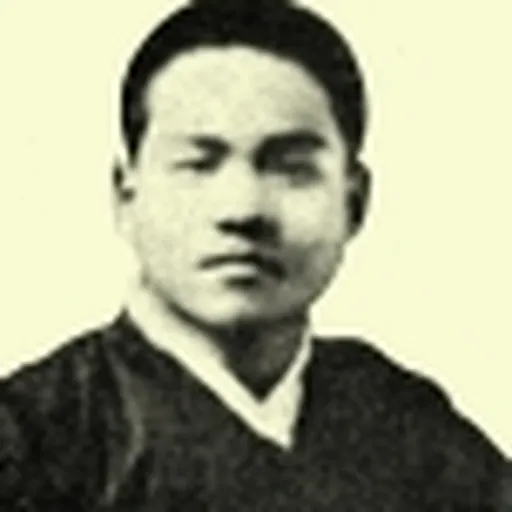
About Na Do-hyang
Lived 1902 – 1927 (aged 25). Na Do-hyang was a Korean and Japanese writer.
Na Dohyang (, 30 March 1902 – 26 August 1927) was a Korean writer born in Seoul.
Biography He graduated from the and entered Keijō Imperial University School of Medicine. However he went to Japan aspiring to find fame in literature. This pursuit of learning about literature didn't last long, because he didn't have the money to support himself. He became a high school teacher in Andong, Gyeongsang-do.
He started his career as a writer publishing A Young Man's Life (젊은이의 시절). His famous works include The Water Wheel (물레방아), Mulberry (뽕), and Deaf Samryongi (벙어리 삼룡이).
Work Na went by the art name Na Bin. His works depict Korean farm villages and people, and life during the 1920s. His last novel criticized the society and reality of his time.
The Literature Translation Institute of Korea analyzes his work:
Na Dohyang’s early works reveal romantic inclinations characteristic of an author who has yet to acquire a mature perspective. “Season of Youth” (Jeolmeuniui sijeol), his debut story, and “Do Not Cry Should You Embrace a Star” (Byeoreul angeodeun uljina malgeol) are full of emotional, dreamy sentimentalism, and have often been criticized for overabundance of modifiers. With the publication of “The Lady Barber” (Yeo-ibalsa, 1923), however, Na began to move away from the romantic vision to acquire a more objective perspective and realistic voice. “Samryong the Mute” (Beongeori samnyongi), one of his best-known works, gives a tragic account of an ugly, mute servant who falls in love with his beautiful, kind-hearted mistress. The servant’s ill-fated love is akin to man’s admiration and longing for ultimate beauty which cannot be attained. A naturalist as well as realist fiction in essence, the story also displays the author’s growing awareness of the class issues and concern for those who belong to the lowest rung in the social strata. Though Na Dohyang never embraced proletarian literature movement, he continued to explore the grim reality of the abject poor in “Mulberry” (Ppong), a story of a woman who prostitutes herself to villagers in order to support herself. The theme receives a more pronounced treatment in The Watermill (Mullaebanga); a tenant-farmer, whose wife is seduced by the landowner, ends up murdering his wife and committing suicide. Although love continues to be a dominant subject matter in Na Dohyang’s later works, it does not remain a mere romantic vision, but becomes a tool for investigating brutality nascent in human beings as well as the sexual corruption caused by unjust society.
Don’t just read it —
keep it.
Full-length biographies made to live with: read them, listen on the way to work, watch them tonight.
- E-book
- Audio
- Video
Instant download · yours to keep · every purchase keeps this site free
Important facts
Related people
Same field, nearest in time





Contemporaries
People whose lives overlapped Na Do-hyang's




Frequently asked questions
Who was Na Do-hyang?
Korean writer
When was Na Do-hyang born?
Na Do-hyang was born on 30 March 1902 in Seoul.
When did Na Do-hyang die?
Na Do-hyang died on 26 August 1927 in Seoul.
What was Na Do-hyang's occupation?
Na Do-hyang was a writer.
What nationality was Na Do-hyang?
Na Do-hyang was Korean and Japanese.
Sources & further reading
Cite this page
APA: Biography.guide. (2026). Na Do-hyang. https://biography.guide/na-do-hyang/
MLA: "Na Do-hyang." Biography.guide, https://biography.guide/na-do-hyang/.
Chicago: "Na Do-hyang." Biography.guide. https://biography.guide/na-do-hyang/.
Data last updated: 2026-09-20 · Spot an error? Report a correction.
Page generated 2026-09-27 05:09 UTC