
About Mutimir of Serbia
Lived 830 – 891 (aged 60–61). Mutimir of Serbia was a politician.
Mutimir (, ) was prince of the first Serbian Principality from ca. 850 until 891. He defeated the Bulgar army, and allied himself with the Byzantine emperor, and the Church in Serbia with the Ecumenical Patriarchate of Constantinople.
He was the eldest son of Knez Vlastimir, great-great-grandson of the unnamed 7th-century Serbian ruler, who managed to unite the Serb tribes into a state. He initially ruled together with his two younger brothers, but they revolted against him and he exiled them to Bulgaria, as guarantors of peace.
Background It is thought that the rapid extension of Bulgars over Slavs to the south prompted the Serbs to unite into a state. It is known that the Serbs and Bulgars lived in peace until the invasion in 839 (the last years of Theophilos). Emperor Theophilos (r. 829–842) probably granted the Serbs independence, and they acknowledged nominal overlordship of the Emperor. The invasion led to a 3-year war, from which Vlastimir emerged victorious; the heavily defeated Khan Presian made no territorial gains, lost many of his men, and was driven out by Vlastimir's army. In the meantime, Braničevo, Morava, Timok, Vardar and Podrimlje were occupied by the Bulgars.
Life
Vlastimir died sometime between 845 and 850 and his rule was divided among his three sons: Mutimir, Strojimir and Gojnik. Although they ruled in an oligarchy, Mutimir had the supreme rule, and the two brothers acted as vassals to him.
In 853 or 854, the Bulgar Army, led by Vladimir, the son of Boris I of Bulgaria, invaded Serbia in an attempt to exact vengeance for the previous defeat. The Serbian Army was led by Mutimir and his brothers, which defeated the Bulgars, capturing Vladimir and 12 boyars. Boris I and Mutimir agreed to cease hostilities (and perhaps an alliance, and Mutimir sent his sons Bran and Stefan to the border to escort the prisoners, where they exchanged items as a sign of peace. Boris gave them "rich gifts", while he was given "two slaves, two falcons, two dogs, and 80 furs".
An internal conflict among the brothers resulted in Mutimir banishing the two younger brothers to the Bulgarian court. He, however, kept the son of Gojnik, Petar, in his court for political reasons. The Ragusians asked Basil I for help, which he answered, sending a large fleet with his admiral Niketas Ooryphas. and most of the land was under the religious jurisdiction of the Ecumenical Patriarchate of Constantinople. Serbia's transition to Christianity would, therefore, coincide with similar initiatives by Rome in Moravia and Bosnia-Slavonia (as, incidentally, also in Bulgaria) and suggest a coordinated action in south-eastern Europe originating in Rome.
Christianization
Early medieval Serbs are accounted as Christian by 870s, with the Christianization of Southwestern Slavs beginning in the 7th century under influence of the Roman Church.
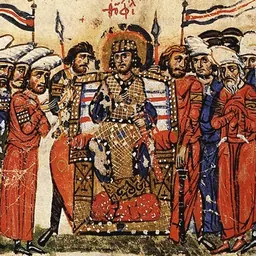
According to 29th chapter of De Administrando Imperio and 54th chapter of Vita Basilii by Constantine VII, the Serbs and other Slavs became (re-)baptized by Constantinopolitan missionaries sent by Basil I. The account is probably an invented narrative by Constantine VII to give credit to Basil I for Christianization which started in the 7th century amid ecclesiastical turmoil between Constantinople and Rome in the region, or a misinterpretation based on the account in his father's Tactica about Basil I baptizing and graecizing the Slavs in Greece. In the DAI chapters specifically about the Serbs and others, Basil I is not mentioned in any political or religious context of the Serbs and others. The Christianization was only partly due to Byzantine and subsequent Bulgarian influence, because Basil I's activity had in plan expansion on the already present Christian organization of the Roman Church in the region of former Praetorian prefecture of Illyricum (including Bulgaria) and getting control over the Serbs and others. In the same century the region was also politically contested between Carolingian Empire and Byzantine Empire. Basil I probably sent at least one embassy to Mutimir.
Mutimir seemingly decided to maintain the communion of Church in Serbia with the Eastern Orthodox Patriarchate of Constantinople when Pope John VIII of Roman Church invited him to get back to the jurisdiction of the bishopric of Sirmium (see also Archbishopric of Moravia) in a letter dated to May 873. Komatina considered that the pope wanted to strengthen the influence of Roman Church on the eastern part of Illyricum considering the borders from a distant past and not recent including Mutimir's actual ancestors. The Serbs and Bulgarians subsequently adopted the Old Slavonic liturgy instead of the Greek. ), in Latin Montemero in Serbian Mutimir. He was a descendant of Višeslavić, his father was Vlastimir, hence, according to the contemporary naming culture, his name was Mutimir Vlastimirović Višeslavić.
Don’t just read it —
keep it.
Full-length biographies made to live with: read them, listen on the way to work, watch them tonight.
- E-book
- Audio
- Video
Instant download · yours to keep · every purchase keeps this site free
Important facts
Family & relationships
People in Mutimir of Serbia's life
Named in this biography and alive at the same time
Related people
Same field, nearest in time



Contemporaries
People whose lives overlapped Mutimir of Serbia's
Frequently asked questions
Who was Mutimir of Serbia?
Prince of the Serbs
When was Mutimir of Serbia born?
Mutimir of Serbia was born in 830 in Stari Ras.
When did Mutimir of Serbia die?
Mutimir of Serbia died in 891.
What was Mutimir of Serbia's occupation?
Mutimir of Serbia was a politician.
Sources & further reading
· Wikipedia: Mutimir of Serbia
Cite this page
APA: Biography.guide. (2026). Mutimir of Serbia. https://biography.guide/mutimir-of-serbia/
MLA: "Mutimir of Serbia." Biography.guide, https://biography.guide/mutimir-of-serbia/.
Chicago: "Mutimir of Serbia." Biography.guide. https://biography.guide/mutimir-of-serbia/.
Data last updated: 2026-09-20 · Spot an error? Report a correction.
Page generated 2026-09-27 05:17 UTC