
About Muneo Yoshikawa
Born 1938. Muneo Yoshikawa is a Japanese writer, known for Double-swing model.
Muneo Jay Yoshikawa (吉川 宗男) is a Japanese professor, author, researcher and consultant in the fields of intercultural communication, human development, human resource management, and leadership.
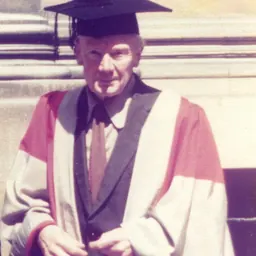
Career Muneo Yoshikawa was born in Tokyo in 1938 and went to study in the United States at the age of 18, graduating from Linfield College in Oregon. He then received his graduate degree and subsequently a Ph.D. from the University of Hawaii. Yoshikawa retired from the University of Hawaii after 35 years of teaching, currently residing in Japan.
Yoshikawa studied the Communication Theory, the New Paradigm Theory, and the Life Information Science Theory. He developed communication theories in the education, health, and business fields, best known among them being the double-swing model of intercultural communication.
He holds the rank of professor emeritus at the University of Hawaii and he is a member of the Board of Directors of Intercultural Open University Foundation (he was originally involved as a mentor and international advisor to this foundation since its inception in 1981). He is also co-director of Mobius Graduate School in Tokyo, councilor of the International Advisory Counsel of The Asian Strategy & Leadership Institute (Malaysia) and associate of Ken Blanchard Companies (San Diego, California). Yoshikawa is also involved in corporate education field, with a focus on multinational and multicultural companies.
The dialogical mode draws upon the Buddhist philosophy (the logic of soku hi) and the ideas of the Jewish philosopher Martin Buber (the I-Thou relationship) in seeing human beings as complete only in relationship. Whilst the dialogue is between two people who are separate and independent, they are simultaneously and inevitably interdependent. The model is graphically presented as the infinity symbol (∞), also as a Möbius strip, visualizing the twofold movement between the self and the other that allows for both unity and uniqueness.
Publications
Yoshikawa, M. J. (1973). Psycho-sociological implications of the Japanese interpersonal communication patterns. In N. D. Liem (Ed.), Aspects of vernacular languages in Asian and Pacific societies (pp. 1–17). Honolulu, HI: Southeast Asian Studies Program, University of Hawaii at Manoa. Yoshikawa, M. J. (1977). Implications of Martin Buber’s philosophy of dialogue in Japanese and American intercultural communication. Communication: The Journal of the Communication Association of the Pacific, 6(1), 103-124. Yoshikawa, M. J. (1978). Some Japanese and American cultural characteristics. In M. H. Prosser, The cultural dialogue: An introduction to intercultural communication (pp. 220–230). Boston, MA: Houghton Mifflin. Yoshikawa, M. J. (1980). The dialogical approach to Japanese-American intercultural encounter. Unpublished doctoral dissertation, University of Hawaii at Manoa, Honolulu, HI. Yoshikawa, M. J. (1984). Culture, cognition, and communication: Implications of the “paradoxical relationship” for intercultural communication. Communication and Cognition, 17(4), 377-385. Yoshikawa, M. J. (1987). Cross-cultural adaptation and perceptual development. In Y. Y. Kim & W. B. Gudykunst (Eds.), Cross-cultural adaptation: Current approaches (pp. 140–148). Newbury Park, CA: Sage. Yoshikawa, M. J. (1987). The double-swing model of intercultural communication between the East and the West. In D. L. Kincaid (Ed.), Communication theory: Eastern and Western perspectives (pp. 319–329). San Diego, CA: Academic Press. Yoshikawa, M. J. (1988). Japanese and American modes of communication and implications for managerial and organizational behavior. In W. Dissanayake (Ed.), Communication theory: The Asian perspective (pp. 150–182). Singapore: Asian Mass Communication Research and Information Center. Yoshikawa, M. J. (1989). Popular performing arts: Manzai and rakugo. In R. G. Powers & H. Kato (Eds.), Handbook of Japanese popular culture (pp. 75–96). New York: Greenwood Press. Hijirida, K., & Yoshikawa, M. J. (1987). Japanese language and culture for business and travel. Honolulu, HI: University of Hawaii Press.
Awards Hawaii University Teaching Award (Hawaii, USA) American Youth Teaching Award (Hawaii, USA)
Don’t just read it —
keep it.
Full-length biographies made to live with: read them, listen on the way to work, watch them tonight.
- E-book
- Audio
- Video
Instant download · yours to keep · every purchase keeps this site free
Important facts
People in Muneo Yoshikawa's life
Named in this biography and alive at the same time

Related people
Same field, nearest in time



Contemporaries
People whose lives overlapped Muneo Yoshikawa's



Frequently asked questions
Who is Muneo Yoshikawa?
Japanese writer
When was Muneo Yoshikawa born?
Muneo Yoshikawa was born in 1938 in Tokyo.
What is Muneo Yoshikawa's occupation?
Muneo Yoshikawa is a writer.
What is Muneo Yoshikawa known for?
Muneo Yoshikawa is known for Double-swing model.
What nationality is Muneo Yoshikawa?
Muneo Yoshikawa is Japanese.
Sources & further reading
Cite this page
APA: Biography.guide. (2026). Muneo Yoshikawa. https://biography.guide/muneo-yoshikawa/
MLA: "Muneo Yoshikawa." Biography.guide, https://biography.guide/muneo-yoshikawa/.
Chicago: "Muneo Yoshikawa." Biography.guide. https://biography.guide/muneo-yoshikawa/.
Data last updated: 2026-09-22 · Spot an error? Report a correction.
Page generated 2026-09-27 05:33 UTC