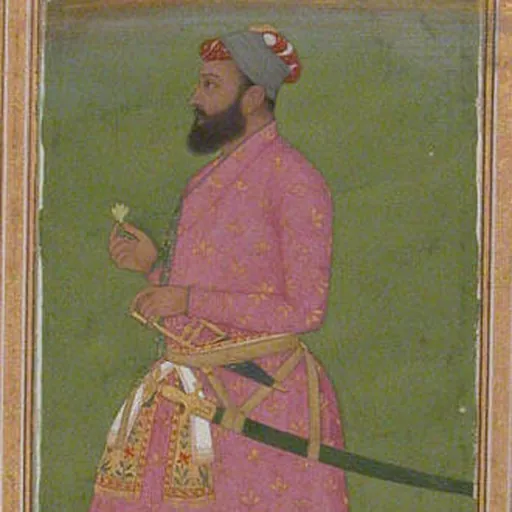
About Muhammad Saleh Kamboh
Muhammad Saleh Kamboh was a poet.
Biography His father was Mir 'Abdullah Mushkin Qalam, a famous Mughal calligrapher.
In 1646, Muhammar Saleh replaced Abd al-Rashid Daylami chief librarian with Mir Salih. Around 1659 – 1660, he completed the Amal-i Salih or Shahjahan-nama. Amal-i-Salih is an account of the life and reign of Shah Jahan. However, the work also includes information on Shah Jahan's predecessors (particularly Akbar and Jahangir) and a compendium of biographies of the Shaikhs, poets, and other notables who were contemporaries with Shah Jahan. It is considered to be one of the most important original sources of events during Shah Jahan's reign. Muhammad Saleh was known as a poet by the Persian title Kashfi and by Arabic Subhan and is also stated to be an accomplished Urdu singer. Professor Muhammad al-Munajjid on his online correspondence has answered that he based his opinion Silk ad-Durar fi A‘yaan al-Qarn ath-Thaani ‘Ashar (4/113) and Aurangzeb biography by Professor ‘Abd al-Mun‘im an-Nimr in his book Tareekh al-Islam fi’l-Hind. group="Notes" It is also stated that when Shaikh Makhdum was appointed as Sadr-us-sudur (chief justice) after death of Sadr Sharif Khan during the reign of Aurangzeb, Muhammad Salih Kamboh was appointed Peshdast (deputy). In the list of mansabdars, Muhammad Saleh Kamboh was recorded as a commander of five hundred soldiers.
Death It is claimed by some accounts that Muhammad Saleh Kamboh served as a Mughal admiral and was killed while fighting alongside his fleet against the Ahoms at Pandu on Bengal-Assam border while helping general Abdus Salam, the Faujdar (infantry commander) of Hajo, during the tenure of Islam Khan Mashadi, the Mughal governor of Bengal. The event referred to above is said to date 1636 CE, which is incorrect, since Muhammad Saleh was very much alive and is known to have completed his Amal-i Salih in 1659/60 CE soon after Aurangzeb (Reign 1658 CE – 1707 CE) became the emperor of India in 1658 CE. According to Naimur Rehman Farooqi, the work was completed in 1669 CE.
The date of Muhammad Saleh's death is not certain. S. M. Latif states on unspecified authority in his works that Muhammad Saleh Kamboh died in A. H. 1085 (1675 CE).
A mosque known as Saleh Kamboh Mosque has been built with his name in Mochi Gate, Walled City of Lahore. He is buried in Lahore, though his grave location is currently disputed by the owners of the property.
Don’t just read it —
keep it.
Full-length biographies made to live with: read them, listen on the way to work, watch them tonight.
- E-book
- Audio
- Video
Instant download · yours to keep · every purchase keeps this site free
Important facts
Related people
Same field, nearest in time

Frequently asked questions
Who was Muhammad Saleh Kamboh?
Calligraphist and official biographer of Emperor Shah Jahan
When was Muhammad Saleh Kamboh born?
Muhammad Saleh Kamboh was born in Mughal Empire.
When did Muhammad Saleh Kamboh die?
Muhammad Saleh Kamboh died in 1675 in Lahore.
What was Muhammad Saleh Kamboh's occupation?
Muhammad Saleh Kamboh was a poet.
Sources & further reading
· Wikipedia: Muhammad Saleh Kamboh
· DBpedia: Muhammad Saleh Kamboh
Cite this page
APA: Biography.guide. (2026). Muhammad Saleh Kamboh. https://biography.guide/muhammad-saleh-kamboh/
MLA: "Muhammad Saleh Kamboh." Biography.guide, https://biography.guide/muhammad-saleh-kamboh/.
Chicago: "Muhammad Saleh Kamboh." Biography.guide. https://biography.guide/muhammad-saleh-kamboh/.
Data last updated: 2026-09-24 · Spot an error? Report a correction.
Portrait: Wikimedia Commons · author & licence
Page generated 2026-10-03 09:34 UTC