
Muhammad Saeed al-Sahhaf
Iraqi diplomatic politician and Information Minister
About Muhammad Saeed al-Sahhaf
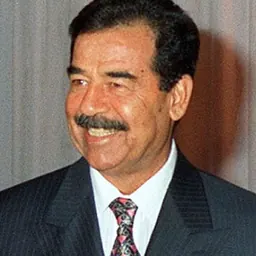
Lived 1940 – 2021 (aged 80). Muhammad Saeed al-Sahhaf was an Iraqi politician, diplomat, journalist and teacher.
Mohammed Saeed al-Sahhaf (; ; born 1940 ) is an Iraqi former diplomat and politician. He served as Iraq's minister of foreign affairs from 1992 to 2001 and later became the Iraqi minister of information. Al-Sahhaf came to worldwide prominence during the 2003 invasion of Iraq when he acted as a spokesman for Saddam Hussein's government. He has been nicknamed Baghdad Bob and Comical Ali due to his colorful and blatantly inaccurate media pronouncements.
Despite being an intrinsic part of the Iraqi regime, his name was not included in the list of the 55 most-wanted individuals nor was he put on trial, which raised questions.
Early life, education, and career Al-Sahhaf was born in Hilla, near Karbala, to a Shi'ite Arab family. After studying journalism at Baghdad University, he graduated with a master's degree in English literature. He planned to become an English teacher
Al-Sahhaf served as an ambassador to Sweden, Burma, the United Nations and Italy before returning to Iraq to serve as foreign minister in 1992.
Al-Sahhaf became known for his daily press briefings in Baghdad during the 2003 invasion of Iraq.
At the beginning of the Iraq War, al-Sahhaf made the following remarks about American troops: "Our initial assessment is that they will all die". On one occasion, he spoke of the disastrous outcomes of previous foreign attempts to invade Iraq, citing an unspecified Western history book and inviting the journalists present to come to his home to read it.
According to CNN, al-Sahhaf described American and British leaders as "an international gang of criminal bastards,' 'blood-sucking bastards,' ignorant imperialists, losers and fools". He also called the U.S. and British forces "flocks of sheep doomed to die in Iraq" and compared them to "a snake slithering through the desert that will be chopped into pieces".
Al-Sahhaf once said, "Baghdad is safe. The battle is still going on. Their infidels are committing suicide by the hundreds on the gates of Baghdad. Don't believe those liars". As he said those words, Iraqi soldiers were running for cover nearby. As American troops surrounded Baghdad, he said, "There are no American infidels in Baghdad. Never!'" On 9 April 2003, Baghdad was formally occupied by coalition forces. Al-Sahhaf "kept broadcasting until the last minute while Baghdad was being destroyed around him".
Reactions Al-Sahhaf's colorful media appearances caused him to be nicknamed "Baghdad Bob" These nicknames were given because he made statements about the conflict that were wildly at odds with reality. Western media treated him as a laughingstock during the initial stages of the Iraq War.
US intelligence analysts later concluded that al-Sahhaf confidently made false statements about the Iraq War because he genuinely believed what he was saying. Army Col. Steve Boltz, the deputy chief of intelligence for V Corps, theorized that because Saddam's regime was known for frequently punishing those who delivered bad news, military officers would fabricate reports about the battlefield situation. This systemic self-deception within the Iraqi hierarchy led to a surprising lack of awareness when the Americans entered the capital, with some captured Iraqi officers later admitting that they had no idea that the US forces had been so close.
A group of Americans from the state of New York created a website called "We Love the Iraqi Information Minister". The website included soundbites of al-Sahhaf's remarks. It became an "internet phenomenon". He was reportedly paid as much as US$200,000 for the television interview. During the interview, he appeared very withdrawn, in contrast with the bombastic persona he projected during the war. Many of his answers consisted of a simple "yes" or "no". He refused to speculate on the causes of the downfall of the Iraqi government.
Al-Sahhaf's fame quickly evaporated as the war continued into the insurgency phase; from the middle of 2003 onward, he faded from the public spotlight, and was no longer a figure in the war. Al-Sahhaf said that he had surrendered to United States forces, had been interrogated by them, and had been released. He was not charged for his role in Saddam Hussein's government.
Don’t just read it —
keep it.
Full-length biographies made to live with: read them, listen on the way to work, watch them tonight.
- E-book
- Audio
- Video
Instant download · yours to keep · every purchase keeps this site free
Important facts
People in Muhammad Saeed al-Sahhaf's life
Named in this biography and alive at the same time
Related people
Same field, nearest in time






Contemporaries
People whose lives overlapped Muhammad Saeed al-Sahhaf's



Frequently asked questions
Who was Muhammad Saeed al-Sahhaf?
Iraqi diplomatic politician and Information Minister
When was Muhammad Saeed al-Sahhaf born?
Muhammad Saeed al-Sahhaf was born on 30 July 1940 in Hillah.
When did Muhammad Saeed al-Sahhaf die?
Muhammad Saeed al-Sahhaf died on 5 March 2021.
What was Muhammad Saeed al-Sahhaf's occupation?
Muhammad Saeed al-Sahhaf was a politician, diplomat, journalist and teacher.
What nationality was Muhammad Saeed al-Sahhaf?
Muhammad Saeed al-Sahhaf was Iraqi.
Sources & further reading
· Wikipedia: Muhammad Saeed al-Sahhaf
· DBpedia: Muhammad Saeed al-Sahhaf
Cite this page
APA: Biography.guide. (2026). Muhammad Saeed al-Sahhaf. https://biography.guide/muhammad-saeed-al-sahhaf/
MLA: "Muhammad Saeed al-Sahhaf." Biography.guide, https://biography.guide/muhammad-saeed-al-sahhaf/.
Chicago: "Muhammad Saeed al-Sahhaf." Biography.guide. https://biography.guide/muhammad-saeed-al-sahhaf/.
Data last updated: 2026-09-20 · Spot an error? Report a correction.
Page generated 2026-09-27 05:31 UTC