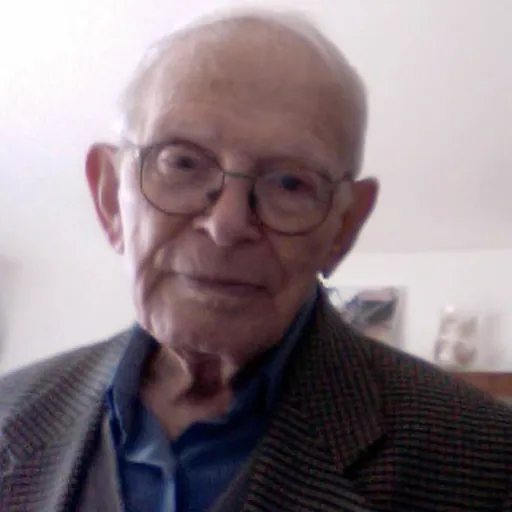
Moshe Ha-Elion
Concentration camps survivor, memoirist and poet in Ladino
About Moshe Ha-Elion
Lived 1925 – 2022 (aged 97). Moshe Ha-Elion was a Greek and Israeli writer and odyssey's translator.
Moshe Ha-Elion at his home in Bat Yam, Israel. January 2016. Moshe Ha-Elion (; 26 February 1925 – 1 November 2022), also written Moshe Haelion, Moshe 'Ha-Elion, Moshé Ha-Elion, Moshé 'Ha-Elion, Moshé Haelyon, was a Holocaust survivor and writer. He survived Auschwitz, the death march, Mauthausen, Melk, and Ebensee. He is the author of a memoir, מיצרי שאול (Meizarey Sheol), originally written in Hebrew and translated into English as The Straits of Hell: The chronicle of a Salonikan Jew in the Nazi extermination camps Auschwitz, Mauthausen, Melk, Ebensee. He wrote three poems in Ladino based on his experiences in the concentration camps and the death march: "La djovenika al lager", "Komo komian el pan", and "En marcha de la muerte", published in Ladino and Hebrew under the title En los Kampos de la Muerte. Moshe Ha-Elion translated Homer's Odyssey into Ladino. He lived in Israel. He had two children, six grandchildren, and nine great-grandchildren.
Biography: before deportation Moshe Ha-Elion was born in Thessaloniki, Greece, on 26 February 1925. He came from a middle-class Sephardic Jewish family. Moshe's grandfather was a rabbi. Moshe's father, Eliau, worked as a bookkeeper in a shop. His mother, Rachel, was a housewife. His sister (a year and a half younger than him) was Ester (Nina). The family spoke Ladino at home. Outside the house, they spoke Greek. Moshe also learned Hebrew. Afterwards, he continued his studies at a public Greek gymnasium in Thessaloniki.
In 1936 there were some anti-Semitic attacks in Thessaloniki. Moshe was then 11 years old. Although his family was Zionist, they never thought of leaving Thessaloniki. When the Germans invaded Thessaloniki (9 April 1941), everything changed: "When the Germans entered, we [felt] a big fear ... because we knew from the newspapers what happened in Germany: the Kristallnacht, the persecutions." On 11 July 1942, all Jewish men between the ages of 18 and 45 were ordered to concentrate in the Independence Square of Thessaloniki for "registration". In the square, the Jews suffered their first humiliations: the Germans forced them to do gymnastics in the hot weather and did not allow them to drink water. Then, Jews were ordered to wear the Yellow Star of David and forced into two ghettos, one in the east of Thessaloniki and one in the western, called Baron Hirsch, adjacent to the rail lines.
On 15 March 1943, the Germans began deporting Jews from Thessaloniki. Every three days, freight cars crammed with an average of 2,000 Thessaloniki Jews headed toward Auschwitz-Birkenau. By the summer of 1943, the Germans had deported 46,091 Jews. On the night of 13 April they arrived to Auschwitz.
Moshe's mother and sister were gassed upon arrival. Moshe's maternal grandparents, his uncle's wife and his one-year-old son were also gassed upon arrival.
Moshe Ha-Elion was tattooed in Auschwitz with the number 114923 on his left arm.
Death march On 21 January 1945, Moshe was forced, together with thousands of prisoners, to march. He describes the death march in his poem "En marcha de la muerte". Every now and then, Moshe could hear the guns killing the victims who could no longer walk. On the second day they arrived at a train station. The prisoners were put inside freight wagons without water or food. Moshe writes that during his years as a prisoner in the Nazi concentration camps his stomach was always crying.
Liberation
On 6 May 1945, one week after Hitler's death, the American army liberated all the sub-camps of Mauthausen, including Ebensee, where Moshe Ha-Elion was a prisoner. Three American tanks entered Ebensee. Some prisoners were touching them to be sure that they were real. He was also a member of the board of the Lión Recanati CASA and Honorary President of the "Chentro de Erensia de las komunidades de Saloniki i de Grecha" (Center of Heritage of the Saloniki and Greece Communities).
Coming back to Auschwitz
Moshe Ha-Elion returned to Auschwitz several times in order to commemorate the victims of the Holocaust. In March 1987 he visited the Auschwitz-Birkenau State Museum together with his daughter, a group of other survivors and a radio crew of the Israeli radio station "Galei Zahal".
Works and compositions
In 1992 Moshe Ha-Elion published an autobiography called מיצרי שאול (Meizarey Sheol) written in Hebrew and translated into English in 2005 with the title The Straits of Hell. The chronicle of a Salonikan Jew in the Nazi extermination camps Auschwitz, Mauthausen, Melk, Ebensee.
In 2000 Moshe Ha-Elion published En los Kampos de la Muerte, a poetic and autobiographical text written in Ladino and formed of three very large poems: "La djovenika al lager" (dedicated to his sister); "Komo komian el pan"; and "En marcha de la muerte" (poem that describes his death march).
Moshe Ha-Elion also composed music for the first poem of En los Kampos de la Muerte: "La djovenika al lager".
En los Kampos de la Muerte has been adapted to a theater-music-poetic show by the baroque ensemble Rubato Appassionato and actor Gary Shochat.
Bibliography and Editions מיצרי שאול. Written and published in Hebrew. Magav Mada Vetechnologia Ltd. Tel-Aviv, 1992. En los Kampos de la Muerte. Originally written in Ladino. Hebrew translation by Avner Perez. Bilingual edition in Ladino & Hebrew. Published by Instituto Maale Adumim, Maale Adumim, Israel, 2000. The Straits of Hell. The chronicle of a Salonikan Jew in the Nazi extermination camps Auschwitz, Mauthausen, Melk, Ebensee. (English translation of מיצרי שאול). Mannheim: Bibliopolis and Cincinnati: BCAP, 2005. Steven B. Bowman, editor. Las Angustias del Enferno: Las pasadias de un Djidio de Saloniki en los kampos de eksterminasion almanes Auschwitz, Mauthausen, Melk i Ebensee (Ladino translation of מיצרי שאול). Language: Ladino. Published by Sentro Moshe David Gaon de Kultura Djudeo-Espanyola / Universidad Ben-Gurion del Negev, 2007 The Straits of Hell: The Chronicle of a Salonikan Jew in the Nazi Extermination Camps Auschwitz, Mauthausen, Melk, Ebensee (Peleus). (English translation of מיצרי שאול). Published by Otto Harrassowitz, 2009. Shay Le-Navon - La Odisea Trezladada en Ladino i Ebreo del Grego Antiguo: Prezentada kon Estima i Afeksion a Yitshak Navon, Sinken Prezidente de Israel i Prezidente de la Autoridad Nasionala del Ladino al Kumplir Noventa Anios [TWO VOLUME SET]. Homer / Ha-Elion, Moshe; Perez, Avner [Trans.] Published by Yeriot, 2011 and 2014
Don’t just read it —
keep it.
Full-length biographies made to live with: read them, listen on the way to work, watch them tonight.
- E-book
- Audio
- Video
Instant download · yours to keep · every purchase keeps this site free
Important facts
People in Moshe Ha-Elion's life
Named in this biography and alive at the same time
Related people
Same field, nearest in time



Contemporaries
People whose lives overlapped Moshe Ha-Elion's



Frequently asked questions
Who was Moshe Ha-Elion?
concentration camps survivor, memoirist and poet in Ladino
When was Moshe Ha-Elion born?
Moshe Ha-Elion was born on 26 February 1925 in Thessaloniki.
When did Moshe Ha-Elion die?
Moshe Ha-Elion died on 1 November 2022 in Israel.
What was Moshe Ha-Elion's occupation?
Moshe Ha-Elion was a writer and odyssey's translator.
What nationality was Moshe Ha-Elion?
Moshe Ha-Elion was Greek and Israeli.
Sources & further reading
Cite this page
APA: Biography.guide. (2026). Moshe Ha-Elion. https://biography.guide/moshe-ha-elion/
MLA: "Moshe Ha-Elion." Biography.guide, https://biography.guide/moshe-ha-elion/.
Chicago: "Moshe Ha-Elion." Biography.guide. https://biography.guide/moshe-ha-elion/.
Data last updated: 2026-09-22 · Spot an error? Report a correction.
Portrait: Wikimedia Commons · author & licence
Page generated 2026-09-27 05:02 UTC