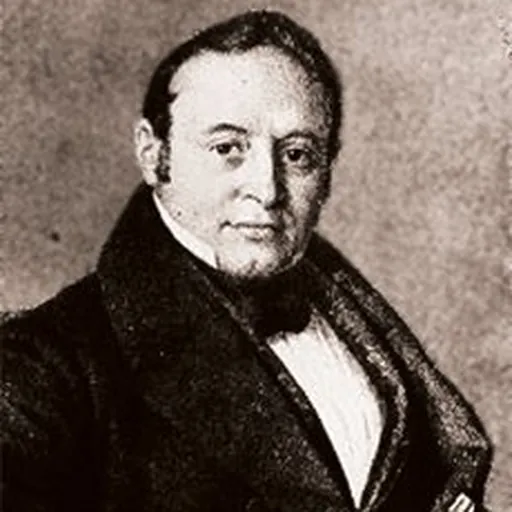
About Moritz Heinrich Romberg
Lived 1795 – 1873 (aged 77). Moritz Heinrich Romberg was a physician, neurologist, university teacher, internist and pathologist.
Moritz Heinrich Romberg (11 November 1795 – 16 June 1873) was a German medical doctor and neurologist who published a classic multi-volume textbook between 1840 and 1846. Considered a pioneer of neurology, he was the first to describe Romberg's sign, a medical sign of impaired proprioception in a patient.
Romberg was born in Meiningen, a town in Thuringia, Germany. Romberg faced early hardship with the death of his father, a Jewish merchant. Following this tragedy, his mother relocated with Romberg and his younger sister to Berlin. It was in Berlin that Romberg spent the rest of his life, eventually making significant contributions in the field of neurology.
He described what is now known as "Romberg's sign" in his original account of tabes dorsalis (a disease caused by syphilis damaging the back of the spinal cord). He related early symptoms as: "The feet feel numbed in standing, walking or lying down, and the patient has the sensation as if they were covered in fur; the resistance of the ground is not felt..."
Romberg's sign he described as: "The gait begins to be insecure... he puts down his feet with greater force...The individual keeps his eyes on his feet to prevent his movements from becoming still more unsteady. If he is ordered to close his eyes while in the erect posture, he at once commences to totter and swing from side to side; the insecurity of his gait also exhibits itself more in the dark." Romberg had not observed this in other paralyses.
The unsteadiness with eyes closed (sensory ataxia), relates to loss of sense of position in the legs and feet that are normally compensated for by the patient who uses vision to provide that information. But when the eyes are closed or in the dark, the loss of sense of position causes unsteadiness and sometimes falls, as Romberg described.
He was one of a few number of innovative neurologists in Europe who in the 1820-50 period introduced clinical observation and deduction into what was then an elementary discipline. He is credited with having been "the first clinical neurologist".
Edward Henry Sieveking translated Romberg's Lehrbuch der Nervenkrankheiten des Menschen into English in 1853.
Romberg's nephew Eduard Heinrich Henoch was a physician who became known for describing Henoch–Schönlein purpura.
Don’t just read it —
keep it.
Full-length biographies made to live with: read them, listen on the way to work, watch them tonight.
- E-book
- Audio
- Video
Instant download · yours to keep · every purchase keeps this site free
Important facts
People in Moritz Heinrich Romberg's life
Named in this biography and alive at the same time

Related people
Same field, nearest in time


Contemporaries
People whose lives overlapped Moritz Heinrich Romberg's





Frequently asked questions
Who was Moritz Heinrich Romberg?
German physician (1795-1873)
When was Moritz Heinrich Romberg born?
Moritz Heinrich Romberg was born on 11 November 1795 in Meiningen.
When did Moritz Heinrich Romberg die?
Moritz Heinrich Romberg died on 16 June 1873 in Berlin.
What was Moritz Heinrich Romberg's occupation?
Moritz Heinrich Romberg was a physician, neurologist, university teacher, internist and pathologist.
What nationality was Moritz Heinrich Romberg?
Moritz Heinrich Romberg's recorded nationality: Duchy of Saxe-Meiningen.
Sources & further reading
· Wikipedia: Moritz Heinrich Romberg
· DBpedia: Moritz Heinrich Romberg
Cite this page
APA: Biography.guide. (2026). Moritz Heinrich Romberg. https://biography.guide/moritz-heinrich-romberg/
MLA: "Moritz Heinrich Romberg." Biography.guide, https://biography.guide/moritz-heinrich-romberg/.
Chicago: "Moritz Heinrich Romberg." Biography.guide. https://biography.guide/moritz-heinrich-romberg/.
Data last updated: 2026-09-21 · Spot an error? Report a correction.
Portrait: Wikimedia Commons · author & licence
Page generated 2026-09-27 05:00 UTC