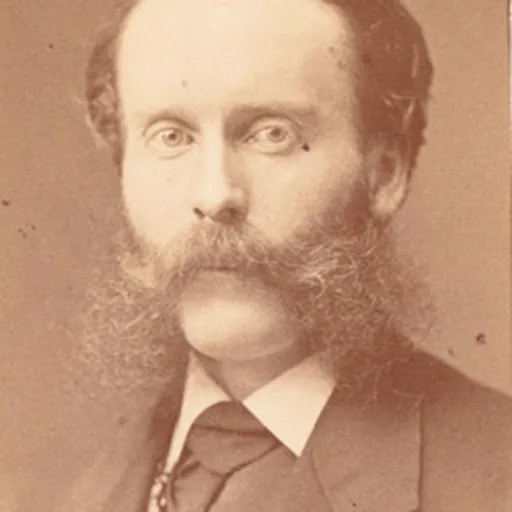
About Moody Merrill
Lived 1836 – 1903 (aged 67). Moody Merrill was an American politician.
Moody Merrill (June 27, 1836 – December 24, 1903) was an American politician, businessman, and fugitive. He served in both houses of the Massachusetts General Court, was president of the Highland Street Railway, helped organize the Boston Consolidated Street Railway, and defeated incumbent Thomas N. Hart to become the Republican nominee in the 1890 Boston mayoral election. In 1893, financial and legal difficulties led him to flee Boston and live under an assumed name in Silver City, New Mexico. He was arrested in 1903, but fled before his trial began. He died before the charges against him could be resolved.
Early life Merrill was born on June 27, 1836 Campton, New Hampshire. He was the ninth of 14 children born to Winthrop and Martha (Noyes) Merrill. Merrill moved to Boston's Roxbury neighborhood in 1859.
Legal career In December 1859, Merrill entered the law office of William Minot. Moran was found guilty but Merrill, who disagreed with how the defense had been handled by his superiors, brought the case before the Governor and the Massachusetts Governor's Council. Although the council had previously denied commutation based on the defense presented at trial, they unanimously commuted the sentence from death to life imprisonment after hearing Merrill's argument. Merrill was able to get Moran a pardon several years later from a different Council. Charles Edward Powers of the Middlesex Railroad was elected president of the new Boston Consolidated Street Railway and Merrill became its vice president. With the merger, the new company became the second largest street railway operating in Boston (after the Metropolitan Railroad). In 1888 the Consolidated Railway was again consolidated, this time into the West End Street Railway.
Merrill purchased land opposite Franklin Park and opened an amusement park called Oakland Garden. The venture was unsuccessful and Merrill founded the Franklin Park Land Company to manage the land formerly occupied by Oakland Garden as well as an adjoining lot that stretched to the Mt. Bowdoin Station. Hart went on to win that year's mayoral election. At the 1889 convention, Merrill, who was mentioned as a possible challenger to Hart, moved that Hart be unanimously declared the nominee for Mayor. In 1890, Merrill defeated Hart 167 votes to 131 to win the Republican nomination for mayor. During the campaign, Merrill's involvement with the Tremont Water Meter Company came under scrutiny. Tremont provided defective water meters to the city of Boston after Merrill came on as a director and helped secure the contract to be the exclusive provider of water meters to the city. Merrill lost the 1890 Boston mayoral election to Democrat Nathan Matthews Jr. 59% to 37%. Merrill indicated that the lack of support from Hart aided in his loss.
Legal issues By 1892, Merrill was heavily invested in the Boston Gas Company, a venture that provided a profit for the majority shareholder, J. Edward Addicks, but not for Merrill and the other Boston men who invested in it. According to Merrill, this put him in a desperate position. On June 11, an attorney who represented three women who were owed money by Merrill petitioned in insolvency court seeking to have Merrill's estate seized. On June 23, at a meeting of the Magneso-Calcite Company creditors, the assignee revealed that Merrill placed $50,000 in bonds in circulation despite Merrill's statements to the contrary. On June 30, Edgar S. Hill, Louis W. Raycroft, and James Hewins were assigned by the court to resolve Merrill's affairs. On December 18 and 19, Merrill's furniture, paintings, and other household goods were sold at auction. Merrill's total liabilities were estimated to be around $300,000. However, because most of his creditors were wealthy, they chose to take the loss rather than face public embarrassment.
Judge John R. McFie introduced Merrill to Territorial Governor Miguel Antonio Otero. Merrill secured an option on the Hanover Mines from Thomas B. Catron for Otero and Chief Justice William J. Mills. After Merrill's true identity was revealed to United States Secretary of the Interior Ethan A. Hitchcock, Merrill withdrew his opposition. Merrill contested his extradition, claiming he had given John Fottier Jr. of Boston money to pay back his creditors and that he had paid back that he owed. However, one creditor, Sarah Cohen, chose to press her claim against Merrill. On June 2, New York Governor Benjamin Odell signed the papers for Merrill's extradition to Massachusetts, stating that while evidence had been presented that Merrill had paid back some of his debts since leaving Boston, the proper venue to decide his guilt or innocence was Massachusetts. He was taken to Boston that night and sent to Charles Street Jail. He was arranged the following day and pleaded not guilty to the charge that he embezzled $19,000 from Cohen. He was released on $10,000 bail, which was put up by Mariellus Coggan and Hollis Street Theatre proprietor Issac B. Rich. On July 3, the trial was postponed indefinitely due to the illness of one of Merrill's attorneys, B. L. M. Tower. Following Merrill's return to Boston, Suffolk County District Attorney Oliver Stevens began to receive complaints from other women who accused Merrill of defrauding them. In October 1903, Merrill was indicted on 6 counts of embezzlement, 17 counts of larceny, and 1 count of false pretences. On October 15, 1903, Merrill, who had returned to New Mexico, missed a court appearance. He was found to be in default of his bond and a warrant was issued for his arrest.
On December 24, 1903, Merrill died at his apartment at the San Viente Hotel in Silver City from pneumonia complicated by other diseases. His body was shipped back to Boston where, on December 31, it was positively identified by Boston Police Captain Joseph Dugan. A funeral service was held on January 1, 1904, at the Walnut Avenue Congregational Church in Roxbury.
Don’t just read it —
keep it.
Full-length biographies made to live with: read them, listen on the way to work, watch them tonight.
- E-book
- Audio
- Video
Instant download · yours to keep · every purchase keeps this site free
Important facts
People in Moody Merrill's life
Named in this biography and alive at the same time


Related people
Same field, nearest in time





Contemporaries
People whose lives overlapped Moody Merrill's





Frequently asked questions
Who was Moody Merrill?
politician in Massachusetts, US (b. 1836)
When was Moody Merrill born?
Moody Merrill was born on 27 June 1836 in Campton.
When did Moody Merrill die?
Moody Merrill died on 24 December 1903 in Silver City.
What was Moody Merrill's occupation?
Moody Merrill was a politician.
What nationality was Moody Merrill?
Moody Merrill was American.
Sources & further reading
Cite this page
APA: Biography.guide. (2026). Moody Merrill. https://biography.guide/moody-merrill/
MLA: "Moody Merrill." Biography.guide, https://biography.guide/moody-merrill/.
Chicago: "Moody Merrill." Biography.guide. https://biography.guide/moody-merrill/.
Data last updated: 2026-09-22 · Spot an error? Report a correction.
Portrait: Wikimedia Commons · author & licence
Page generated 2026-09-27 05:01 UTC