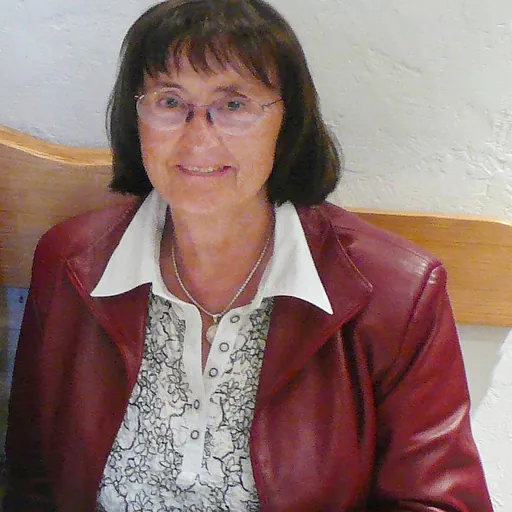
About Monika Taubitz
Born 1937. Monika Taubitz is a German writer, poet and teacher.
Monika Taubitz (born 2 September 1937) is a German poet and writer. She is also associated with Silesia and Kłodzko Land.
Biography Taubitz was born in what was then Breslau on 2 September 1937. She spent her early years in Markt Bohrau. After her father's death, she lived with her mother at her family’s home in Breslau. Fearing bombings, they moved in 1944 to her paternal grandfather's house in Eisersdorf in Kłodzko Land. In 1946, after being expelled to Germany, she ended up in Nordenham, State of Hanover, and later, in 1951, in the Allgäu region.
Taubitz attended a teacher training high school in Ochsenhausen and then studied at the Pädagogisches Institut in Weingarten, Baden-Württemberg (since 1962, Pädagogische Hochschule Weingarten).
Taubitz is a member of numerous artistic associations and served as the chairwoman of the Wangener Kreis – Society for Literature and Art of the East in Wangen im Allgäu from 1996 to 2011. She is currently its honorary chairwoman.
Taubitz has strong family ties to Kłodzko Land and Silesia. Her grandfather's brothers were Benno Taubitz, a long-serving priest and the first pastor of the Polanica parish (1913–1940), and Joseph Taubitz, the pastor of the Szczytna parish. Her father, Josef Taubitz (1882–1941), was born in Altheide-Bad and spent 32 years as a teacher in Markt Bohrau. He was also a composer, creating choral works, including Beautiful Fisherwoman (with text by Heinrich Heine), several liturgical songs, and a grand mass with orchestral accompaniment. The godfather and music teacher of the writer’s grandfather, Alfons Tobias Taubitz (1859–1939), was the composer . The grandfather worked as a teacher in Altheide-Bad from 1875 to 1882 and later as the head of a primary school and choir director in Eisersdorf for 42 years. It was in his home that the writer, as a child, spent the final period of World War II after leaving bombed Breslau in 1944. Thirty years later, these memories inspired her book , written from the perspective of the child she was then, an eight-year-old. Accompanied by her friend Anne Wachter and Sudeten guide , she traveled across Kłodzko Land, experiences which are reflected in her works, including poems published in the collection This Land Gave Me Its Word: Poems about Silesia from 2006. Her work as the chairwoman of Wangener Kreis has changed not only perceptions of Poland but also the consciousness of a generation of German writers and poets originating from Silesia. Katarzyna Nowakowska's book Faces and Contexts of Identity in German-language Literature of the 20th and 21st Centuries, which addresses the key aspect of literary work – the search for one's "self" and the definition of individual and group identity. Justyna Kubocz's work A Land Emerges from Memory – Images of Silesia in Monika Taubitz's Poetry, in the volume Silesia as a Literary Province: Literature between Regionalism and Universalism.
For her 75th birthday, a Festschrift titled Selected from Silesia: Essays on Literature from the 18th to the 21st Century was dedicated to her, featuring chapters on her work, including: Justyna Kubocz's essay Monika Taubitz and Poland: An Attempt at Assessment. Paweł Zimniak's essay Mountain Landscapes as Spaces of Emotion: On the Performativity of Spatial Experience in Monika Taubitz's Texts.
At the international scientific conference Cultural Life of Kłodzko Land held in Wrocław in 2015, several papers were dedicated to Taubitz's writing:
For her 80th birthday, a titled To the Land That Gave Her Its Word was dedicated to her, with chapters on her biography, works, and reader reception, including essays by Justyna Kubocz and Paweł Zimniak.
Awards, distinctions, and honors Taubitz has been honored with numerous awards, including prestigious ones such as: The Eichendorff-Literaturpreis (1978) The Andreas Gryphius Prize (2012) The (2016) for Flußleben The Edith Heine Poetry Prize from the Kulturwerk Schlesien Foundation (2022) (supporting award, 1980),
moreover: Hörspiel- und Erzählerpreis des Ostdeutschen Kulturrates (1981), Preis der Harzburger Literaturtage (1983)
She has also received the following distinctions and honors: The Papal Benemerenti medal (1976) The Cross of Merit on Ribbon of the Order of Merit of the Federal Republic of Germany (2014) for her literary achievements and "building bridges" between Germans and Poles Honorary citizenship of the city of Meersburg (2018), the 11th recipient in 150 years and the first woman to receive it. On June 2, 2025, Monika Taubitz was awarded the "Merito de Wratislavia" medal for her literary works in prose and poetry about her hometown of Wrocław. The mayor of Wrocław called her "Ambassador of Wrocław".
Works Some of Taubitz's notable works include:
In Poland, several of her works have been published by Atut publishing house from Wrocław:
Published by Quaestio:
Other works include:
Don’t just read it —
keep it.
Full-length biographies made to live with: read them, listen on the way to work, watch them tonight.
- E-book
- Audio
- Video
Instant download · yours to keep · every purchase keeps this site free
Important facts
Related people
Same field, nearest in time


Contemporaries
People whose lives overlapped Monika Taubitz's




Frequently asked questions
Who is Monika Taubitz?
German writer
When was Monika Taubitz born?
Monika Taubitz was born on 2 September 1937 in Wrocław.
What is Monika Taubitz's occupation?
Monika Taubitz is a writer, poet and teacher.
What nationality is Monika Taubitz?
Monika Taubitz is German.
Sources & further reading
Cite this page
APA: Biography.guide. (2026). Monika Taubitz. https://biography.guide/monika-taubitz/
MLA: "Monika Taubitz." Biography.guide, https://biography.guide/monika-taubitz/.
Chicago: "Monika Taubitz." Biography.guide. https://biography.guide/monika-taubitz/.
Data last updated: 2026-09-23 · Spot an error? Report a correction.
Portrait: Wikimedia Commons · author & licence
Page generated 2026-09-27 05:05 UTC