
About Monica G. Turner
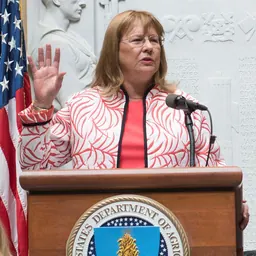
Monica G. Turner was an American ecologist.
Monica G. Turner is an American ecologist known for her work at Yellowstone National Park since the large fires of 1988. She is currently the Eugene P. Odum Professor of Ecology at the University of Wisconsin–Madison.
Life and career Turner was raised in the suburbs of Long Island just outside New York City. Her father was a self-employed lawyer and her mother was a Girl Scouts executive. Turner obtained her B.S in Biology summa cum laude from Fordham University in 1980. Turner went on to receive her Ph.D. in Ecology from the University of Georgia.
After finishing her Ph.D., she stayed at the University of Georgia as a postdoctoral researcher. She worked with Eugene P. Odum to examine the changes in land use in the Georgia landscape, one of the earliest US landscape ecology studies.
In 1986, together with Frank Golley, Turner helped organize the first American meeting for landscape ecology. In 1987, after completion of her postdoctoral research, Turner went on to become a staff scientist at the Oak Ridge National Laboratory. At Oak Ridge, Turner began a project on the spatial distribution of land use in forests of the southern Appalachian Mountains.
Throughout her career, Turner has published around 250 scientific papers.
Work at Yellowstone During her time at Oak Ridge, her group developed simulations important in modeling key concepts in landscape ecology, including predictions of species movement patterns, spread of disturbance, and the connectivity of habitats across landscapes. In 1988, Turner sought to find a landscape in which to study her model. After rejoining with fellow ecologist Bill Romme, an expert in Yellowstone fire-history, Turner was able to find the landscape she needed in the fire-ridden Yellowstone, in which more than one-third of the park had been burned.
The 1988 "summer of fire" made Yellowstone history. Early blazes, sparked in June by a combination of lightning and human activities, burned for several weeks without raising much concern. As the summer got hotter and drier, though, the situation quickly turned. In July, "we had active fires spread, but nothing that we hadn't previously experienced," recalls Roy Renkin, a Yellowstone biologist. "But then, here came August. ... Then things started to really pick up and go." Turner also examined the regrowth of lodgepole pine and other dominant tree species in the park.
Books Landscape Heterogeneity and Disturbance Quantitative Methods in Landscape Ecology Landscape Ecology in Theory and Practice (co-authored with R.H. Gardner and R.V. O'Neill) Learning Landscape Ecology: A Practical Guide to Concepts and Techniques (co-authored Gergel, S.E.) Ecosystem Function in Heterogeneous Landscapes (co-authored Lovett, G.M., C.G. Jones and K.C. Weathers) Foundation Papers in Landscape Ecology (co-authored with Wiens, J.A., M.R. Moss and D. J. Mladenoff)
Don’t just read it —
keep it.
Full-length biographies made to live with: read them, listen on the way to work, watch them tonight.
- E-book
- Audio
- Video
Instant download · yours to keep · every purchase keeps this site free
Important facts
Related people
Same field, nearest in time




Frequently asked questions
Who was Monica G. Turner?
American ecologist
What was Monica G. Turner's occupation?
Monica G. Turner was an ecologist.
What nationality was Monica G. Turner?
Monica G. Turner was American.
Sources & further reading
Cite this page
APA: Biography.guide. (2026). Monica G. Turner. https://biography.guide/monica-g-turner/
MLA: "Monica G. Turner." Biography.guide, https://biography.guide/monica-g-turner/.
Chicago: "Monica G. Turner." Biography.guide. https://biography.guide/monica-g-turner/.
Data last updated: 2026-09-20 · Spot an error? Report a correction.
Page generated 2026-09-27 05:28 UTC