About Mkrtich Khrimian
Lived 1820 – 1907 (aged 87). Mkrtich Khrimian was a Turkish and Russian christian minister.
Mkrtich Khrimian
After returning to Constantinople, Khrimian delivered a series of speeches "which secured him a place in the radicalisation of Armenian thinking, and the clear and forceful articulation of demands based on nationalist principles." He gave a well-known sermon in which he called for the armament of the Armenians in order to fight for an independent Armenia. He told his flock that "Armenia, in contrast with the Christian states of the Balkans, did not win autonomy from the Porte because no Armenian blood had been shed in the cause of freedom." Famous for its allegories, the sermon is considered to have initiated the Armenian revolutionary movement. including the treasures of Etchmiadzin. The act had the primary purpose of accelerating the process of Russification of the Armenian people and church. Khrimian collaborated with the Armenian Revolutionary Federation (ARF or Dashnaktsutyun) to organize mass demonstrations against the edict. According to the historian Rouben Paul Adalian, it was a combination of Dashnaktsutyun's popular resistance and Khrimian's personal defiance that resulted in the edict being canceled in 1905.
He consecrated the new churches of two provincial towns, Goris ( and Gavar, in 1903 and 1905, respectively.
In 1907, Khrimian clarified the relations between the patriarch of Constantinople and emphasized the primacy of the see of Echmiadzin. In September of that year he sent a letter to Nicholas II in which he called upon the Russian government to prevent the violence then facing the Ottoman Empire's Armenian population.
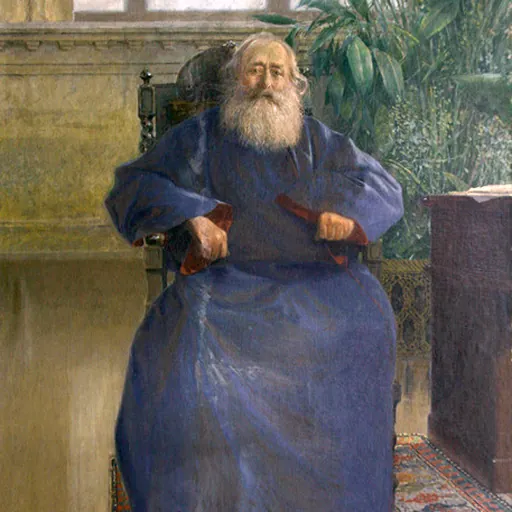
Views and ideological influence Progressivism A 1906 painting of Khrimian by Vardges Sureniants depicting the moment he received the letter about the Russian decree ordering the confiscation of Armenian Church properties in 1903.
In the 1860s and 1870s, Khrimian was, along with Harutiun Svadjian, one of the major liberal Armenian activists in the Ottoman Empire. At the same time, liberals like Grigor Artsruni, Mikael Nalbandian, and Stepanos Nazarian were active in the Russian Empire. Arra Avakian described him as a "very progressive educator." American feminist Alice Stone Blackwell wrote in 1917: "All his views were progressive" and praised his promotion of female education: "He was a strong advocate of education for girls, and in one of his books, The Family of Paradise, he argues against the prevailing Oriental idea that husbands have a right to rule over their wives by force." Vartooguian, writing in 1896, suggested that Khrimian "was a conservative in matters of the Church."
Nationalism Razmik Panossian writes that Khrimian had a powerful influence on Armenian nationalism. According to Panossian, he is the "single most important nineteenth century figure to have entered Armenian consciousness as the bearer of the radical message of national liberation". According to Tekkoyun, "Khrimian was a prominent figure in the formation of the Armenian nationalism." H. F. B. Lynch, who visited Etchmiadzin in 1893, wrote about Khrimian in his book on Armenia: "With him religion and patriotism are almost interchangeable terms." In the words of Adalian, Khrimian is "revered for his patriotic fervor and staunch defense of Armenian national interests." Another author described him as a "major spokesman for Armenian nationalist aspirations on the international stage." According to Tekkoyun, Khrimian "always advocated the awareness of laymen with nationalistic and patriotic ideas, which was possible only through the medium of journals and literature." Khrimian particularly emphasized the use of vernacular language in his writings.
Khrimian's view of Armenian nationalism as a cultural reawakening transformed into nationalism as an armed revolutionary movement in response to the repressive regime of Ottoman and Russian government as well as European policies towards Armenia. Khrimian explicitly endorsed the Armenian Revolutionary Federation (Dashnaktsutyun) in an 1896 letter to the Armenians of Van, in which he wrote:
Before this the church had maintained a distance from the Armenian revolutionary groups as the latter saw the former as a conservative institution. It was Khrimian who welcomed revolutionary activism, especially by the Dashnaktsutyun, the most influential Armenian party. According to Panossian, Khrimian thus radicalised, to a certain degree, the Armenian Church and as such secularised in its vision of the Armenian nation.
Death and legacy
Khrimian died on 29 October 1907. He was buried, like many of his predecessors, at the courtyard of Etchmiadzin Cathedral. Sculptor Sergey Merkurov made his death mask.
Khrimian was revered by Armenians during his lifetime. He was called Hayrik (diminutive for "father") since his time as abbot of Surb Karapet Monastery near Mush in the early 1860s. Sarkis Atamian claims that "o man, perhaps, in Armenian history, has come to symbolize the kind, wise, paternalistic leader of his flock as did Khrimian who was given the title Hairig (little father) in affection by his people." Jack Kalpakian describes Khrimian as "second only to the mythical Haik as the nation's father figure." Catholicos Vazgen I (r. 1955–94) called Khrimian the "greatest revolutionary [of the Armenian peasantry]".
Don’t just read it —
keep it.
Full-length biographies made to live with: read them, listen on the way to work, watch them tonight.
- E-book
- Audio
- Video
Instant download · yours to keep · every purchase keeps this site free
Important facts
People in Mkrtich Khrimian's life
Named in this biography and alive at the same time




Related people
Same field, nearest in time

Contemporaries
People whose lives overlapped Mkrtich Khrimian's


Frequently asked questions
Who was Mkrtich Khrimian?
Catholicoi of Armenia (1820–1907)
When was Mkrtich Khrimian born?
Mkrtich Khrimian was born on 4 April 1820 in Van.
When did Mkrtich Khrimian die?
Mkrtich Khrimian died on 29 October 1907 in Vagharshapat.
What was Mkrtich Khrimian's occupation?
Mkrtich Khrimian was a christian minister.
What nationality was Mkrtich Khrimian?
Mkrtich Khrimian was Turkish and Russian.
Sources & further reading
Cite this page
APA: Biography.guide. (2026). Mkrtich Khrimian. https://biography.guide/mkrtich-khrimian/
MLA: "Mkrtich Khrimian." Biography.guide, https://biography.guide/mkrtich-khrimian/.
Chicago: "Mkrtich Khrimian." Biography.guide. https://biography.guide/mkrtich-khrimian/.
Data last updated: 2026-09-23 · Spot an error? Report a correction.
Portrait: Wikimedia Commons · author & licence
Page generated 2026-09-27 05:08 UTC