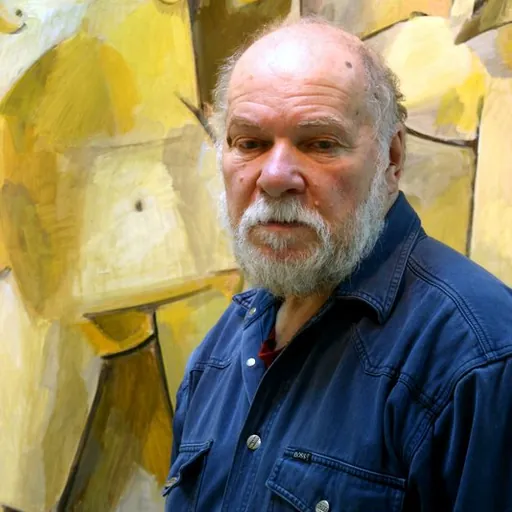
About Misha Brusilovsky
Lived 1931 – 2016 (aged 85). Misha Brusilovsky was a Russian painter.
Misha Brusilovsky (born Mikhail Brussilovsky; 7 May 1931 – 3 November 2016) was a Russian artist, painter and graphic artist. He was a Member of the Russian union of artists, an honored artist of the Russian Federation, a distinguished member of Russian Academy of Arts, a laureate of the "G. S. Mosin prize" and a winner of the Sverdlovsk region Governor's prize "For outstanding achievements in literature and art".
Biography Childhood
Misha Brusilovsky was born on 7 May 1931 in Kiev. His father, Shaya Shevelevich Brusilovsky (1904–43), was a military engineer who was killed in the war, and his mother, Frida Abramovna Goldberg (1906–89), worked in trade. He had one brother Seva – Vsevolod Brusilovsky (born 1936).
In 1938 Misha's father was sent on an extended mission to the Far East, where he went with his whole family. They lived on the In Station in Birakan and Birobidzhan. in the South Urals to their aunt Raya, their father's sister. Their father went to the front, and their mother stayed in Kiev and joined them later. In 1943, their aunt Raya, a general practitioner and surgeon, was mobilised, and Misha went with her on a medical train.
Six months later, Brusilovsky returned to Kiev, which had been liberated from Germany. In an attempt to earn some money, he joined a group of boys who shined shoes on the square in front of the train station. Every evening, a grown-up lad with the nickname Kot (Tomcat)
Once, for Kot's birthday, Misha drew his portrait with coloured pencils, and showed it to him. Kot took the drawing, and a while later he brought Brusilovsky to a boarding school for gifted children. and Minas Avetisyan. He graduated from the Institute in 1959 (his thesis supervisor was Alexei Pakhomov) and then he was assigned a job in the city of Sverdlovsk.
Creative work
Sverdlovsk In Sverdlovsk, Misha Brusilovsky began teaching drawing in Shadr Art College, and he also began working with the Central Ural Publishing House as an artist-illustrator. He met Vitaly Volovich, Herman Metelev, Andrei Antonov, Anatoly Kalashnikov and other Sverdlovsk artists, and he also met the artist Gennady Mosin with whom he had been friendly back in the Repin Institute. He worked with Mosin on mounted pictures. He also took orders for monumental pieces.
The chairperson of the Sverdlovsk Union of Artists A. G. Vyaznikov, who in the interests of his own career was waging a wide-scale war against formalism and some bureaucrats in the Sverdlovsk branch of the communist party had a negative reaction to Brusilovsky's work.
In 1961, for Brusilovsky's thirtieth birthday, the Sverdlovsk Union of Artists organised an exhibition of painting and graphic art in the Sverdlovsk House of the Artist, together with an exhibition of another Sverdlovsk artist K. Zyumbilov. On 10 May 1961, the newspaper "The Ural Worker", in "The audience responds" column, published a note by the name of "An unnecessary enterprise", signed by a certain "public servant N. Efimov" in which all of Brusilovsky's pieces which had been presented at the exhibition came under criticism.
centered Placed on page two of the newspaper, amidst coverage of the forthcoming 22nd Congress of the Communist Party of the Soviet Union, it vividly demonstrated how important it was for the Sverdlovsk authorities that this graduate of the Leningrad Repin Institute of Arts, Brusilovsky, a Kievan by origin, be expelled from the Ural arts scene. — Aleksandr Ryumin
In this way the museum acquired Mikhail Brusilovsky's wonderful canvas "Pig-breeding farm in the Golubskovsky sovkhoz", where the little artist looks shyly up at shapely milkmaids. The painting caused a huge scandal in its time: communists from the Union of Artists reproached the artist for using a traditional composition, instead of an infant putting a pig into the arms of its Madonna.
Boris Yeltsin, who held the role of first secretary of the Sverdlovsk branch of the Communist Party at the time, publicly declared that the painting was harmful to Soviet art. In 1989, Brusilovsky received an invitation from the French collector and gallery owner Garik (Garig) Basmadjan to have an exhibition in France. In April 1989 Brusilovsky arrived in Paris. The exhibition was scheduled for November, but before that a lot of work had to be done to prepare the canvasses, which had arrived in France rolled up, and there were also a host of promotional activities. A reproduction of the painting was put on the cover of the exhibition catalogue, and also on advertising posters. Because of Garik Basmadjan's disappearance, the gallery stopped working with Misha Brusilovsky, and he returned to Russia having left a large number of his pieces in Paris.
The 1990s In 1990, after he came back from France, Brusilovsky was awarded the "G. S. Mosin prize", for his contribution to the development of art in the Ural region. When the project was complete, the client unexpectedly went abroad. He refused to collect the canvasses, and gave the artists permission to do what they wanted with the paintings. Misha Brusilovsky kept the paintings in his studio for many years, and only in 2013 were they exhibited to the general public.
In 1992 Brusilovsky visited the United States. He lived in the cities of Columbus and New York. In New York he visited his old friends from the Urals, the poet Bella Abramovna Dijur and her son Ernest Neizvestny. He also met the painter Anatoly Kalashnikov, who had come to New York from Sverdlovsk.
centered Something happened to me in America. I worked a lot, and most importantly, I had the impression that everything that I was doing was good. I would get up at six and go to bed at three in the morning. I did more than I had managed to do in the twenty years I lived Sverdlovsk-Ekaterinburg. — Misha Brusilovsky — and once again he began to revisit his favourite themes.
centered "The Rape of Europa", "Leda and the Swan, "Little red riding-hood", "Tomcats", "Woman on Horse", "Hunting Lions", and the biblical themes, especially "Peter and the Rooster", and even the renowned tragic composition "Pieta. To the victims of war" are understood in a new interpretation (but in no way a repetition) in the harmony of contrasts, and not as a confrontation between them using various styles. — Aleksandr Ryumin — which he created according to the principles of abstract art. These included works such as "Abstraction", "Composition", "Opus 2", "Opus 3", "Subjects", "Six subjects", "House", "Window", "Port", "Landscape", "Landscape at night", "Peace", "Remembering", "Leave-taking" and "Golgotha".
centered The exhibit included paintings which had been completed in recent years. Ten years after the retrospective exhibition in 1989 in the Ekaterinburg Municipal Museum of Fine Arts, Brusilovsky came before the public for the first time with compositions which used a new style of painting, whose expressive potential was most clearly illustrated by the large-scale canvas "Expulsion from Paradise". — Aleksandr Ryumin — and there was a travelling exhibition "Russian art. 300 years" (Peking, Shanghai, Hong Kong, China) and a personal exhibition in the Ekaterinburg Museum of Fine Arts.
In 2003 the gallery "Gold Scorpion", in its series of permanent exhibits "Noah's Ark", put on a joint exhibition of the works of Misha Brusilovsky and the sculptor Andrei Antonov.
In 2004, Brusilovsky took part in the exhibit "Carrying the Cross", organised by the Ekaterinburg Museum of Fine Arts.
In 2009 Brusilovsky took part in an exhibition of contemporary American and Russian art "Contact: Wind and Fire", organised with the support of the Department of Print and Culture of the General Consulate of the US in Ekaterinburg, the non-governmental foundation "Ekaterinburg creative union of cultural workers" and the "Ekaterinburg gallery of contemporary art". Works by famous American and Ural artists were exhibited at the event.
On 28 April 2009, the premiere of Svetlana Abakumova's documentary film "Sunday in the studio" was screened (Studio FSS, art-movement Old Man Bukashin, Studio Telesistema). The film is dedicated to Misha Brusilovsky's life and work.
In 2010, the art gallery "Art-Slovar" opened the permanent exhibit "Luminaries of Ural art", which included works by Brusilovsky such as "Samson and Delilah", "Leda and the Swan", "Rape of the Sabine Women" and "Auschwitz".
On 9 June 2011, the premiere of Boris Shapiro's documentary film "Misha and his friends", filmed in the "Bo-Sha-film" studio,
On 22 November 2011 Brusilovsky was awarded the title of Honoured artist of the Russian Federation by order of the President of the Russian Federation.
On 28 November 2013 Brusilovsky was made a Distinguished member of the Russian academy of arts.
Brusilovsky's works are located in the Ekaterinburg Museum of Fine Arts, the Perm State Art Gallery, the Ekaterinburg Gallery of Contemporary Art, the Chelyabinsk Region Gallery, the Orenburg Region Museum of Fine Arts, the Irbit State Museum of Fine Arts, and also in private collections in Russia, Austria, England, Germany, Israel, US, France and Switzerland.
The paintings which Brusilovsky left in France and in the US are periodically sold at some of the largest auctions in the world. In 2006, at a Sotheby's auction in London, the painting "Football", was sold for 108000 Pounds.
According to the publication "The Art Newspaper Russia", Misha Brusilovsky occupies 38th place was in the list of the 50 most expensive living Russian artists.
Death Misha Brusilovsky died on 3 November 2016 in Yekaterinburg, Russia
Selected works
Titles and awards 1990 — Laureate of the "G. S. Mosin prize" 2002 — Laureate of the Sverdlovsk region Governor's prize "For outstanding achievements in literature and art". 2011 — Honoured artist of the Russian Federation 2013 — Distinguished member of Russian Academy of Artists
Sculptural composition "City dwellers. Conversation" In August 2008 the sculptural composition "City dwellers. Conversation" was installed on a square in Ekaterinburg at the junction of Lenin Prospect and Michurin Street. The work of sculptor Andrei Antonov (1944–2011), the composition depicts three Ural artists: Misha Brusilovsky, Vitaly Volovich and Herman Metelev.
Literature • In 2002, the "Ural Gold Foundation" (Yekaterinburg) and the journal "Our heritage" (Moscow), published the book "Misha Brusilovsky. World of the artist", which tells the story of the life and work of Misha Brusilovsky. Author: Aleksandr Ryumin.
Don’t just read it —
keep it.
Full-length biographies made to live with: read them, listen on the way to work, watch them tonight.
- E-book
- Audio
- Video
Instant download · yours to keep · every purchase keeps this site free
Important facts
People in Misha Brusilovsky's life
Named in this biography and alive at the same time

Related people
Same field, nearest in time


Contemporaries
People whose lives overlapped Misha Brusilovsky's
Frequently asked questions
Who was Misha Brusilovsky?
Russian artist (1931-2016)
When was Misha Brusilovsky born?
Misha Brusilovsky was born on 7 May 1931 in Kyiv.
When did Misha Brusilovsky die?
Misha Brusilovsky died on 3 November 2016 in Yekaterinburg.
What was Misha Brusilovsky's occupation?
Misha Brusilovsky was a painter.
What nationality was Misha Brusilovsky?
Misha Brusilovsky was Russian.
Sources & further reading
· Wikipedia: Misha Brusilovsky
Cite this page
APA: Biography.guide. (2026). Misha Brusilovsky. https://biography.guide/misha-brusilovsky/
MLA: "Misha Brusilovsky." Biography.guide, https://biography.guide/misha-brusilovsky/.
Chicago: "Misha Brusilovsky." Biography.guide. https://biography.guide/misha-brusilovsky/.
Data last updated: 2026-09-23 · Spot an error? Report a correction.
Portrait: Wikimedia Commons · author & licence
Page generated 2026-09-27 05:05 UTC