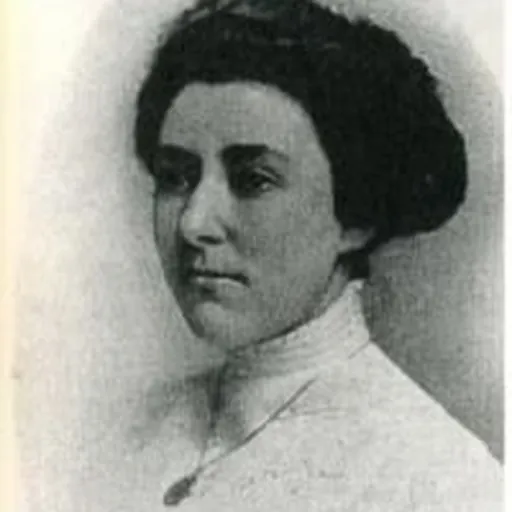
About Minnie Vautrin
Lived 1886 – 1941 (aged 54). Minnie Vautrin was an American missionary, educator and diarist.
Wilhelmina "Minnie" Vautrin (September 27, 1886 – May 14, 1941) was an American missionary, diarist, educator and president of Ginling College. A Christian missionary in China for 28 years, she became known for caring for and protecting at least 10,000 Chinese refugees during the Nanjing Massacre in China, during which she kept a now-published diary, at times even challenging the Japanese authorities for documents in an attempt to protect the civilians staying at her college.
After surviving in the Nanking Safety Zone from 1937, she returned to the United States in May 1940. One year later, she committed suicide in America due to extreme stress and trauma from the Nanjing Massacre. Vautrin was awarded the Order of the Blue Jade by the Chinese government for her humanitarian work during the Nanjing Massacre.
Early life and education Wilhelmina Vautrin was born in Secor, Clayton Township, Illinois, on September 27, 1886, to Pauline (née Lohr) and Edmond Louis Vautrin. Her father Edmond, who considered himself French, immigrated from the often-contested Lorraine region to the United States. He arrived in Clayton County, Illinois, in 1883 to undergo a blacksmithing apprenticeship with his uncle in Peoria, and later moved to nearby Secor, where he married Pauline. Minnie was the second of the couple's three children; her elder brother died as an infant.
When Minnie was six years old, her mother died of unrecorded causes. After this, Minnie was sent to several different foster homes. Three years later, the courts permitted her to return home to her father, where she assumed many household chores as well as excelled in school. A teacher later remembered Vautrin, commenting that "Minnie was a born student...She could excel in most anything she tried, and was a genuinely Christian girl." After primary school, Vautrin attended Secor High School. During that time, Vautrin worked several part-time jobs to save for further schooling, as well as volunteered at local churches.
Vautrin was accepted to Illinois State Normal University in Normal, Illinois in 1903. Her limited finances meant Vautrin had to work, and delayed her studies several times. She nonetheless graduated in 1907, ranked first in her class of 93 students and delivered a speech at the commencement. She taught mathematics at LeRoy High School, Illinois, before continuing her studies at the University of Illinois. At that university, Vautrin was president of the Student Volunteer Movement for Foreign Missions. She graduated in 1912 as salutatorian of her class with an A.B. in Science.
Missionary career
The university pastor recommended Vautrin to the recruiters of the Foreign Christian Missionary Society, who requested that she replace a teacher in China.
When Vautrin received this request in 1912, Christian missions to China, facilitated by groups such as the Foreign Christian Missionary Society, had begun to flourish as a result of the treaties ending the First Opium War (1840–1842) and Second Opium War (1863–1865) that opened Chinese seaports to Christianity.
In 1918, after serving for a period of six years in China, Minnie returned to the United States for furlough. She enrolled in Columbia University in New York City to pursue a Master's degree in Education, which she received in 1919. While at Columbia University, Vautrin was approached by a teacher from Ginling College, and was asked to serve as president of the institution for one year. Vautrin postponed her wedding for one year in order to become the acting president at Ginling College in 1919. However, she later broke off her engagement and never married.
At Ginling College, Vautrin decided to extend her one-year agreement. She created courses on education administration and management, an innovative student-teaching program, and handled the planning and funding of the new campus by the West Gate of Nanjing. During the fall semester of 1922, Vautrin hosted a fundraiser to build an elementary school for 150 local, mostly illiterate children who lived in the homes near Ginling College's campus. The biographer Hua-ling Hu writes that, while at Ginling College, Minnie "attempted to lead the students to fulfill the spirit of Ginling's motto, 'abundant life,' by making them walk out of the 'ivory tower' to see and understand the suffering of the poor and by encouraging them to devote their lives for the betterment of the society."
Upon hearing of the Marco Polo Bridge Incident in 1937, Vautrin cancelled her planned furlough, scheduled for 1938, and immediately returned to Nanjing from Tokyo in order to protect Ginling College and its students. Vautrin would patrol the campus grounds and repel incursions of Japanese soldiers into the college and rescue and care for refugees. She saw to the burial of the dead and the reception of newborn babies and was successful in tracing missing husbands and sons. Industrial or crafts classes were provided for women who had lost their husbands, so that they might support themselves. One hundred women graduated under this program. One entry in her journal, recorded shortly before her death, displays her devotion to Ginling College and the people of China, whom she served for 28 years as a Christian missionary:
Had I ten perfect lives, I would give them all to China.
Legacy Vautrin was awarded the Order of Brilliant Jade on July 30, 1938, by the Chinese government for her sacrifices during the Nanjing Massacre. Her work saving the lives of Chinese civilians during the massacre is recounted in the biographical book, American Goddess at the Rape of Nanking, written by historian Hua-Ling Hu.
The Nanjing Massacre Memorial Hall is a museum built by the Nanjing Municipal Government to memorialize the 300,000 victims of the Nanjing massacre, the survivors, and those who tried to protect the people of Nanjing during the atrocity. In the museum, there is a memorial to Minnie Vautrin. Additionally, there is a statue of Vautrin in Jinling Women's College, among memorials to the other non-Chinese individuals who helped to protect the college and its inhabitants during the Nanjing massacre.
The hardcore band Hiretsukan honors Wilhelmina Vautrin in their song "Song For Wilhelmina Vautrin" on their 2005 record End States.
Other She is depicted in Lu Chuan's 2009 film City of Life and Death. In the 2009 film John Rabe, Minnie Vautrin is replaced by the fictitious Valérie Dupres of an "International Girls College" as an important fellow Nanking Safety Zone committee member. In Nanjing Requiem, a 2011 novel by Chinese-born writer and Boston University professor Ha Jin, Ha writes from the perspective of a fictionalized assistant to Vautrin named Anling Gao. Minnie Vautrin's diaries provided inspiration for the novella 13 Flowers of Nanjing written by Geling Yan, which was the basis for the 2011 film The Flowers of War , directed by Zhang Yimou.
Don’t just read it —
keep it.
Full-length biographies made to live with: read them, listen on the way to work, watch them tonight.
- E-book
- Audio
- Video
Instant download · yours to keep · every purchase keeps this site free
Important facts
People in Minnie Vautrin's life
Named in this biography and alive at the same time


Related people
Same field, nearest in time



Contemporaries
People whose lives overlapped Minnie Vautrin's



Frequently asked questions
Who was Minnie Vautrin?
missionary in China
When was Minnie Vautrin born?
Minnie Vautrin was born on 27 September 1886 in Secor.
When did Minnie Vautrin die?
Minnie Vautrin died on 14 May 1941 in Indianapolis.
What was Minnie Vautrin's occupation?
Minnie Vautrin was a missionary, educator and diarist.
What nationality was Minnie Vautrin?
Minnie Vautrin was American.
Sources & further reading
Cite this page
APA: Biography.guide. (2026). Minnie Vautrin. https://biography.guide/minnie-vautrin/
MLA: "Minnie Vautrin." Biography.guide, https://biography.guide/minnie-vautrin/.
Chicago: "Minnie Vautrin." Biography.guide. https://biography.guide/minnie-vautrin/.
Data last updated: 2026-09-23 · Spot an error? Report a correction.
Portrait: Wikimedia Commons · author & licence
Page generated 2026-09-27 05:07 UTC