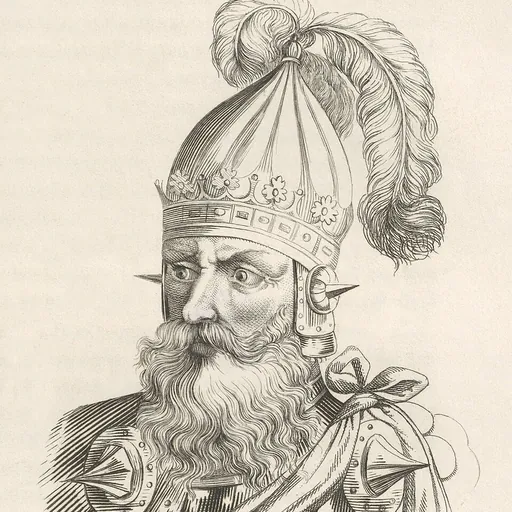
Mindaugas
King of Lithuania
About Mindaugas
Lived 1203 – 1263 (aged 59–60). Mindaugas was a Lithuanian.
Mindaugas (c. 1203 – 12 September 1263) was the first known Grand Duke of Lithuania and the only crowned King of Lithuania. Little is known of his origins, early life, or rise to power; he is mentioned in a 1219 treaty as an elder duke, and in 1236 as the leader of all the Lithuanians. The contemporary and modern sources discussing his ascent mention strategic marriages along with banishment or murder of his rivals. He extended his domain into regions southeast of Lithuania proper during the 1230s and 1240s. In 1250 or 1251, during the course of internal power struggles, he was baptised as a Roman Catholic; this action enabled him to establish an alliance with the Livonian Order, a long-standing antagonist of the Lithuanians. By 1245, Mindaugas was already being referred to as "the highest king" in certain documents. During the summer of 1253, he was crowned king, ruling between 300,000 and 400,000 subjects, and was nicknamed as Mindaugas the Sapient by the Livonians.
While Mindaugas's reign as king was marked by many state-building accomplishments, his conflicts with relatives and other dukes continued. The western part of Lithuania – Samogitia – strongly resisted the alliance's rule. His gains in the southeast were challenged by the Tatars. He broke peace with the Livonian Order in 1261, possibly renouncing Christianity, and was assassinated in 1263 by his nephew Treniota and another rival, Duke Daumantas of Pskov. His three immediate successors were assassinated as well. The disorder was not resolved until Traidenis gained the title of grand duke c. 1270.
Although his reputation was unsettled during the following centuries and his descendants were not notable, he gained standing during the 19th and 20th centuries. Mindaugas was the only king of Lithuania;
Boguchwala i Godyslawa Paska Chronicle describes Mindaugas as a ruthless king of Prussia, who, in 1260, withdrew from the Christian faith and obliterated Mazovian city Płock and Prussia committing a great slaughter among the Christian people. Other important sources are the papal bulls regarding baptism and coronation of Mindaugas. The Lithuanians did not produce any surviving records themselves, except for a series of acts granting lands to the Livonian Order, but their authenticity is disputed. Due to lack of sources, some important questions regarding Mindaugas and his reign cannot be answered. in Latin; Mindouwe, Myndow, Myndawe, and Mindaw in German; Mendog, Mondog, Mendoch, and Mindovg in Polish; and Mindovg, Mindog, and Mindowh in Old Church Slavonic, among others.
Relative peace and stability prevailed for about eight years. Mindaugas used this opportunity to concentrate on the expansion to the east, and to establish and organize state institutions. He strengthened his influence in Black Ruthenia, in Polatsk, a major center of commerce in the Daugava River basin, and in Pinsk.
Don’t just read it —
keep it.
Full-length biographies made to live with: read them, listen on the way to work, watch them tonight.
- E-book
- Audio
- Video
Instant download · yours to keep · every purchase keeps this site free
Important facts
Family & relationships
People in Mindaugas's life
Named in this biography and alive at the same time

Contemporaries
People whose lives overlapped Mindaugas's





Frequently asked questions
Who was Mindaugas?
king of Lithuania
When was Mindaugas born?
Mindaugas was born in 1203 in Lithuania.
When did Mindaugas die?
Mindaugas died on 12 September 1263 in Lithuania.
What nationality was Mindaugas?
Mindaugas was Lithuanian.
Sources & further reading
Cite this page
APA: Biography.guide. (2026). Mindaugas. https://biography.guide/mindaugas/
MLA: "Mindaugas." Biography.guide, https://biography.guide/mindaugas/.
Chicago: "Mindaugas." Biography.guide. https://biography.guide/mindaugas/.
Data last updated: 2026-09-22 · Spot an error? Report a correction.
Portrait: Wikimedia Commons · author & licence
Page generated 2026-09-27 05:04 UTC