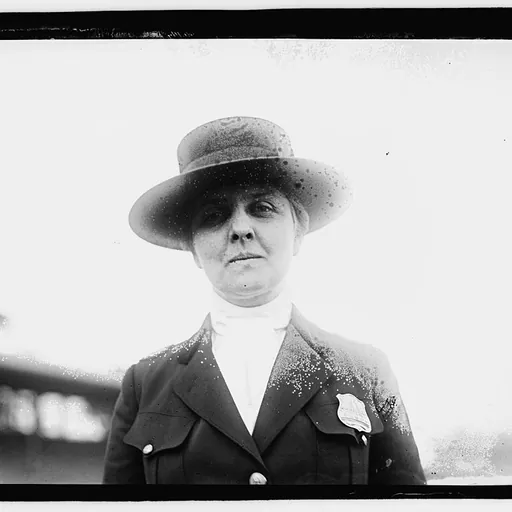
About Mina Van Winkle
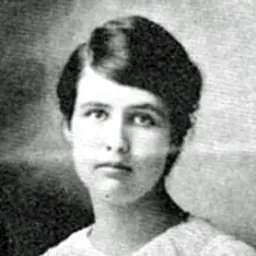
Lived 1875 – 1932 (aged 56). Mina Van Winkle was an American social worker and suffragist.
Mina Caroline Ginger Van Winkle (March 26, 1875 – January 16, 1933) was a crusading social worker, suffragist, and groundbreaking police lieutenant. From 1919 until her death in 1933, she led the Women's Bureau of the Metropolitan Police Department of the District of Columbia (in Washington D.C.), and became a national leader in the protection of girls and other women during the law enforcement and judicial process.
In 1905, while associated with the National Consumers League and the Newark Bureau of Associated Charities, she exposed the harsh conditions in which immigrant child laborers from Italy worked in New Jersey farm fields.
On October 27, 1906, she became the second wife of Abraham Van Winkle, wealthy president of a manufacturing company (and a widower 36 years her senior) who had financially supported the Bureau of Associated Charities. During their marriage, she engaged in social work on a volunteer basis. She resided in Newark, New Jersey, until approximately 1917.
Suffragist In 1908, Van Winkle organized the Equality League of Self-Supporting Women of New Jersey, which in 1912 was renamed the Women's Political Union of New Jersey. She was the head of New Jersey chapter of the Union at the stage when the American suffrage movement clashed with eastern political machines and supporters of lawful drinking fearful that suffrage would lead to prohibition. Her tenure as president of the Union included 1915's unsuccessful effort to amend New Jersey's constitution by referendum to give women the right to vote. Following that defeat, the New Jersey chapter of the Union merged into the New Jersey Woman Suffrage Association, whose officers governed the resulting organization.
Near the beginning of the presidential election year of 1916 (and several months after her husband's 1915 death), she announced that she would establish a legal residence in Kansas, which had extended to women the right to vote in presidential elections. It is unclear whether she carried through with that announcement.
As the suffrage movement was on the verge of succeeding through the passage of the Nineteenth Amendment to the U.S. Constitution, she was a speaker at the 1920 National Woman's Party convention.
U.S. Food Administration official Soon after the United States' entry into World War I, the Food and Fuel Control Act of 1917 established the United States Food Administration, with a mandate to voluntarily reduce the domestic consumption of food and produce, while increasing home production. President Woodrow Wilson appointed future president Herbert Hoover as its head, and Hoover appointed Van Winkle to organize and direct its speakers' bureau.
Police lieutenant In 1916, the Metropolitan Police Department of the District of Columbia began to hire policewomen. In the summer of 1918, Police Major and Superintendent Raymond W. Pulliam established a woman's bureau, originally directed by Marion O. Spingarn. By October of that year, Van Winkle was one of four members of the Bureau. Most of the officers in the Bureau in 1920 were trained as school teachers, nurses, or social workers, and included one lawyer. McLean later testified that his objection was that the Bureau had taken the girl from a hospital and was detaining her without charge. He denied that he had asked that anyone be fired (let alone the sister of a senator whom McLean considered a friend), but expressed his view that the Bureau was "rather a dangerous toy for a sincere woman to play with," referring to Van Winkle.
From 1919 until the time of her death, she was president and chief financial contributor of the International Association of Policewomen. Her defense against the charge was highly publicized, and served to attract further publicity to the particular role of the Women's Bureau within the Department.
Death She died on January 16, 1933.
Legacy From 1919 until the time of her death, she was president and chief financial contributor of the International Association of Policewomen.
Views Noting that almost all prostitutes suffered from venereal disease, Van Winkle described such diseases as "the penalty for prostitution", and told the House Subcommittee that prostitutes should not be jailed.
When asked in 1925 to explain the meaning of the phrase "indecent music" (which was used in a Police Department order forbidding it), she described it as "that tom-tommy sort of Oriental music that makes men forget home and babies." After initially describing the saxophone as positively immoral, she qualified her position, recognizing that "saxophone music is beautiful when played correctly, but when played by certain types of musicians it is very degrading."
In a 1928 speech, she blamed the "incompetence" of older generations for the delinquency of "flaming youth". "Our mothers were kept in a sublime state of ignorance by their parents. They were utterly incompetent to help us, or to give us an understanding of life." She described automobile rides, with their problems for the girl, hip flasks, petting and all the other "failings" of the modern girl as an unsolvable problem for mothers who were trained in the philosophy of Little Women.
In 1928, Van Winkle told a reporter that "Washington is the mecca for all psychopathic women of the nation," who come to the City "with their distorted stories about men high in our nation's life," and accuse those men of being their lovers, or husbands, or the center of some weirdly dramatic situation. She explained that, due to the vigilance of the Women's Bureau, the government officials and other well-known Washingtonians accused of serious misdemeanors often do not even know they have been involved, because policewomen intercept such women, sending some to insane asylums and others home to their husbands, fathers, or brothers.
When questioned in 1920 by Rep. Tinkham about why all members of the Women's Bureau were unmarried, Van Winkle explained that, "I really do not personally approve of having married women away from their families, and we think it would be bad for the work to have her divided attention, as our work demands our whole attention." Speaking more generally in 1928, she stated that "the average wage-earning wife is not intelligent enough to manage both home and job," and "most women who babble of careers would be better off as homemakers."
She told a journalist in 1928 that, "first of all, the policewoman must be a lady. She must be born as well as made for her job. From her background she must draw innate refinement, innate tact and a finely adjusted sense of values that can be had only from early training of the right kind."
Don’t just read it —
keep it.
Full-length biographies made to live with: read them, listen on the way to work, watch them tonight.
- E-book
- Audio
- Video
Instant download · yours to keep · every purchase keeps this site free
Important facts
People in Mina Van Winkle's life
Named in this biography and alive at the same time

Related people
Same field, nearest in time



Contemporaries
People whose lives overlapped Mina Van Winkle's

Frequently asked questions
Who was Mina Van Winkle?
American suffragist
When was Mina Van Winkle born?
Mina Van Winkle was born on 26 March 1875 in New York City.
When did Mina Van Winkle die?
Mina Van Winkle died on 16 January 1932.
What was Mina Van Winkle's occupation?
Mina Van Winkle was a social worker and suffragist.
What nationality was Mina Van Winkle?
Mina Van Winkle was American.
Sources & further reading
Cite this page
APA: Biography.guide. (2026). Mina Van Winkle. https://biography.guide/mina-van-winkle/
MLA: "Mina Van Winkle." Biography.guide, https://biography.guide/mina-van-winkle/.
Chicago: "Mina Van Winkle." Biography.guide. https://biography.guide/mina-van-winkle/.
Data last updated: 2026-09-21 · Spot an error? Report a correction.
Portrait: Wikimedia Commons · author & licence
Page generated 2026-09-27 05:00 UTC