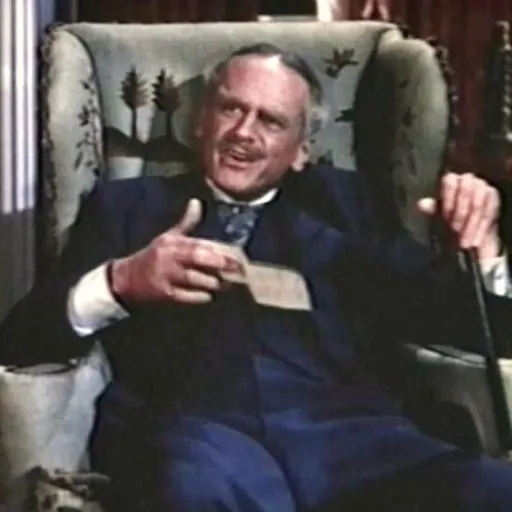
About Miles Mander
Lived 1888 – 1946 (aged 57). Miles Mander was a British actor, film director, screenwriter, film producer, playwright and farmer.
Miles Mander (born Lionel Henry Mander; 14 May 1888 – 8 February 1946), was an English character actor, writer, director and producer in the post-war period of early British cinema during the 1920s to mid-1930s, as well as a playwright and novelist.
From a privileged upper middle-class background, as a young man Mander engaged in motor sports, aviation and ballooning. In World War I he served in France with tethered kite balloons used for military observation. From 1920 to 1936 Mander was involved in the British film industry in various capacities. He acted in both silent and sound films and was involved with several film production companies. He began writing screenplays and directing in the mid-1920s, working on early sound films. Mander directed his first feature film in 1928. With the advent of sound films he established an international reputation as a character actor. After directing The Flying Doctor in Australia in 1936, Mander lived and worked in Hollywood, where he was cast in over 60 feature films until his death in 1946.
Biography
Early life
Lionel Henry Mander was born on 14 May 1888 at Wolverhampton in Staffordshire, the second son of S. Theodore Mander and Flora (née Paint). The family lived at Wightwick Manor; his father was a paint manufacturer who served as mayor of Wolverhampton, a member of the prominent Mander family, industrialists and public servants of the Midlands region. His father died in September 1900, when Lionel was aged twelve, and his mother died in April 1905.
From 1901 to early 1903 Mander was educated at Harrow School in Greater London, where he resided at The Grove boarding house. After leaving Harrow Mander was educated in Canada, where his mother had family connections. He attended the Loretto School and McGill University in Montreal. Mander had early acting experience in musical comedy, including tours in Canada and the United States. Martin Mander had emigrated to New Zealand in 1890 and established the 'Horoeka-Waimata' sheep station in the Waimata Valley, near Gisborne on the north-east coast of New Zealand's North Island. He left Australia aboard the R.M.S. India, which departed from Sydney for London in May 1909.
After returning to Britain Mander took an interest in aviation. He attended Louis Blériot's pilot training school at Pau in southern France and purchased a Blériot XI monoplane. In early 1910 Mander took flying lessons with Claude Grahame-White at the Brooklands aerodrome (adjoining the motor racing circuit). His aircraft crashed at Brooklands requiring a new wing to be fitted. In May 1910 a man named Alfred Hooper was riding his bicycle to work when a car driven by Mander "ran into him and knocked him down". Mander was living at Wolverhampton at the time. Hooper was injured to such an extent that he was absent from work for twelve weeks. In October 1910 he was awarded £60 damages in a West Bromwich court.
Mander was an entrant in the first all-British aviation meeting at Dunstall Park in Wolverhampton, held from 27 June to 2 July 1910. He was one of four novice pilots yet to receive their aviator's certificate from the Royal Aero Club, necessary for participation in the events. In the end Mander did not qualify in time and had to withdraw. On the second day of the meeting strong winds demolished Mander's temporary canvas hangar housing his monoplane.
Mander invested in Grahame-White's company that developed the Hendon Aerodrome in London.
On 21 February 1912 Mander and Prativa Sundari Devi were married at Calcutta in India. Prativa was an Indian princess of the princely state of Cooch Behar, British India, the second daughter of Maharaja Nripendra Narayan and Maharani Suniti Devi of Cooch Behar. The couple celebrated their marriage at the residence of the bride's father, dressed in Indian costume and married in the Hindu Brahmo Samaj rites. After the marriage the couple returned to England, initially living in Buckingham Gate in London. Mander later claimed that the marriage was "unhappy owing to his wife's violent temper".
Mander began free ballooning in 1912. In early 1913 Mander, in company with the aviator Claude Grahame-White, made his first ascent in a gas balloon, launched from Saint-Cloud in the western suburbs of Paris. He received his aeronaut's certificate from the Royal Aero Club in June 1913.
Mander enlisted in the British armed forces (Royal Marines) on 20 September 1914. He was promoted to sergeant soon after enlisting. He was promoted to sub-lieutenant in February 1915 in the Royal Naval Division (RND), made up of volunteers and reservists not needed for service at sea. A month later Mander was commissioned as a lieutenant in the Supply and Transport Company of the RND. In 1915 Mander was transferred to the Royal Army Service Corps. Mander served with tethered kite balloons, which were extensively used for military observation during World War I. A year or two after the war ended, Mander travelled in Albania after which he was elected as a fellow of the Royal Geographical Society. In 1925 he published Albania Today, a book based on his travels in that country.
With the motor industry in the doldrums in the immediate post-war years, at the suggestion of a friend Mander found occasional work in the British film industry, initially as an extra. In 1921 Mander appeared in two films produced by Stoll Pictures, credited under the name of Miles Mander. He played the role of 'Lieutenant Devereaux' in The Place of Honour (released in June 1921) and as 'Godfrey Norton' in A Scandal in Bohemia (released in July 1921), the seventh in a series of films based on Sir Arthur Conan Doyle's 'Sherlock Holmes' stories.
In June 1921 Mander petitioned for the dissolution of his marriage to Prativa "on the ground of her adultery with Mr. Reginald de Beer" (described as a clerk "employed in a Government office"). Mander gave evidence in the divorce court of having observed, in August 1920, Prativa and De Beer in bed together through the window of Prativa's flat in Wellington Court, Knightsbridge.
Mander was the general manager of Solar Films Ltd, a company with directors that included Adrian Brunel. Early in 1922 Solar Films took a twelve month lease of the Philharmonic Hall in order to present a series of travel film-lectures. The films were produced by "expert photographers on expeditions carried out on behalf of the company by distinguished travellers and explorers". The company planned to present the films accompanied by a lecture delivered by a traveller associated with the actual expedition. The film-lectures were not a success.
Film career
In 1922 Mander played roles in two films directed by Sinclair Hill, Half a Truth released in June 1922 and Open Country released in December 1922. In the early 1920s Mander was a member of a group described by the film producer Michael Balcon as "the Pack". The group, which included Alfred Hitchcock and Adrian Brunel, often "assembled at the Legrain coffee shop in Brewer Street, Soho, on the days we were not working (which were all too frequent)". The company's first film was The Man Without Desire, filmed in Italy and directed by Brunel, with Novello in the lead male role. Atlas Biocraft made a series of "ultra-cheap" short films during 1923 and 1924.
In 1923 Mander married for a second time. His second wife was Kathleen ('Bunty') French, of Sydney, Australia. The couple had a son named Theodore, born in 1926. In 1925 Kathleen Mander appeared alongside her husband in a short comedy film, Cut It Out: A Day in the Life of a Censor, another Atlas Biocraft production directed by Brunel, in which she was credited as 'Mrs. Miles Mander'. He was then cast as one of the male leads in The Pleasure Garden, Hitchcock's first feature film as director. The film was a collaboration between Gainsborough Pictures and the German Emelka Studios and was filmed on location in Italy and in the studio in Munich.
In late 1926 Mander joined the staff of De Forest Phonofilms, initially operating from a small studio in Clapham, and managed by the West End showman Vivian Van Damm. The company was producing short sound films called 'phonofilms', using an optical sound-on-film system developed in the early 1920s by the American inventors Lee de Forest and Theodore Case. Phonofilms, comprising mainly music hall sketches, songs and extracts from plays, began to be shown in the supporting programmes of British cinemas from October 1926.
Mander directed and acted in the first London performances of his own plays, Those Common People in 1927 and It's a Pity About Humanity in 1930. He established a reputation as a film actor "by his studies of dissipated characters, such as drunkards or dope-addicts" in such films as The Fake (1927) and The Physician (1928). The First Born was directed by Mander, his first major film as director, and he also played the lead male role as the dissolute 'Sir Hugo Boycott', alongside Madeleine Carroll as his wife. The film critic Paul Rotha wrote that The First Born "provided evidence of his wit and intelligence in filmic expression... being almost entirely the product of Mander's creative mentality". However in the copy of the film released to the public, "much of Miles Mander's original conception was destroyed" when the film was edited by the distributing firm without the director's control.
In late 1930 and 1931 Mander directed two films for British International Pictures, both of them sound films made at the company's Elstree Studios near London. The Woman Between, adapted from a play by Miles Malleson, was released in January 1931. In the film Fascination, released in July 1931, Mander once again directed Madeleine Carroll as the female lead.
In 1933 Miles and Kathleen Mander were living in Knightsbridge, with a "week-end place" in Kent. Soon afterwards, at Julius Hagen's Twickenham Studios, he directed The Morals of Marcus (released in February 1935).
In 1935 Mander travelled to the United States and lived in Hollywood for nine months, during which he acted in Here's to Romance for the Fox Film Corporation and The Three Musketeers for RKO Radio Pictures.
Soon after Mander returned to Britain from Hollywood, he was asked by the Gaumont-British Picture Corporation to undertake direction of The Flying Doctor, to be filmed in Australia. Mander arrived in Sydney aboard the Strathnaver on 12 November 1935, accompanied by Gaumont-British staff members John O. C. Orton (scenario department) and Thomas D. Connochie (production manager). They were later joined by Derek Williams, a lighting and camera expert. Another technician, Leslie Fry, was already in place at the Pagewood studios of National Studios Ltd. where the interior filming for The Flying Doctor was to take place. In late December 1935 it was announced that the Hollywood actor, Charles Farrell would play the lead in the film. Farrell arrived in Sydney on 27 January and shooting commenced on The Flying Doctor soon afterwards.
By early January 1936 Mander was driving in Sydney in a V-8 Vauxhall automobile. During his time in Sydney Mander was charged on two separate occasions with "driving at a speed dangerous to the public", on 3 February 1936 on Parramatta Road and on 10 March "in the vicinity of Bankstown, Warwick Farm and Liverpool". On the first occasion Mander had been driving the car with the female lead Mary Maguire as a passenger, returning from Leura filming location scenes for The Flying Doctor. He was convicted of the charges on 31 March 1936 and fines were imposed. The final day of shooting for the film was on 28 March. On 1 April 1936 Mander, together with Farrell and Orton, departed from Sydney for the United States aboard the Monterey.
Miles and Kathleen Mander divorced in 1936. In 1936 Mander left Britain to live in America, relocating to Hollywood. Soon after his arrival he played a role in the historical drama Lloyd's of London, released in November 1936. The film featured Madeleine Carroll in the female lead, an actress Mander had earlier directed in The First Born (1928) and Fascination (1931). During his career in Hollywood he was often given character roles playing unctuous villains, many of them of the unprincipled English upper-class type.
Filmography As actor
Testimony (1920) (film debut) The Place of Honour (1921) as 'Lt. Devereaux' A Scandal in Bohemia (1921) as 'Godfrey Norton' The Temporary Lady (short) (1921) as 'Monkton' Half a Truth (1922) as 'Marquis Sallast' Open Country (1922) as 'Hon. William Chevenix' Lovers in Araby (1924) as 'Derek Fare' The Prude's Fall (1925) as 'Sir Neville Moreton' The Pleasure Garden (1925) as 'Levett' London Love (1926) as 'Sir James Daring' Tip Toes (1927) as 'Rollo Stevens' The Fake (1927) as 'Hon. Gerald Pillick' Parisiennes (1928) as 'Armand de Marny' The Joker (1928) as 'Mr. Borwick' The Physician (1928) as 'Walter Amphiel' Balaclava (1928) as 'Captain Gardner' The First Born (1928) as 'Sir Hugo Boycott' Perjury (1929) as 'Adolf Sperber' The Crooked Billet (1929) as 'Guy Morrow' Loose Ends (1930) as 'Raymond Carteret' Murder! (1930) as 'Gordon Druce' Mary (1931) as 'Gordon Moore' The Missing Rembrandt (1932) as 'Claude Holford' Lily Christine (1932) as 'Ambatriadi' That Night in London (1932) as 'Harry Tresham' Bitter Sweet (1933) as 'Captain Auguste Lutte' Don Quixote (1933) as 'The Duke of Fallanga' Loyalties (1933) as 'Capt. Ronald Dancy, DSO' The Private Life of Henry VIII (1933) as 'Wriothesley' Matinee Idol (1933) as 'Harley Travers' The Four Masked Men (1934) as 'Rodney Fraser' The Battle (1934) as 'Feize' The Case for the Crown (1934) as 'James L. Barton' Death Drives Through (1935) as 'Garry Ames' Here's to Romance (1935) as 'Bert' The Three Musketeers (1935) as King Louis XIII The Flying Doctor (1936) as a spectator at boxing match (uncredited) Lloyd's of London (1936) as 'Jukes' Slave Ship (1937) as 'Corey' Wake Up and Live (1937) as 'James Stratton' Youth on Parole (1937) as 'Sparkler' Kidnapped (1938) as 'Ebenezer Balfour' The Mad Miss Manton (1938) as 'Mr. Fred Thomas' Suez (1938) as Benjamin Disraeli The Three Musketeers (1939) as Cardinal Richelieu The Little Princess (1939) as 'Lord Wickham' Wuthering Heights (1939) as 'Lockwood' Daredevils of the Red Circle (1939, serial) as 'Horace Granville' The Man in the Iron Mask (1939) as 'Aramis' Stanley and Livingstone (1939) as 'Sir John Gresham' Tower of London (1939) as King Henry VI The Earl of Chicago (1940) as the Attorney General (uncredited) Laddie (1940) as 'Mr. Charles Pryor' The House of the Seven Gables (1940) as 'Deacon Arnold Foster' Road to Singapore (1940) as 'Sir Malcolm Drake' (uncredited) Primrose Path (1940) as 'Homer Adams' Babies for Sale (1940) as 'Dr. Wallace Rankin' Captain Caution (1940) as 'Lt. Strope' South of Suez (1940) as 'Roger Smythe' Free and Easy (1941) as a solicitor (uncredited) Shadows on the Stairs (1941) as 'Tom Armitage' That Hamilton Woman (1941) as 'Lord Keith' They Met in Bombay (1941) as a doctor (uncredited) Dr. Kildare's Wedding Day (1941) as 'Dr. John F. Lockberg' Fly-By-Night (1942) as 'Prof. Langner' A Tragedy at Midnight (1942) as 'Dr Hilary Wilton' Captains of the Clouds (1942) as Winston Churchill (voice) (uncredited) To Be or Not to Be (1942) as 'Major Cunningham' Fingers at the Window (1942) as 'Dr. Kurt Immelman' This Above All (1942) as 'Major' Tarzan's New York Adventure (1942) as 'Portmaster' Mrs. Miniver (1942) as a German agent on the radio (voice) (uncredited) Somewhere I'll Find You (1942) as 'Floyd Kirsten' (uncredited) The War Against Mrs. Hadley (1942) as 'Doctor Leonard V. Meecham' Apache Trail (1942) as 'James V. Thorne' Lucky Jordan (1942) as 'Kilpatrick' Journey for Margaret (1942) in a minor role (uncredited) Secrets of the Underground (1942) as 'Paul Panois' Assignment in Brittany (1943) as 'Col. Herman Fournier' Five Graves to Cairo (1943) as 'Col. Fitzhume' (uncredited) First Comes Courage (1943) as 'Col. Wallace' (uncredited) Phantom of the Opera (1943) as 'Maurice Pleyel' Guadalcanal Diary (1943) as 'Weatherby' (uncredited) The Return of the Vampire (1943) as 'Sir Frederick Fleet' Madame Curie (1943) as a businessman (uncredited) Four Jills in a Jeep (1944) as 'Col. Hartley' (uncredited) The Story of Dr. Wassell (1944) as a man (uncredited) The White Cliffs of Dover (1944) as 'Major Loring' at hospital (uncredited) The Scarlet Claw (1944) as 'Judge Brisson' The Pearl of Death (1944) as 'Giles Conover' Enter Arsene Lupin (1944) as 'Charles Seagrave' Murder, My Sweet (1944) as 'Mr. Leuwen Grayle' The Picture of Dorian Gray (1945) as 'Sir Robert Bentley' The Brighton Strangler (1945) as 'Chief Inspector W.R. Allison' Crime Doctor's Warning (1945) as 'Frederick Malone' Week-End at the Waldorf (1945) as the British Secretary Confidential Agent (1945) as 'Mr. Brigstock' The Bandit of Sherwood Forest (1946) as 'Lord Warrick' The Walls Came Tumbling Down (1946) as 'Dr. Marko' (released posthumously) The Imperfect Lady (1947) as 'Mr. Rogan' (final film, released posthumously)
As director
The Whistler (1926) short made by DeForest Phonofilm The Sheik of Araby (1926) short made by DeForest Phonofilm Knee Deep in Daisies (1926) short made by DeForest Phonofilm The Fair Maid of Perth (1926) short made by DeForest Phonofilm False Colours (1927) short made by DeForest Phonofilm The Sentence of Death (1927), short made by DeForest Phonofilm Packing Up (1927) short made by DeForest Phonofilm As We Lie (1927) short film made by DeForest Phonofilm The First Born (1928) The Woman Between (1931) Fascination (1931) Youthful Folly (1934) The Morals of Marcus (1935) The Flying Doctor (1936)
As writer
Lovers in Araby (1924) As We Lie (1927) (story) The First Born (1928) The Woman Between (1931) L'Atlantide (1932) directed by G. W. Pabst The Lodger (1932) The Morals of Marcus (1935) The Flying Doctor (1936)
As producer
The Man Without Desire (1923) The Shimmy Sheik (short) (1923) Two-chinned Chow (short) (1923) Yes, We Have No - ! (animated short) (1923) Crossing the Great Sagrada (short) (1924) Unnatural Life Studies (short) (1924) The Pathetic Gazette (short) (1924) Adam's Film Review (short) (1924) Lovers in Araby (1924) The First Born (1928) The Flying Doctor (1936) Watchtower Over Tomorrow (1945) (uncredited)
Publications
Lionel H. Mander (1925), Albania Today. She was educated at Worthing in West Sussex, England.
D.
Don’t just read it —
keep it.
Full-length biographies made to live with: read them, listen on the way to work, watch them tonight.
- E-book
- Audio
- Video
Instant download · yours to keep · every purchase keeps this site free
Important facts
People in Miles Mander's life
Named in this biography and alive at the same time






Related people
Same field, nearest in time

Contemporaries
People whose lives overlapped Miles Mander's




Frequently asked questions
Who was Miles Mander?
English actor (1888–1946)
When was Miles Mander born?
Miles Mander was born on 14 May 1888 in Wolverhampton.
When did Miles Mander die?
Miles Mander died on 8 February 1946 in Hollywood.
What was Miles Mander's occupation?
Miles Mander was an actor, film director, screenwriter, film producer, playwright and farmer.
What nationality was Miles Mander?
Miles Mander was British.
Sources & further reading
Cite this page
APA: Biography.guide. (2026). Miles Mander. https://biography.guide/miles-mander/
MLA: "Miles Mander." Biography.guide, https://biography.guide/miles-mander/.
Chicago: "Miles Mander." Biography.guide. https://biography.guide/miles-mander/.
Data last updated: 2026-09-24 · Spot an error? Report a correction.
Portrait: Wikimedia Commons · author & licence
Page generated 2026-09-27 05:08 UTC