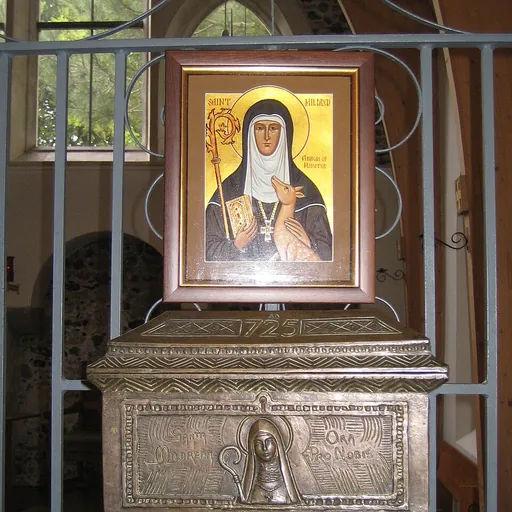
About Mildthryth
Lived 700 – 734. Mildthryth was a nun.
Saint Mildrith, also Mildthryth, Mildryth and Mildred, (born c. 660, died after 732), was a 7th- and 8th-century Anglo-Saxon abbess of the Abbey at Minster-in-Thanet, Kent. She was declared a saint after her death, and, in 1030, her remains were moved to Canterbury.
Life and family Mildrith was the daughter of King Merewalh of Magonsaete, an area similar to the present day Herefordshire, a sub-kingdom of Mercia. Her mother was Domne Eafe (also sometimes named as Saint Eormenburga), herself a great-granddaughter of Æthelberht of Kent, and as such appearing in the so-called Kentish Royal Legend.
Her sisters Milburga of Much Wenlock and Mildgyth were also considered saints, and Mildrith, along with her extended family, features in the Kentish Royal Legend, also known as the "Mildrith Legend". In the 11th century, Goscelin wrote a hagiography of Mildrith, the Vita Mildrethae. Another work, the Nova Legenda Anglie of 1516, gives an extensive account of her life.
Mildrith's maternal family had close ties to the Merovingian rulers of Gaul, and Mildrith is said to have been educated at the prestigious Merovingian royal abbey of Chelles.
The last abbess of Minster in Thanet was Leofruna, who was captured by Danes in 1011. The abbey was abandoned and the church downgraded to a parish church. Mildrith's remains, despite fierce local opposition, were translated to St Augustine's Abbey, Canterbury in 1030,
Some of her relics were given, in the 11th century, to a church at Deventer, Netherlands. In 1881 the feast day of St Mildred was officially reinstated by Pope Leo XIII. In 1882, following a refounding of a Benedictine monastery at Minster in Thanet, the nuns petitioned the Archbishop of Utrecht, who granted their return to Thanet. It became a private house until 1937, when it was purchased by Benedictine nuns from St Walburga's Abbey in Eichstätt, Bavaria, as a refuge from persecution and became a dependent priory. In 1953, a relic of St Mildred was brought there.
Don’t just read it —
keep it.
Full-length biographies made to live with: read them, listen on the way to work, watch them tonight.
- E-book
- Audio
- Video
Instant download · yours to keep · every purchase keeps this site free
Important facts
Related people
Same field, nearest in time



Contemporaries
People whose lives overlapped Mildthryth's



Frequently asked questions
Who was Mildthryth?
Anglo-Saxon Abbess
When was Mildthryth born?
Mildthryth was born in 700.
When did Mildthryth die?
Mildthryth died on 13 July 734 in Minster.
What was Mildthryth's occupation?
Mildthryth was a nun.
What nationality was Mildthryth?
Mildthryth's recorded nationality: Kingdom of Kent, Kingdom of Mercia.
Sources & further reading
Cite this page
APA: Biography.guide. (2026). Mildthryth. https://biography.guide/mildthryth/
MLA: "Mildthryth." Biography.guide, https://biography.guide/mildthryth/.
Chicago: "Mildthryth." Biography.guide. https://biography.guide/mildthryth/.
Data last updated: 2026-09-23 · Spot an error? Report a correction.
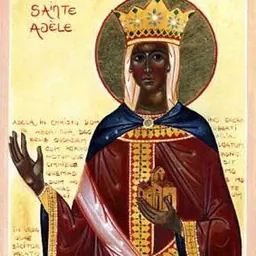
Portrait: Wikimedia Commons · author & licence
Page generated 2026-09-27 05:05 UTC