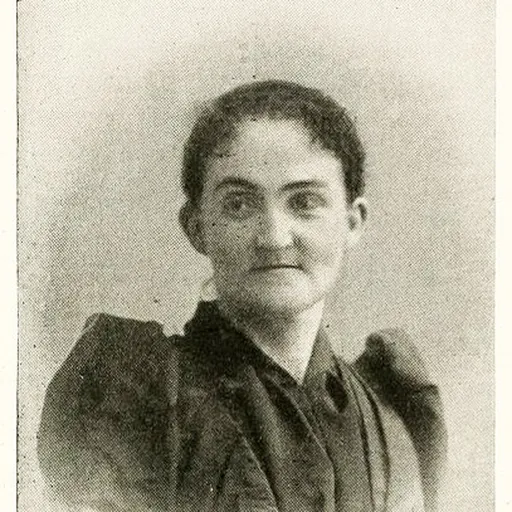
About Mildred Lewis Rutherford
Lived 1851 – 1928 (aged 77). Mildred Lewis Rutherford was an American historian, teacher and writer.
Mildred Lewis Rutherford (July 16, 1851 – August 15, 1928) was a prominent white supremacist speaker, educator, and author from Athens, Georgia. She served in the Lucy Cobb Institute, as its head and in other capacities, for over forty years, and oversaw the addition of the Seney-Stovall Chapel to the school. Heavily involved in many organizations, she became the historian general of the United Daughters of the Confederacy (UDC), and a speech given by her for the UDC was the first by a woman to be recorded in the Congressional Record. She was a prolific writer in historical subjects and an advocate of the Lost Cause narrative. Rutherford was distinctive in dressing as a southern belle for her speeches. She held strong pro-Confederacy, proslavery views and opposed women's suffrage.
Biography
Family background Mildred Rutherford was born July 16, 1851, in Athens, Georgia; she was the daughter of Laura Cobb Rutherford (Howell and Thomas's sister) and Williams Rutherford, a professor of mathematics at the University of Georgia. Mildred Rutherford was the granddaughter of John Addison Cobb, whose involvement in agriculture (he owned a plantation with 209 slaves by 1840), the Georgia Railroad, and real estate made him "one of the area's wealthiest men". in 1868.
Educator
After teaching in Atlanta for eight years, and lived in a house directly across the street until it burned c. 1926, continuing to serve the school in various capacities for over forty years According to Sarah Case,
She decided the students needed a chapel and had them write seeking funding for one. In 1881, Nellie Stovall wrote "a beautiful and girlish letter" to George I. Seney, who responded with $10,000 in funding (and a challenge to the town for an additional $4,000) for the structure, an octagonal red brick building called the Seney–Stovall Chapel.
Case further describes Lucy Cobb under Rutherford's direction:
Orator and historian Rutherford was an accomplished public speakershe ofttimes dressed as a southern belle when oratingwho addressed a great number of local organizations, including the YMCA, the Ladies Memorial Association (for which she served as president), and the Athens chapter of the United Daughters of the Confederacy (UDC), and in November 1912 addressed the national assembly of the UDC as their historian general.
She "became perhaps the best-known amateur historian in the early twentieth century for her extensive writings and speeches, her historical journal, published from 1923 to 1927, and her promotion of historical work among the UDC as that organization's Historian General from 1911 to 1916". She gave "the first speech by a woman to be printed in the Congressional Record" in 1916 at a UDC convention.
Death and legacy In 1927 Rutherford became seriously ill. Late on Christmas night, as she convalesced, her house suffered a devastating fire, consuming many of her personal papers and belongings, including "most of her private collection of Confederate artifacts". She died on August 15, 1928, and was interred in Oconee Hill Cemetery, in East Hill, one of the two original sections of the cemetery. Her great niece Mildred Seydell was named in her honor and became a well-known journalist, one of the first in Georgia, and a nationally syndicated columnist.
Rutherford has a student dormitory named after her at the University of Georgia.
Views
Rutherford was Baptist with a strong faith She lauded the works of Southern writers and female writers. and she defended American slavery, thinking its only problem was the burden it put upon the white slaveholders. Specifically she fought to indoctrinate future generations by eliminating any books which did not support her views, writing to all schools and librarians, "Reject any book that says the South fought to hold her slaves". She was willing to alter the historical record to make her point—in a speech in Dallas in 1916 she claimed that "the negroes in the South were never called slaves. That term came in with the abolition crusade." Historian David W. Blight stated that she sought the vindication of the Confederacy "with a political fervor that would rival the ministry of propaganda in any twentieth-century dictatorship".
In 1914, she joined the Georgia Association Opposed to Woman Suffrage and became a "vocal opponent" of women's suffrage and the Nineteenth Amendment to the United States Constitution, which was ratified on August 18, 1920. She viewed suffrage as "not a step toward equality, but rather a way of robbing women of the only power they truly heldthat of feminine influence and persuasion within their families. Rutherford never reconciled this view with the fact that she herself was one of Georgia's most publicly active and well-known women of her time". Her opposition was "formidable": Dolly Blount Lamar and Rutherford headed the organization, and in 1919 this "conservative state" became the nation's first to reject the amendment. Case asserts that while "Rutherford reserved her strongest resistance for the suffrage amendment," she "opposed all constitutional amendments, including prohibition, despite her anti-alcohol sentiments, on the basis of limiting federal power".
Selected writings Mildred Lewis Rutherford wrote 29 historically significant books and pamphlets, many printed at her own expense. They were widely read. Among them are:
at Internet Archive.
Don’t just read it —
keep it.
Full-length biographies made to live with: read them, listen on the way to work, watch them tonight.
- E-book
- Audio
- Video
Instant download · yours to keep · every purchase keeps this site free
Important facts
People in Mildred Lewis Rutherford's life
Named in this biography and alive at the same time



Related people
Same field, nearest in time


Contemporaries
People whose lives overlapped Mildred Lewis Rutherford's


Frequently asked questions
Who was Mildred Lewis Rutherford?
educator, author, historian general of the United Daughters of the Confederacy (1851-1928)
When was Mildred Lewis Rutherford born?
Mildred Lewis Rutherford was born on 16 July 1851 in Athens.
When did Mildred Lewis Rutherford die?
Mildred Lewis Rutherford died on 15 August 1928.
What was Mildred Lewis Rutherford's occupation?
Mildred Lewis Rutherford was a historian, teacher and writer.
What nationality was Mildred Lewis Rutherford?
Mildred Lewis Rutherford was American.
Sources & further reading
· Wikipedia: Mildred Lewis Rutherford
· DBpedia: Mildred Lewis Rutherford
Cite this page
APA: Biography.guide. (2026). Mildred Lewis Rutherford. https://biography.guide/mildred-lewis-rutherford/
MLA: "Mildred Lewis Rutherford." Biography.guide, https://biography.guide/mildred-lewis-rutherford/.
Chicago: "Mildred Lewis Rutherford." Biography.guide. https://biography.guide/mildred-lewis-rutherford/.
Data last updated: 2026-09-22 · Spot an error? Report a correction.
Portrait: Wikimedia Commons · author & licence
Page generated 2026-09-27 05:02 UTC