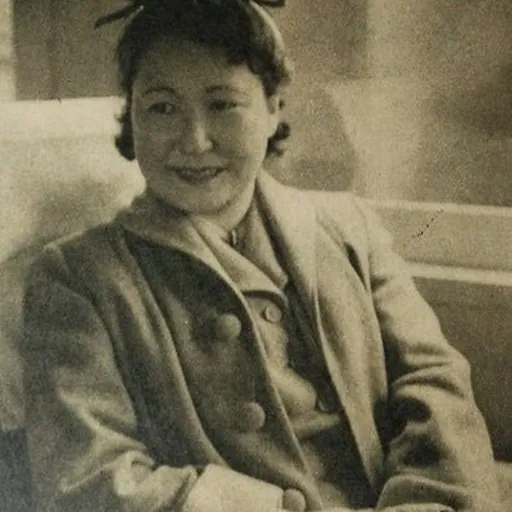
About Miki Sawada
Lived 1901 – 1980 (aged 78). Miki Sawada was a Japanese social worker and writer.
was a Japanese social worker popularly known as the "mother of 2,000" American Japanese mixed orphans.
Early life She was born in Tokyo, Japan on 19 September 1901. She was the oldest daughter of Baron Hisaya Iwasaki, who was known as the richest man in Japan. She was thus the granddaughter of Iwasaki Yataro, the founder of the Mitsubishi Zaibatsu conglomerate. As a child, she attended private girls' schools in Ochanomizu until she was 15. After that she was taught by Umeko Tsuda, her private tutor.
In 1922, she married Japanese diplomat Renzo Sawada, who represented Japan as a diplomat and United Nations ambassador. He was a Christian, and she converted to Christianity upon her marriage to him. They had four children.
Elizabeth Saunders Home
Renzo's diplomatic work took them to Buenos Aires, Beijing, London, Paris, and New York City. During her life outside Japan as the wife of a diplomat, she met and befriended many people who later helped her found the Elizabeth Saunders Home, such as Josephine Baker. While living in London, she visited an orphanage operated by Thomas John Barnardo called Dr. Barnardo's Home, which later inspired her to start her own.
After World War II, Sawada took many mixed-race children, or konketsuji, into her house. In 1948, she sold all of her possessions and used the money to found the Elizabeth Saunders Home in Oiso, Kanagawa, Japan. It was named after the British governess whose charitable bequest, made through the Anglican Church in Japan, was the first donation Sawada received to fund the home. In 1950, the Kanagawa Prefectural Government recognized the home as a public child welfare institution, which Sawada claimed eased her financial burden significantly.
Contemporary historians, particularly Kristin Roebuck, have complicated the narrative surrounding Sawada's treatment of mixed-race orphans, claiming that her humanitarian belief in adoption might have been compromised by a belief that konketsuji had to be segregated from Japanese society. Sawada's 1953 book Konketsuji no Haha contains an anecdote in which a grandmother gives up a konketsuji child for adoption without her daughter's consent; when the daughter comes to reclaim it, Sawada refuses to give it up and tells her to "learn shame." A "no visitation" policy was instituted at the home by 1952. In her annual trips to the United States, Sawada gave speeches implying that the impermeability of American immigration for konketsuji might create "a situation the Communists easily turn into propaganda."
Sawada was awarded the Order of the Sacred Treasure, second class on 29 April 1972.
She died of a heart attack in Mallorca on 12 May 1980.
Don’t just read it —
keep it.
Full-length biographies made to live with: read them, listen on the way to work, watch them tonight.
- E-book
- Audio
- Video
Instant download · yours to keep · every purchase keeps this site free
Important facts
People in Miki Sawada's life
Named in this biography and alive at the same time




Related people
Same field, nearest in time



Contemporaries
People whose lives overlapped Miki Sawada's



Frequently asked questions
Who was Miki Sawada?
Japanese social worker
When was Miki Sawada born?
Miki Sawada was born on 19 September 1901 in Hongō-ku.
When did Miki Sawada die?
Miki Sawada died on 12 May 1980 in Palma.
What was Miki Sawada's occupation?
Miki Sawada was a social worker and writer.
What nationality was Miki Sawada?
Miki Sawada was Japanese.
Sources & further reading
Cite this page
APA: Biography.guide. (2026). Miki Sawada. https://biography.guide/miki-sawada/
MLA: "Miki Sawada." Biography.guide, https://biography.guide/miki-sawada/.
Chicago: "Miki Sawada." Biography.guide. https://biography.guide/miki-sawada/.
Data last updated: 2026-09-22 · Spot an error? Report a correction.
Portrait: Wikimedia Commons · author & licence
Page generated 2026-09-27 04:57 UTC