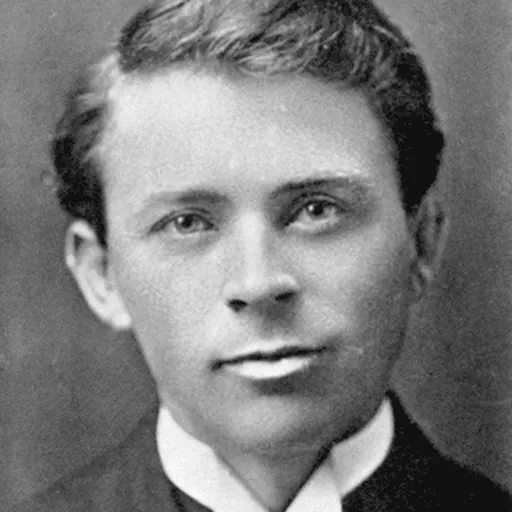
Mike Donahue
American college football coach, college basketball coach, college baseball coach, college athletics administrator
About Mike Donahue
Lived 1876 – 1960 (aged 84). Mike Donahue was an American basketball coach and american football player.
Michael Joseph "Iron Mike" Donahue (June 14, 1876 – December 11, 1960) was an Irish-American football player, coach of football, basketball, baseball, tennis, track, soccer, and golf, and a college athletics administrator. He served as the head football coach at Auburn University (1904–1906, 1908–1922), at Louisiana State University (1923–1927), and at Spring Hill College.
In 18 seasons coaching football at Auburn, Donahue amassed a record of 106–35–5 and had three squads go undefeated with four more suffering only one loss. His .743 career winning percentage is the second highest in Auburn history, surpassing notable coaches such as John Heisman and Ralph "Shug" Jordan. Donahue Drive in Auburn, Alabama, on which Jordan–Hare Stadium is located and the Tiger Walk takes place, is named in his honor, as is Mike Donahue Drive on the LSU campus.
Donahue also coached basketball (1905–1921), baseball, track, and soccer (1912–?) at Auburn and baseball (1925–1926) and tennis (1946–1947) at LSU. He was inducted as a coach into the College Football Hall of Fame as part of its inaugural class in 1951.
Early life Donahue was born in County Kerry, Ireland and attended Yale University. Donahue played as a substitute quarterback on the football team, and was twice captain of the scrub team. He graduated in 1903. Donahue stood just 5'4" tall, with red hair and blue eyes.
Coaching career Auburn Upon graduating college, Donahue became the tenth head coach of the Auburn Tigers football team beginning in 1904, the same year Vanderbilt hired Dan McGugin. Former Auburn head coach Billy Watkins led the effort to acquire Donahue. Contrasting with McGugin, Fuzzy Woodruff wrote that Donahue was "a mouse-like little man with little to say, save when aroused, on which he was capable of utterances of great fire and fervor." His teams were led by his 7–2–2 defense.
His coaching career saw immediate success, as his first team went undefeated at 5–0 including a defeat of rival Alabama which was the purpose for his hiring. Donahue's Auburn teams won six Southern Intercollegiate Athletic Association titles, in 1904, 1908, 1910, 1913, 1914 and 1919.
Donahue's 1913 and 1914 teams went undefeated, with the 1914 squad allowing zero points to be scored all year, and have been recognized as national champions by various, retroactive selectors including Billingsley Report and the Howell Ratings. From 1913 into 1915, Auburn went 22 consecutive games without a loss. One source on the 1913 team reads "Coach Donahue loved the fullback dive and would run the play over and over again before sending the elusive Newell wide on a sweep."
Donahue's 1920 team averaged a then-school record 36.9 points per game. His last team was considered one of the best teams Auburn turned out in the first half of the 20th century.
His .743 career winning percentage is the second highest in Auburn history, surpassing notable coaches including John Heisman, Ralph "Shug" Jordan, Pat Dye, Terry Bowden, and Tommy Tuberville.
Donahue also served as athletic director, basketball coach, baseball coach, track coach, and soccer coach while at Auburn. In 1905, he initiated the school's first official varsity basketball team, which went 3–1–1, including victories over Georgia Tech and Tulane, a two-point loss to the Columbus (Georgia) All-Stars, and a tie with the Birmingham Athletic Club. Under Donahue, basketball practice was a contact sport; a former player once lamented, "He never bothered calling fouls--said it slowed up the game."
In 1912, Donahue coached Auburn's first soccer team.
Donahue resigned in December 1922, citing threats from the Ku Klux Klan, who did not want a Roman Catholic as the college's athletic director.
LSU Donahue went on to become the seventeenth head football coach at LSU in 1923 and had a 23–19–3 record over five seasons. The 1924 team beat Indiana. The 1927 team tied Wallace Wade's Alabama Crimson Tide. He signed a six-year extension as football coach and athletic director after the 1927 season, but retired from coaching two months later.
He also served briefly as the head coach of the LSU Tigers baseball team (1925–1926), compiling a record of 15–15–3, and as the head men's tennis coach at LSU (1946–1947), tallying a mark of 0–7. In 1944 and 1945, Donahue served as the head coach of the LSU Tigers golf team.
Spring Hill Donahue served as the athletic director at Spring Hill College from 1929 to 1936. In 1934, Donahue reentered the active coaching ranks, when he was hired as head coach and mentored his son, Mike, Jr.
Death and legacy Donahue died on December 11, 1960, in Baton Rouge, Louisiana.
Head coaching record Football
Basketball
Baseball
Don’t just read it —
keep it.
Full-length biographies made to live with: read them, listen on the way to work, watch them tonight.
- E-book
- Audio
- Video
Instant download · yours to keep · every purchase keeps this site free
Important facts
People in Mike Donahue's life
Named in this biography and alive at the same time






Related people
Same field, nearest in time


Contemporaries
People whose lives overlapped Mike Donahue's
Frequently asked questions
Who was Mike Donahue?
American college football coach, college basketball coach, college baseball coach, college athletics administrator (1876-1960)
When was Mike Donahue born?
Mike Donahue was born on 14 June 1876 in County Kerry.
When did Mike Donahue die?
Mike Donahue died on 11 December 1960 in Baton Rouge.
What was Mike Donahue's occupation?
Mike Donahue was a basketball coach and american football player.
What nationality was Mike Donahue?
Mike Donahue was American.
Sources & further reading
Cite this page
APA: Biography.guide. (2026). Mike Donahue. https://biography.guide/mike-donahue/
MLA: "Mike Donahue." Biography.guide, https://biography.guide/mike-donahue/.
Chicago: "Mike Donahue." Biography.guide. https://biography.guide/mike-donahue/.
Data last updated: 2026-09-23 · Spot an error? Report a correction.
Portrait: Wikimedia Commons · author & licence
Page generated 2026-09-27 05:05 UTC