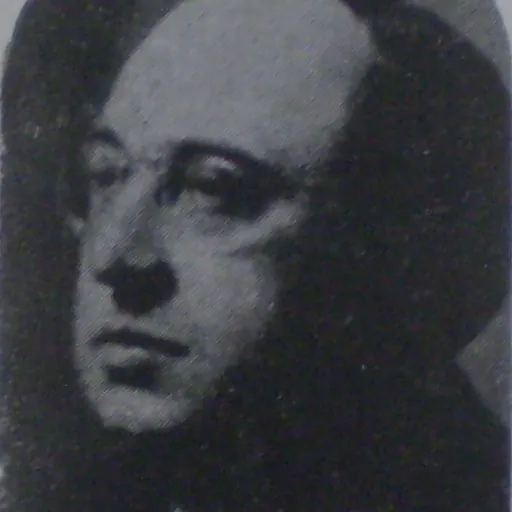
About Miguel Ángel Virasoro
Lived 1900 – 1966 (aged 66). Miguel Ángel Virasoro was an Argentine translator, philosopher and philosophy.
Miguel Ángel Virasoro (1900–1966) was an Argentine philosopher.
Life Born in Santa Fe, Argentina, in 1900, Virasoro graduated with a law degree from the University of La Plata.
In 1947 he took over the direction of the magazine Logos | Report which resulted in the same year which still remains the best version of Being and Nothingness Sartre into Castilian. In 1949, Virasoro participated in the first National Congress of Philosophy held in Mendoza with a presentation dialectical existentialism. In 1952 he was appointed vice dean of the Faculty of Philosophy and also takes over the leadership of the Department of Philosophy. In 1954 he took over the Argentine Institute of Thought. In 1955 he was expelled for political reasons since 1960 began teaching at several universities in the interior, especially the de Cuyo, in an intense and fruitful activity until his death in 1966. His work earned lofty concepts both at home and abroad, of Benedetto Croce, Alejandro Korn, among others.
He had a son of the same name, who would become a prominent theoretical physicist and whose work contributed to the development of string theory.
Philosophical work Like many men from his generation came to philosophy through the paths of the academy but for a personal tour of self, an impulse that internal vocation personally selected readings tone of the spiritual atmosphere of the time . He belonged to the generation of 1925, not only by chronology, but also by the philosophical orientation which shaped his thinking at a time with all the enthusiasm and fervor of his youth were part of this age group Astrada, Fatone, Vasallo, Lugones, Borges and others reacted against the positivist and pragmatic features that printed in politics and culture of Argentina. Virasoro himself defined his generation as one that "For the first time in our history is outlined with sufficient spiritual inner life as to feel determined to an ideal of disinterested culture ...".These first works that addressed the issue of culture is a valuable contribution to the study of our modern American consciousness "in the words of Guglielmini, editor of the Early and prologue of his first book A Theory of Self and Culture (1928) that worth the National Prize of Culture and opens the doors of a university professorship. Since then begins to serve as professor in the chair of modern and contemporary philosophy of the UBA.
The thought of Virasoro enrolled in the current existentialist revolves around the existential problem in a form of arming go through an intermittent dialogue with Hegel, Heidegger, Nietzsche and often with Eastern philosophy. An armed thinking in dialogue, which is a welcome and a synthesis-oriented reject Hegel, Heidegger notoriously Nietzschean inspiration, whose expression is what he calls "dialectic al existentialism. (Existentialism dialectical, 1958) dialectical Existentialism is a correction of Hegel, the slogan deslogizar because the dialectic is based on the existence whose principle is freedom.
In Hegel's Logic (1932), argues that the Hegelian dialectic prefix a field of possibilities that makes the spirit where mechanized activity becoming, rather than an open possibility, diluted as a closed circle of eternal return, and excludes any desire to affair and conquering one's virtue is philosophical. Against this stands the active nature of the spirit that is always right and will, vital impulse of life but does not deny the claims, but does not repress the instincts that leads to full empowerment. But unlike Nietzsche who agrees with this reassessment of the vital forces, proposed ranking them according to their greater or lesser contribution to the implementation of the spirit and therefore the reverse, "he says of what is happening in contemporary society. This understanding of the dialectical method allows you to recover the right of difference that can not be reduced to the formalism of the synthesis of opposites. While on the ground the outline of competitions, you can not capture the richness of difference.This requires that thought out of itself, requires the intuition that takes the concept of the static tautological. (The metaphysical intuition, 1965) From this perspective the dialectic of opposites becomes existential dialectic, then march toward the concrete, the existence, in which the overcoming of opposites is impossible. In this area, the contradictions are insoluble when overcome in Hegel appears as reconciliation of opposites guaranteed by the necessary evolution, is given here as hiatus, the qualitative leap forward is the land of paradox where opposites coexist, land and carved by Kierkegaard. (Freedom, existence and being, 1942) Thus anchor their thinking in Heidegger for whom consciousness is not something theoretical but emotional. "temple of spirit", "pre-understanding" original predisposition to anxiety, which is not form but content and not of conscience but of existence. But here again Virasoro corrected: the original is not anxiety born of the awareness of finitude, that which in Sartre and Kierkegaard is expressed as limited awareness of this in every election. Anxiety is just another aspect of the deeper phenomenon that contains: the thirst for being, "anxiety", force or impulse that is being itself as an abstract possibility. A conception of being as opposed substance as the impetus, a pure will to be where he does not play any type of need. Freedom, but freedom to be held in permanent tension and implies a sense of being as pure possibility that is actualized in the form of a quota want individual and limited, as the abstract universal being as impotent and needs the body to perform. Major works
Don’t just read it —
keep it.
Full-length biographies made to live with: read them, listen on the way to work, watch them tonight.
- E-book
- Audio
- Video
Instant download · yours to keep · every purchase keeps this site free
Important facts
People in Miguel Ángel Virasoro's life
Named in this biography and alive at the same time

Related people
Same field, nearest in time



Contemporaries
People whose lives overlapped Miguel Ángel Virasoro's



Frequently asked questions
Who was Miguel Ángel Virasoro?
Argentine philosopher
When was Miguel Ángel Virasoro born?
Miguel Ángel Virasoro was born on 9 April 1900 in Santa Fe.
When did Miguel Ángel Virasoro die?
Miguel Ángel Virasoro died on 29 June 1966 in Buenos Aires.
What was Miguel Ángel Virasoro's occupation?
Miguel Ángel Virasoro was a translator, philosopher and philosophy.
What nationality was Miguel Ángel Virasoro?
Miguel Ángel Virasoro was Argentine.
Sources & further reading
· Wikipedia: Miguel Ángel Virasoro
· DBpedia: Miguel Ángel Virasoro (philosopher)
Cite this page
APA: Biography.guide. (2026). Miguel Ángel Virasoro. https://biography.guide/miguel-angel-virasoro-translator/
MLA: "Miguel Ángel Virasoro." Biography.guide, https://biography.guide/miguel-angel-virasoro-translator/.
Chicago: "Miguel Ángel Virasoro." Biography.guide. https://biography.guide/miguel-angel-virasoro-translator/.
Data last updated: 2026-09-23 · Spot an error? Report a correction.
Portrait: Wikimedia Commons · author & licence
Page generated 2026-09-27 05:06 UTC