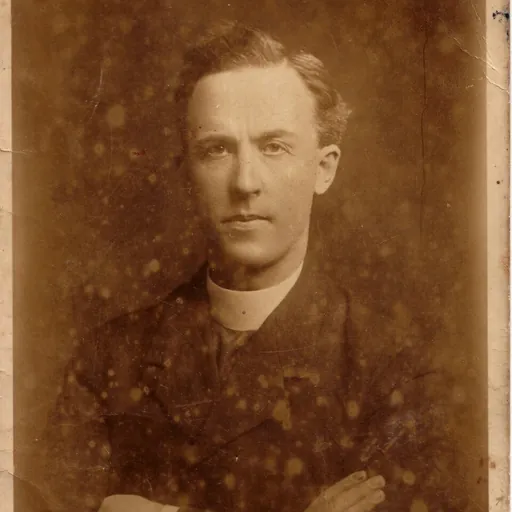
About Michael O'Flanagan
Lived 1876 – 1942 (aged 65). Michael O'Flanagan was a British and Irish historian and catholic priest.
Michael O'Flanagan (; 13 August 1876 – 7 August 1942) was a Roman Catholic priest, Irish language scholar, inventor and historian. He was a popular, socialist Irish republican; "a vice-president of the Irish Agricultural Organisation Society, he was a proponent of land redistribution." He was Gaelic League envoy to the United States from 1910 to 1912, and he supported the striking dockers in Sligo in 1913. While conditions were not as severe as thirty years earlier, there was great fear among the people who had survived the earlier starvation, expressed in a wave of religious fervour, as for example, the apparitions at Knock in 1879. The Flanagan family were staunch supporters of the Fenian movement. As a young man Michael lived through the evictions, boycotts and shootings of the Land War. His parents were members of the Land League, and he was fascinated by politics, avidly following the rise and fall of Charles Stewart Parnell. O'Flanagan attended the local national school at Cloonboniffe, known as the Don School,
O'Flanagan was ordained a priest of the Third Order of St. Francis for the Diocese of Elphin in Sligo Cathedral on 15 August 1900 at the age of 24.
His mission was to promote Irish industry, in particular the lace industry, and to find investment and collect donations for agricultural and industrial projects in the west of Ireland. The diocese of Elphin had purchased the Dillon estate at Loughglynn in County Roscommon and had established a dairy industry there, managed by nuns of the Franciscan Missionaries of Mary. Part of O'Flanagan's mission was to pay off the outstanding debt on the venture. O'Flanagan's radical influence and energy would help transform and reorganise the party after the Election of the Snows in 1917. O'Flanagan and MacColum arrived on 1 October 1910 and set up an office at 624 Madison Avenue in New York. Problems arose with American funders over the alleged association with the staging of John Millington Synge's controversial play "Playboy of the Western World". John Devoy threatened to withdraw his support from the Gaelic League, if this was the kind of Irish culture American money was supporting. O'Flanagan, after consultation with Hyde in Dublin, issued a statement in the New York Times on 4 December 1911 disassociating the work of the Gaelic League from anything to do with William Butler Yeats, Lady Gregory or the Abbey players.
Return to Ireland O'Flanagan returned to Ireland where Bishop Clancy appointed him curate in Roscommon in 1912. On 19 October Bishop Clancy died, and his successor, Bernard Coyne was a conservative who seems to have resented O'Flanagan's perceived modernism and independence, and their relationship was to be a poor one.
In March 1913 a protracted strike broke out at the Sligo Docks. In May O'Flanagan visited the strikers to show his solidarity and advised them to continue insisting for their rights.
O'Flanagan was active in attempting to reorganise and popularise the Sinn Féin party. On 22 February 1914 while staying in Crossna, he wrote a letter to Count Plunkett, then head of the National Museum in Dublin, hoping to encourage the Count to join Sinn Féin:I enclose my rough outline of plan of organisation. It will need a good deal of criticism in regard to detail. My object was to get money in as quickly as possible so that we might get on with the work to hand. You would need somebody who has made a study of organisation methods to consider it carefully before adoption. I think myself that the Sinn Féin organisation will now spread through the country if vigorously pressed from headquarters. Get the Sinn Féin Executive to send out copies of the rules to the principal men amongst the local committees of North Roscommon. If Sinn Féin spreads rapidly the Irish Alliance will not be needed. However, there is no time to lose. In 1914 O'Flanagan was invited back to Rome to give a series of Lenten lectures, and he spent six weeks, again preaching in San Silvestro's. At the end of his course of lectures he received a medal from the pope, Benedict XV.
While living in Cliffoney he actively campaigned against recruitment in the British army. His sermons were noted down by the RIC from the barracks next to the church who often occupied the front pew with notebooks to hand. O'Flanagan was actively opposed to the conscription of young Irishmen into the British army.
The Cloonerco Bog Fight While living in Cliffoney, O'Flanagan discovered that the villagers were being denied access to the local bogs by the Congested Districts Board, the public body in charge of land redistribution. After a protracted and fruitless correspondence with the CDB he eventually took action, coincidentally on the day O'Donovan Rossa died in New York.
On 30 June 1915 O'Flanagan led some 200 of his parishioners up to Cloonerco bog where they commenced cutting turf, an incident which became known as "The Cloonerco Bog Fight".
The Father O'Flanagan Hall The villagers of Cliffoney had no church hall or communal gathering place, and meetings were generally held on the main street at the crossroads, outside the R.I.C barracks at Speaker's Corner. Shortly after O'Flanagan's arrival in Cliffoney, a new national school was opened. He wrote to the owner of the old school, Colonel Ashley of Classiebawn castle and asked him to give the building to the villagers. Ashley complied and handed over the building, which was erected in 1824 by Lord Palmerston. In gratitude the villagers named their new hall the Father O'Flanagan Hall and it soon became the home of the Cliffoney Sinn Féin club. During the Cloonerco Bog protest a large stack of turf, draped with a tricolour, was built outside the hall. O'Flanagan had visited the O'Donovan Rossa family during his travels in America. O'Flanagan then delivered a passionate oration to a select group of Irish Volunteers and nationalists at the reception of O'Donovan Rossa's remains to the lying-in-state in Dublin City Hall. Countess Markievicz was so profoundly moved by his speech that she began to consider converting to Catholicism. The following day O'Flanagan accompanied the O'Donovan Rossa family to Glasnevin Cemetery where he recited the final prayers in Irish by the graveside standing beside Patrick Pearse who then made his iconic speech.
O'Flanagan's fiery speech was recorded by the RIC and widely reported in the national press. Upon his return to Crossna he was sanctioned by Bishop Coyne, who sent O"Flanagan a letter on 14 January 1916 stating:I regret exceedingly that I find it necessary – in the interests of religion, ecclesiastical discipline and good order – to withdraw from you as I do hereby and until further notice, permission to preach anywhere in this diocese: – as also to celebrate mass outside the parish of Ardcarne without my permission in writing...... The letter concluded, "I remain your grieved and afflicted Bishop, signed Bernard Coyne."
O'Flanagan spent the summer of 1916 in North Roscommon, and did his best to obey the Bishop's instructions. While living in Crossna he became friends with Patrick Moran. When a company of Volunteers was formed in the area, Moran, a member of the Volunteers procured sixteen rifles which were transferred from Dublin to Carrick-on-Shannon by O'Flanagan.
He wrote and published many articles in the papers and journals, and outraged nationalists with a letter to the Freeman's Journal in June 1916 where he considered the implications of David Lloyd George's proposal to implement the 1914 Home Rule Act outside the six counties. Though he was ridiculed by fellow nationalists, who threw this letter back at O'Flanagan many times over the following years, another vice-president of Sinn Féin, Martin McGuinness eventually came to the same conclusion in 1998.
In a letter to Alice Stopford Green dated 30 July 1916, containing signatures collected for the petition to reprieve Sir Roger Casement, O'Flanagan expressed his admiration for "the men of Easter Week," commenting: Some of us do not like the quasi apology for the execution of the Irish Volunteer Leaders, insinuated in the fourth paragraph but we are willing to waive that point for the purpose of doing our part for Roger Casement. The men who were executed in Dublin are to us martyrs & heroes, & the Government that ordered their execution are guilty of a great crime.
One nation or two? Two months after the rising in Dublin, in June 1916, O'Flanagan published a letter to Lloyd George. In Belfast, the Irish News was later to claim that as an "eloquent exposition of Ireland’s ‘dual nationhood'", it made the Prime Minister's "partitionist case" for the 1920 Government of Ireland Act. Since described by former Taoiseach, John Bruton, as "the only Irish nationalist who took Ulster unionist concerns seriously", O'Flanagan had argued that while "geography has worked hard to make one nation out of Ireland; history has worked against it", and that force could not, or should not, be used to overcome the division that endured: The island of Ireland and the national unit of Ireland simply do not coincide. In the last analysis the test of nationality is the wish of the people… The Unionists of Ulster have never transferred their love and allegiance to Ireland. They may be Irelanders, using Ireland as a geographical term, but they are not Irish in the national sense… We claim the right to decide what is to be our nation. We refuse them the same right. After three hundred years England has begun to despair of making us love her by force. And so we are anxious to start where England left off. And we are going to compel Antrim and Down to love us by force.O'Flanagan remained committed to the Sinn Féin programme of an Ireland independent and united, but was suggesting that it could only be achieved by openly acknowledging the complications that Protestant Ulster presented.
Along with John J. O'Kelly and P. T. Keohane, O'Flanagan proposed Count George Noble Plunkett, father of the executed 1916 leader as a candidate, as "the passport to the situation at the time,"
Noting these preparations Bishop Coyne issued a warning by letter to O'Flanagan on 21 January 1917, beginning "In view of the present political unrest in part of the country, and to prevent any misunderstanding in the future, I would like to call your attention to the following statute on the national Synod of Maynooth (p. 121, no. 379)." Citing four statutes in Latin the Bishop's letter concludes: "Non-compliance with the terms of these statutes will mean, in your case, an "ipso facto" suspension, and deprivation of the ordinary faculties of the diocese. I am, B. Coyne."
O'Flanagan, meanwhile, was busy organising and coordinating the campaign as events unfolded. He wrote to his friend John Silke of Castlerea, asking him to "kindly get as much money as you can and send it to me for deposit with sheriff on behalf of Count Plunkett. It must be deposited with sheriff in Boyle before 2 o'clock on Friday 25th inst."
The campaign became known as the Election of the Snows on account of the adverse weather conditions which saw snow drifts of up to ten feet high blocking the roads. O'Flanagan, though forbidden to speak outside the boundaries of the parish, was at the forefront in running the campaign for the Count, which included the organisation of clearing the snow off the roads so that supporters could get out to vote. Count Plunkett only arrived two days before election day. Count Plunkett and O'Flanagan were "chaired" from the courthouse to a celebration where Plunkett surprised his audience by announcing he would abstain from Westminster. Count Plunkett wanted to establish branches of his Liberty Clubs throughout the country, while others present felt they should more usefully continue to use the name and organisation of Sinn Féin. Ashe's remains were followed by a procession of 30,000 who marched to Glasnevin cemetery where Michael Collins gave the graveside oration. O'Flanagan proved a highly effective organiser and party manager.
On the same day the Irish Convention published their report the British Government decided to impose conscription on Ireland. The resulting backlash brought all the diverse nationalist strands together, including the Catholic church leaders and the Irish Party, united in a massive anti-conscription protest campaign. When the Military Service Act was passed in the House of Commons on 16 April 1918, John Dillon led the IPP members out in protest and they returned to Ireland to join the campaign. In response to this wave of protest, Lord French's German Plot was set in motion, when old letters belonging to Sir Roger Casement were resurrected and used as flimsy propaganda. On 16 and 17 May sixty-nine Sinn Féin leaders were arrested and imprisoned by Crown forces, or went on the run if they had been tipped off by Michael Collins. O'Flanagan was exempted because he was a priest, and was left as the acting-president of the party.
East Cavan By-election A political cartoon showing Arthur Griffith (left) and John Dillon (right). In early 1918 Sinn Féin contested and failed to win three by-elections in South Armagh, Waterford and Tyrone. Another important by-election occurred on 20 June 1918 in East Cavan. With most of the leading Sinn Féin members in prison as a result of the German Plot, seasoned campaigners were in short supply. O'Flanagan was approached by Andy Lavin and asked to canvas for Arthur Griffith, then incarcerated in Gloucester prison. The oration, which was suppressed by the censor, was printed and distributed widely as by Sinn Féin as "Father O'Flanagan's Suppressed Speech." O'Flanagan put terrific energy into the contest, and featured widely in both RIC and newspaper reports, always helpful for propaganda: "it was reported from Ballyjamesduff that a victim of paralysis has been visited by O'Flanagan and that, a few days after receiving the priest's blessing, the man was able to walk a short distance. With such advantages Sinn Féin could not lose." When the people of Crossna discovered his suspension, they promptly followed the example set the Cliffoney villagers and locked Crossna church in protest. The RIC recorded his speech and estimated that there were at least 2,000 people in attendance.
The First Dáil's inauguration took place in the Mansion House in Dublin on 21 January 1919. "The majority of the 103 members returned in the 1918 election were not present – some by choice, others through force of circumstance, their absences recorded in the recurring phrase of that day 'faoi ghlas ag Gallaibh.'" Harry Boland and Michael Collins were absent, having travelled to England to engineer de Valera's escape from Lincoln prison.
In early May the Irish American delegation visited Dublin on their return from a fruitless mission to the Paris Peace Conference. The delegates, Michael F. Ryan, Edward Dunne and Frank P. Walsh posed for a photograph with senior members of Sinn Féin. O'Flanagan is standing with Count Plunkett and Arthur Griffith, accompanied by Éamon de Valera, Lawrence O'Neill the Lord Mayor of Dublin, and possibly W. T. Cosgrave, on the steps of the Mansion House.
On 19 May 1919, after a protracted period of negotiations involving the intercession of Archbishop Gilmartin of Tuam, O'Flanagan was restored to his full status as a priest. He was sent to Roscommon Town to resume his clerical duties. As a member of the Dáil's Land Executive he was responsible for propaganda and agriculture in County Roscommon. A Frank Leah illustration in the National Library of Ireland shows him attending a meeting the Dáil, chaired by Count Plunkett, on 21 June 1919.
Raid on O'Flanagan's rooms Violence and reprisals continued to escalate throughout the country in late 1920. On 11 October O'Flanagan was arrested by Crown forces on his way to a meeting of the Ballinasloe Asylum Committee, but was released within a few hours. alt= These papers were placed here 1 November 1920 by M. O'Flanagan & Sister Gerald (Carty) and Michael McDermot who was in charge of the electric engine of the Laundry, in order to save them from the raids of lloyd George's Auxiliaries & so-called police. M. O'Flannagáin. A note dated 1 November by O'Flanagan on the back of a letter from bishop Coyne, explaining why he was hiding his papers at Loughglynn.
On Friday 22 October, O'Flanagan's rooms in Roscommon were raided by two members of the Auxiliaries, accompanied by two RIC officers. They took books, papers, confiscated his typewriter, chopped up a suitcase of vestments, and stole a £5 note. The incident is recounted in the witness statement of John Duffy, one of the R. I. C. constables present. O'Flanagan's secretary and typist Vera McDonnell also left a record of the raid.
alt=Sinn Féin Bank, 6 Harcourt Street, Dublin after a raid by Crown forces, 1 December 1920. Sinn Féin Bank, 6 Harcourt Street, Dublin after a raid by Crown forces, 1 December 1920. Three nights later on 25 October the Moneygold ambush took place three miles south of Cliffoney. Several houses in Cliffoney were burned along with Grange Temperance Hall and Ballintrillick Creamery. Also burned in reprisal was the Sinn Féin hall at Cliffoney, named after Father Michael O'Flanagan. Painted on the ruined walls of the latter was a message for local republicans: 'Vacated home of murder gang.'" Collins and Griffith had been holding meetings with Archbishop Clune, who had been sent over by Lloyd George to negotiate terms of a truce. Lloyd George took O'Flanagan's messages as a sign of disunity among the leaders of Sinn Féin, and promptly changed the terms of his deal with Clune to include a surrender of weapons. Hand-written draft of a telegram from O'Flanagan to Lloyd George, December 1920. "A later comment by O'Flanagan suggests that his cable was a deliberate attempt to sabotage Clune's efforts, which he held to be too much influenced by Dublin Castle." He continued his dialogue with the British Prime Minister until de Valera's return from America on 23 December. De Valera arrived back in Ireland on 23 December, the day the Government of Ireland Act was passed, dividing the country in two. It was "because de Valera anticipated that the British government would soon attempt to resolve the Irish situation through placing an emphasis on church diplomatic channels that he considered that the Dáil had to be fully prepared for this eventuality by having as strong a rapport with the church as possible. For this reason, although de Valera dissuaded O'Flanagan from continuing the peace negotiations, he only censured rather than expelled him from Sinn Féin for having bypassed the authority of the Dáil." In late January 1921, O'Flanagan and judge James O'Connor met informally in London with Sir Edward Carson to discuss a peaceful solution to the conflict, but without success. O'Flanagan's movements and meetings were recorded and reported by detectives from the RIC. However these options were not taken up by De Valera.
Lloyd George and his cabinet then intensified the conflict and the last six months of the War of Independence were the most violent. On Monday 14 March 1921 O'Flanagan's friend, Patrick Moran from Crossna, was executed in Mountjoy Jail for several murders.
O'Flanagan was touring the east coast giving lectures and getting plenty of newspaper coverage in his mission "to help in raising the second external bond certificate loan of Dáil Éireann," when the Anglo-Irish Treaty was signed on 6 December 1921. By January 1922 Sinn Féin had divided on the issue of the Treaty. O'Flanagan and his friend and fellow envoy John J. O'Kelly (Sceilg) were strongly opposed to the Treaty, and refused to accept the validity or authority of the Free State.
In 1922 an article by O'Flanagan titled "Co-operation" was published as a sixteen-page booklet by Cumann Leigheacht an Phobail in Dublin. The article discusses the economic and human value of Co-operative Societies for Ireland.
Australia When O'Flanagan and O'Kelly arrived in Australia they met the Archbishop of Melbourne, Daniel Mannix. The Archbishop had been one of O'Flanagan's teachers in Maynooth and he was politically sympathetic to their mission. Before long they were arrested for making seditious speeches, and incarcerated for several weeks in "Botany Bay" before eventually being deported on 16 July. They were sent to France before making their way back to the United States.
Return to Ireland 1925 On 21 February 1925 O'Flanagan arrived home from the United States to help the third incarnation of Sinn Féin contest a number of by-elections. Reformed in 1923 by de Valera, the third Sinn Féin "was a coalition of different elements, and while it no longer included any non-republicans it remained an uneasy combination of extremists and (relative) moderates, of ideologues and politicians, of fundamentalists and realists." Increasingly disillusioned with Sinn Féin's policy of abstention he began to consider other means to enter the Free State parliament. In a clandestine visit to Rome to visit Monsignor John Hagan, de Valera worked out his formula to bypass the Oath. In April O'Flanagan was suspended from clerical duties by Bishop Coyne and forbidden to say mass, because of his outspoken nationalist activities and the anti-clerical speeches he had made in America and for delivering "dis-edifying harangues to excited mobs at five places in the diocese of Elphin." His opinions, especially his views on the Catholic church alarmed some of the more devout and politically ambitious members of Sinn Féin. Silenced again, he maintained his radical stance on social issues writing a series of articles in the republican journal An Phoblacht between June and December 1925.
Sinn Féin split 1926 On 9–11 March 1926, an extraordinary Ard-Fheis was summoned by de Valera. O'Flanagan possibly expected this, since rumours that "a number of Irregulars are in favour of entry to the Dáil" had been circulating since January. O'Flanagan tabled a counter motion stating:That it is incompatible with the fundamental principles of Sinn Féin as it is injurious to the honour of Ireland, to send representatives into any usurping legislature set up by English law in Ireland. De Valera left to found Fianna Fáil, and the majority of the more talented members of Sinn Féin followed him, leaving behind the rump Sean Lemass referred to as a "galaxy of cranks." A lecture he gave at Tara Halls in New York, Thursday evening, 30 June 1927 titled "Church and Politics" was printed as a pamphlet and sold.
Inventions O'Flanagan had an interest in inventions and over the years filed patents for many of them. He applied for a patent for a gyroscopic travel bed designed for long-distance ocean voyages (of which he had plenty of experience) in 1923. In 1936 he patented his design for a cavity wall insulation product. By the late 1920s, when he had no income from the Church, he was selling his goggles by mail order from his home in Bray, County Wicklow, advertising them in the Catholic Bulletin and on his lecture tours in the USA. The Father O'Flanagan Patent Goggles were the first real replacement for motorcycle goggles. They became popular for long-distance swimmers such as International Marathon Swimming Hall of Fame Honor Swimmer Abilio Alvaro Da Costa Couto of Brazil. Four months after his death, in November 1942, O'Flanagan was awarded a prize for his goggles at an exhibition of scientific inventions held in the Mansion House in Dublin.
O'Flanagan revived, funded and managed the project, editing the handwritten letters into typed transcripts, making multiple copies for each county. These records are invaluable, and are still being used by Irish archaeologists, and O'Flanagan's name appears in the notes of countless papers as Ordnance Survey editor. In his 1927 lecture, Church and Politics, O'Flanagan describes how he funded the massive undertaking using a donation from supporters in America, and mentions the vast amounts of documents destroyed in the Four Courts bombardments. O'Flanagan was an active member of the National Graves Association, and in 1935 he unveiled the Moore's Bridge memorial in Kildare in memory of seven republican volunteers executed by the Free State in December 1922. Sinn Féin lacked energy and vision in the mid-1930s. The 1935 Árd Fhéis of Sinn Féin, held in Wynn's Hotel, Dublin, was chaired by O'Flanagan, back after a recent illness. In his address he "stated that Sinn Féin would have contested the recent Galway by-election had they had a candidate of personality. "Sceilg," Count Plunkett and Tom Maguire had each been asked but had refused." While de Valera and the Irish Government retained a policy of neutrality and non-intervention, the Irish Catholic Bishops were almost violently pro-Franco, and sanctioned church gate collections to raise money for the national cause. Eoin O'Duffy, former Free State chief of police and leader of the Blueshirts, sailed from Galway taking some 800 men with him to fight for the national cause. Some sixty Irish socialists and republicans led by Frank Ryan went to fight with the International Brigades in what became known as the Connolly Column.
O'Flanagan threw himself into the campaign against Franco. On 3 December 1936 he chaired a meeting in the engineers hall in Dublin, where George Gilmore, recently back from Spain, Hanna Sheehy-Skeffington and Frank Ryan presented alternate views to the raging pro-Franco propaganda. On 17 January 1937 O'Flanagan and Basque priest Fr. Ramon Laborda spoke at a packed meeting in the Gaiety Theatre.
On 17 April O'Flanagan set off once again for America, where he spent a month lecturing and raising funds for the republican cause and collecting donations for food, clothing and medical supplies. However, Irish Catholics in America were strongly pro-Franco, who was seen as opposing Communism, and O'Flanagan's month-long visit was opposed by many members of the North American hierarchy, who questioned his credentials and warned people not to be taken in nor to contribute funds to his cause. An Irish Foodship for Spain, chaired by O'Flanagan, was set up in Dublin in 1938.
In September 1938 the International Brigades were disbanded and sent home. Forty-four members of the Connolly Column had died in combat, while their leader Frank Ryan had been captured and was in prison in Burgos. When the last members of the Connolly Column arrived back in Dublin on 10 December 1938, they were met at Abbey Street and welcomed home by O'Flanagan. At a commemorative meeting in Molesworth Hall, Dublin, after speeches by Roddy Connolly, Terry O'Flanagan and Jim Prendergast, both of whom had fought in the conflict, O'Flanagan unveiled a banner remembering the men who had died in Spain. At the end of December O'Flanagan travelled to Spain where he spoke at meetings in Barcelona and Madrid, and also met with representatives of the Republican government.
Death and funeral Michael O'Flanagan's last letter, sent to his old friend Bernie Conway in Cliffoney, 2 August 1942. After a short illness in the nursing home at 7 Mount Street Crescent, Dublin, O'Flanagan died of stomach cancer on at 4.30 pm on Friday 7 August 1942, within a few days of his sixty-sixth birthday.
O'Flanagan was given a state funeral, organised by Sean Fitzpatrick of the ITGWU. His remains lay in state in the Round Room in City Hall, where he had made his speech at O'Donovan Rossa's funeral in 1915. His remains were laid out in an open coffin and guarded by veterans of the War of Independence and 21,000 people, including Éamon de Valera came to pay their respects.
O'Flanagan is buried in the Republican Plot in Glasnevin Cemetery, between Maude Gonne and Austin Stack. This pamphlet, titled "Fr. Michael O'Flanagan: Sceilg's Graveside Oration, August 10, 1942," has become a collector's item. alt=O'Flanagan's Funeral, Republican Plot, Glasnevin cemetery, 10 August 1942. O'Flanagan's funeral, Republican Plot, Glasnevin cemetery, 10 August 1942. A memorial font was placed in the porch of Cliffoney church, but the Catholic Church would not allow Fr. O'Flanagan's name to be added, so the font was adorned with a plain Latin cross and the date 1943. O'Flanagan was described in a memoir by Sean O'Casey as "An unselfish man, a brilliant speaker, with a dangerous need of more respect for bishops dressed in a little brief authority; a priest spoiled by too many good qualities." In 1954 C. Desmond Greaves, editor of the Irish Democrat, fearing O'Flanagan's memory was becoming lost to the younger generation, published a booklet titled "Father Michael O'Flanagan: Republican Priest." In 1992 a plaque with O'Flanagan's name was finally permitted by the Catholic church. The unveiling was attended by Pat O'Flanagan, a grand-nephew of O'Flanagan, and Thomas Hargadon, the last living member of the 1942 memorial committee. A memorial was placed on his grave by the National Graves Association in 1992 to mark the 50th anniversary of his death. A memorial commemoration organised by the National Graves Association was held at O'Flanagan's grave in Glasnevin cemetery on 25 August 2019. After an oration delivered by Tommy McKearney a new Celtic cross headstone was unveiled.
Don’t just read it —
keep it.
Full-length biographies made to live with: read them, listen on the way to work, watch them tonight.
- E-book
- Audio
- Video
Instant download · yours to keep · every purchase keeps this site free
Important facts
People in Michael O'Flanagan's life
Named in this biography and alive at the same time




Related people
Same field, nearest in time

Contemporaries
People whose lives overlapped Michael O'Flanagan's

Frequently asked questions
Who was Michael O'Flanagan?
Irish priest and activist (1876–1942)
When was Michael O'Flanagan born?
Michael O'Flanagan was born on 13 August 1876.
When did Michael O'Flanagan die?
Michael O'Flanagan died on 7 August 1942.
What was Michael O'Flanagan's occupation?
Michael O'Flanagan was a historian and catholic priest.
What nationality was Michael O'Flanagan?
Michael O'Flanagan was British and Irish.
Sources & further reading
· Wikipedia: Michael O'Flanagan
Cite this page
APA: Biography.guide. (2026). Michael O'Flanagan. https://biography.guide/michael-o-flanagan/
MLA: "Michael O'Flanagan." Biography.guide, https://biography.guide/michael-o-flanagan/.
Chicago: "Michael O'Flanagan." Biography.guide. https://biography.guide/michael-o-flanagan/.
Data last updated: 2026-09-24 · Spot an error? Report a correction.
Portrait: Wikimedia Commons · author & licence
Page generated 2026-09-27 05:08 UTC