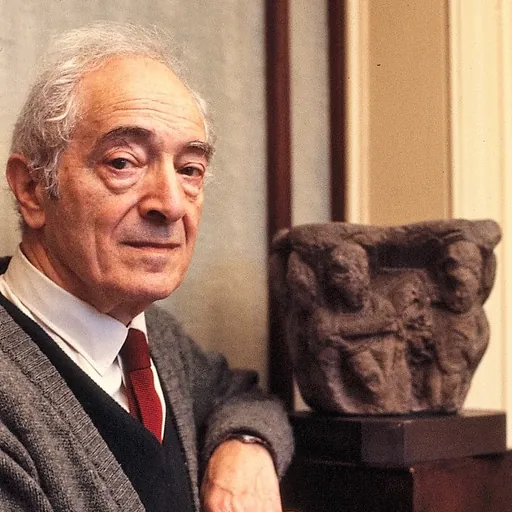
About Meyer Schapiro
Lived 1904 – 1996 (aged 91). Meyer Schapiro was an American art historian, historian, university teacher, art theorist and aesthetician.
Meyer Schapiro (23 September 1904 – 3 March 1996) was a Lithuanian-born American art historian who developed new art historical methodologies that incorporated an interdisciplinary approach to the study of works. An expert on early Christian, Medieval and modern art, he explored periods and movements with an eye toward their works' social, political and material constructions.
Credited with fundamentally changing the course of the art historical discipline, Schapiro's scholarly approach was dynamic and it engaged other scholars, philosophers and artists. An active professor, lecturer, student, writer and humanist, he maintained a long professional association with Columbia University in New York.
Background Meir Schapiro was born in Šiauliai, Lithuania (then Governorate of Kaunas of the Russian Empire) on September 23, 1904. His ancestors were Talmudic scholars. His parents, Nathan Menachem Schapiro and Fanny Adelman Schapiro, were Lithuanian Jews.
In 1906, his father came to New York City and found a job as a Hebrew teacher at the Yitzcak Elchanan Yeshiva on the Lower East Side. Once secure, he sent for his family, who emigrated in 1907. The son's first name changed from "Meir" to "Meyer". He grew up in the Brownsville section of Brooklyn, where he was first exposed to art in evening classes taught by John Sloan at the Hebrew Educational Society.
He attended Public School 84 and then Boys High School in Brooklyn. He attended lectures on anthropology and economics at the Young People's Socialist League. During summers, he worked as a Western Union delivery boy, a warehouse packer, an electrical-supply assembler and an adjustment clerk at Macy's. During his undergraduate days, he became known for his "Schapiric victory", by allegedly reducing an instructor to tears by means of dialectic logic. In 1924, he received his bachelor's degree with honors in art history and philosophy. Princeton University denied him admission for his doctorate, so he continued at Columbia and earned his doctoral degree in art history in 1929. His professors at that time included Ernest DeWald. His dissertation, five years in the making, examined the cloister and portal of Moissac Abbey, built about A.D. 1100: Dr. Schapiro's research went far beyond the implications of Moissac itself. Medieval church history, liturgy, theology, social history, illuminated manuscripts, folklore, epigraphy, the analysis of ornament and national characteristics (real or imagined) all were pressed into service and synthesized. As a result, what had been thought of as antiquarian artifacts were seen to have a completely different character. "A new sphere of artistic creation," Dr. Schapiro called it, "without religious content and imbued with values of spontaneity, individual fantasy, delight in color and movement, and the expression of feelings that anticipate modern art. This new art, on the margins of religious work, was accompanied by a conscious taste of the spectators for the beauty of workmanship, materials and artistic devices, apart from religious meanings." Schapiro and other dissenters, including Mark Rothko, Gottlieb, Harris and Bolotowsky, condemned dictatorships in Germany, Russia, Italy, Spain and Japan and founded a Cultural Committee which became the Federation of Modern Painters and Sculptors.
Schapiro was a proponent of modern art, on which he published essays alongside books on Van Gogh and Cézanne. He was a founder of Dissent, along with Irving Howe and Michael Harrington. From 1966 to 1967 Schapiro was the Norton professor at Harvard University.
Schapiro's discourse on style is often considered his greatest contribution to the study of art history. He said style refers to the formal qualities and visual characteristics of a piece of art, and demonstrated it could be used as an identifier of a particular period and as a diagnostic tool. Style is indicative of the artist and the culture at large. It reflects the economic and social circumstances in which an artist works and breathes and reveals underlying cultural assumptions and normative values.
Personal life and death
Schapiro's brother was financier Morris Schapiro.
In the 1950s, Schapiro urged Willem de Kooning to finish painting Woman I (1950–1952). Schapiro demonstrated how the concurrent existence of two historical styles in one monastery was indicative of economic upheaval and class conflict.
Schapiro's students include: Sigmund Abeles Jonathan Crary Helen Frankenthaler Peter Golfinopoulos Michael Hafftka Carroll Janis Allan Kaprow Hilton Kramer Robert Motherwell Dorothy Miner David Rosand William Rubin Lucas Samaras Virginia Wright Barbara Rose
Portraits Alice Neel painted his portrait in 1947 and 1983. (A lifelong artist, Schapiro produced a number of self-portraits. )
Awards
Schapiro was a fellow of the American Academy of Arts and Sciences, the National Institute of Arts and Letters and the American Philosophical Society. The artworks were exhibited at the Metropolitan Museum of Art.
Don’t just read it —
keep it.
Full-length biographies made to live with: read them, listen on the way to work, watch them tonight.
- E-book
- Audio
- Video
Instant download · yours to keep · every purchase keeps this site free
Important facts
People in Meyer Schapiro's life
Named in this biography and alive at the same time


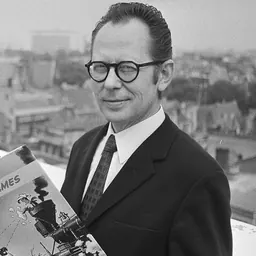

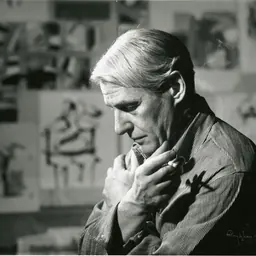
Related people
Same field, nearest in time


Contemporaries
People whose lives overlapped Meyer Schapiro's





Frequently asked questions
Who was Meyer Schapiro?
American historian of art (1904–1996)
When was Meyer Schapiro born?
Meyer Schapiro was born on 23 September 1904 in Šiauliai.
When did Meyer Schapiro die?
Meyer Schapiro died on 3 March 1996 in New York City.
What was Meyer Schapiro's occupation?
Meyer Schapiro was an art historian, historian, university teacher, art theorist and aesthetician.
What nationality was Meyer Schapiro?
Meyer Schapiro was American.
Sources & further reading
Cite this page
APA: Biography.guide. (2026). Meyer Schapiro. https://biography.guide/meyer-schapiro/
MLA: "Meyer Schapiro." Biography.guide, https://biography.guide/meyer-schapiro/.
Chicago: "Meyer Schapiro." Biography.guide. https://biography.guide/meyer-schapiro/.
Data last updated: 2026-09-23 · Spot an error? Report a correction.
Portrait: Wikimedia Commons · author & licence
Page generated 2026-09-27 05:07 UTC