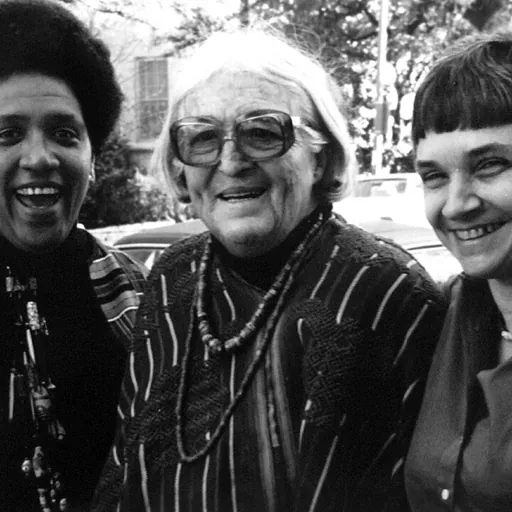
About Meridel Le Sueur
Lived 1900 – 1996 (aged 96). Meridel Le Sueur was an American historian, writer, novelist, essayist and children's writer.
Meridel Le Sueur (February 22, 1900 – November 14, 1996) was an American writer associated with the proletarian literature movement of the 1930s and 1940s. Her best-known works include the 1932 essay “Women on the Breadlines” and the novel The Girl. Le Sueur’s close association with Communist organizations eventually led to her being blacklisted in the 1950s during the Cold War. This sharply reduced the amount of work she was able to publish. Interest in her work revived in the 1970s and 1980s, when scholars and second-wave feminists reassessed her contributions to American radical and feminist literature.
Early life and activist family Meridel Le Sueur was born in Murray, Iowa, on February 22, 1900, to William Winston Wharton and Marian “Mary Del” Lucy, both of whom were involved in social and political reform movements that often required the family to relocate.
In the years following high school, Le Sueur continued exploring artistic and political worlds beyond the Midwest. "After a year studying dance and physical fitness at the American College of Physical Education in Chicago, Illinois, Meridel moved to New York City, where she lived in an anarchist commune with Emma Goldman and studied at the American Academy of Dramatic Arts." Her acting career primarily took place in California, where she worked in Hollywood as an extra in The Perils of Pauline and Last of the Mohicans, and as a stuntwoman in silent movies. Although she would not continue acting, it expanded her interest in the telling of stories and creative work. he included sixteen of Le Sueur's published short stories as either a citation or as a reprint. Her essay "I Was Marching" was reprinted three times. Her book Salute to Spring was shown in the International Publishers imprint during the 1940s, which included twelve pieces of both fiction and journalism. She also wrote several popular children's books, including the biographies "Nancy Hanks of Wilderness Road", "The Story of Davy Crockett"", "The Story of Johnny Appleseed", and "Sparrow Hawk". "A Story of Abraham Lincoln's Mother", one of her earliest children's books, was published in 1949. Composed of poetry, it focused on the dull life of a young girl named Billie Jo living through the bleakness of Oklahoma in the 1930s. Because her communist political views shaped much of her literary work, the Cold War climate and its repression of radical writers forced Le Sueur to withdraw from public life and take her work underground since many of her publishing outlets were shut down. It wasn’t until the end of the 1960s that her work became visible again thanks to a better political climate and the start of the new women’s movement. A few pieces of her work were reissued in the 1970s under the title Corn Village.
Women on the Breadlines Women on the Breadlines was Le Sueur’s first piece written for the publication New Masses in 1932. The piece documents the realities of the nearly three million women who were unemployed during the Great Depression. During the Great Depression, there were long lines of people waiting for free food, known as breadlines. Le Sueur observed that underprivileged women typically avoided these lines in order to protect their image and hide their poverty. They avoided the breadlines by pooling together their resources, selling their possessions and/or their bodies, and/or applying for relief, which was seen as humiliating for many during this time.
Le Sueur’s writing style outlines the economic and psychological effects of their situation. She includes distinctive images such as women surviving on bacon rinds and potato peelings, or a very tired woman described in the conclusion of the story whose body shows signs of a significantly laborious life. The editors of New Masses criticized "Women on the Breadlines," describing it as having a defeatist tone. Editors urged her to depict more revolutionary and opportunistic events that were offered by unemployment councils. Despite this criticism, Le Sueur continued to view her portrayal of suffering not as pessimism, but as solidarity. "Woman on the Breadlines" has since been widely accepted as an early example of Le Sueur’s political devotion to giving voices to the struggling working-class women.
Le Sueur based The Girl on stories from the women in the Workers Alliance organization. Le Sueur joined the Communist Party in 1924. The Communist party “provided a political theory and a program of action to which she could commit herself while at the same time retaining the freedom to be critical.” Elaine Hedges, the editor of Le Sueur's collection of work Ripening, says that Le Sueur “was aware herself of the male orientation of the party.” While Le Sueur criticized the Communist party for its dismissal of women’s rights “communal solidarity” was still a cornerstone of Le Sueur’s work. 1992 1997
Quotes "When the workers send for you, then you know you're really good. Sometimes they would send money to pay the bus fare." "I tell the young writers who visit: 'Carry a notebook. That is the secret of a radical writer. Write it down as it is happening.'"
Don’t just read it —
keep it.
Full-length biographies made to live with: read them, listen on the way to work, watch them tonight.
- E-book
- Audio
- Video
Instant download · yours to keep · every purchase keeps this site free
Important facts
Family & relationships
People in Meridel Le Sueur's life
Named in this biography and alive at the same time


Related people
Same field, nearest in time


Contemporaries
People whose lives overlapped Meridel Le Sueur's




Frequently asked questions
Who was Meridel Le Sueur?
American writer and social activist (1900–1996)
When was Meridel Le Sueur born?
Meridel Le Sueur was born on 22 February 1900 in Murray.
When did Meridel Le Sueur die?
Meridel Le Sueur died on 14 November 1996 in Hudson.
What was Meridel Le Sueur's occupation?
Meridel Le Sueur was a historian, writer, novelist, essayist and children's writer.
What nationality was Meridel Le Sueur?
Meridel Le Sueur was American.
Sources & further reading
Cite this page
APA: Biography.guide. (2026). Meridel Le Sueur. https://biography.guide/meridel-le-sueur/
MLA: "Meridel Le Sueur." Biography.guide, https://biography.guide/meridel-le-sueur/.
Chicago: "Meridel Le Sueur." Biography.guide. https://biography.guide/meridel-le-sueur/.
Data last updated: 2026-09-23 · Spot an error? Report a correction.
Portrait: Wikimedia Commons · author & licence
Page generated 2026-09-27 05:06 UTC