
Mehmed Siyāḥ Qalam
Semi-legendary XIV/XV century Iranian painter (or more likely group of painters) under whose name exist particular genre of islamic painting
About Mehmed Siyāḥ Qalam
Born 1450. Mehmed Siyāḥ Qalam was an Iranian illuminator.
Folio 64, recto; Demons and the dead in ritualistic dance. This scene shows Buddhist influence, especially in the flowing drapery, and wild rhythms of their dance
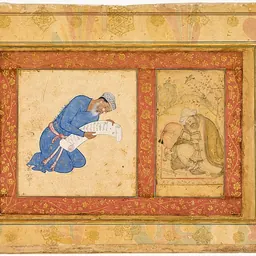
The album of Muḥammad Siyāh Qalam or Siāh-Qalam (; ; ), comprises around 80 extant late 14th and early 15th century folio paintings, ink drawings (qalam-siāhi), and calligraphies, on various material, sometimes silk. The album that contains these paintings, most of which are signed as Mehmet or Muhammad Siyah Qalam, is called the Fatih. These paintings depict cultural and religious ritual norms of the time period, providing insight into the demographics of that era as well as the geography.
In tone and theme, the images are a high point of Persian draftsmanship and include works from the Mozaffarid, Jalāyerid and Turkmen periods. They are sometimes attributed to the notname Ustad Siyah Qalam; equivalent in English to the Master of the Black Pen. There have been conflicting opinions about whether Siyah Qalam was an individual or a group of artists. This discourse arose because the artwork was created in a non-cohesive style, with the name "Siyah Qalam" written and positioned differently on each piece.
Identifying the notname has led to debate, with some associating Muhammad Siyah Qalam with a Herati painter, Hajji Muhammad. Others have identified Yaqub Beg’s court painters, Shaykhi and Darvish Muhammad, as contributors to the collection alongside Muhammad Siyah Qalam, while some suggest Darvish Muhammad and Muhammad Siyah Qalam may be one and the same.
Subject matter
Within the collection, there are depictions of demons, monsters, camp life, animals, fairy-like beings, and human figures in Chinese and Mongolian clothing. Alongside figural depictions are also details of nature (such as rocks and trees) which recur in Turkman court paintings of the Yaqub Beg period. images seem to conjure the devastation and bleakness of Genghis Khan's reign. The images contain dark colours, heavy lines, and highly animated figures against a blank background, using unsized, unpolished paper and a limited range of colours.
The compositions are highly expressive, and a number of figures are engaged in ecstatic ritual or dance. The fantastical monsters are drawn from local Pre-Islamic Central Asian folklore, bearing resemblance to beings of Indian, Chinese and Middle Eastern legend, as Central Asia lies on the cultural crossroad between the Middle East, South Asia and East Asia. Furthermore, a drawing in the Siyah Qalam collection seems to be an adaptation of a European painting of Hercules strangling a lion. The living wear various head-dresses and costumes and carry a variety of tools and weapons, and engage in different rituals. The demons are semi-naked, often wearing short skirts and barefoot, with some having long scarves over their shoulders. Despite speculation about the life and work of the painter, or painters, who painted in this style, the aesthetic and inspiration certainly originates from the various schools of painting most recognizable from the region of Central or Southwest Asia.
The extant leaves are taken from a number of scrolls that were transferred in the course of wars and land occupations. The extant leaves are recorded in inventories in Istanbul and in the library of Topkapi Palace of Sultan Selim I as treasure from his 1514 Persian adventure.
In 1910, Siyah Qalam's paintings were displayed in an exhibition of Islamic art in Munich. Since that exhibition, various scholars have attempted to pinpoint when and where the artist surfaced, with a variety of viewpoints advanced.
Gallery
Don’t just read it —
keep it.
Full-length biographies made to live with: read them, listen on the way to work, watch them tonight.
- E-book
- Audio
- Video
Instant download · yours to keep · every purchase keeps this site free
Important facts
Related people
Same field, nearest in time





Frequently asked questions
Who was Mehmed Siyāḥ Qalam?
semi-legendary XIV/XV century Iranian painter (or more likely group of painters) under whose name exist particular genre of islamic painting
When was Mehmed Siyāḥ Qalam born?
Mehmed Siyāḥ Qalam was born in 1450 in Tabriz.
What was Mehmed Siyāḥ Qalam's occupation?
Mehmed Siyāḥ Qalam was an illuminator.
What nationality was Mehmed Siyāḥ Qalam?
Mehmed Siyāḥ Qalam was Iranian.
Sources & further reading
· Wikipedia: Mehmed Siyāḥ Qalam
Cite this page
APA: Biography.guide. (2026). Mehmed Siyāḥ Qalam. https://biography.guide/mehmed-siyah-qalam/
MLA: "Mehmed Siyāḥ Qalam." Biography.guide, https://biography.guide/mehmed-siyah-qalam/.
Chicago: "Mehmed Siyāḥ Qalam." Biography.guide. https://biography.guide/mehmed-siyah-qalam/.
Data last updated: 2026-09-20 · Spot an error? Report a correction.
Page generated 2026-09-27 05:28 UTC