
About Medardus
Lived 470 – 560 (aged 89–90). Medardus was a catholic priest, missionary and bishop.
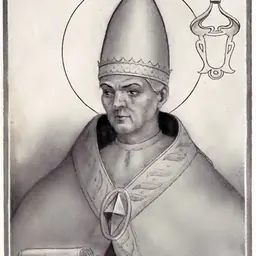
Medardus or Medard (French: Médard or Méard) (ca. 456–545) was the Bishop of Noyon. He moved the seat of the diocese from Vermand to Noviomagus Veromanduorum (modern Noyon) in northern France. Medardus was one of the most honored bishops of his time, often depicted laughing, with his mouth wide open, and therefore he was invoked against toothache.
Life Medardus was born around 456 at Salency, Oise, in Picardy. His father, Nectaridus, was a noble of Frankish origin, while his mother Protagia was Gallo-Roman. The Roman Martyrology includes the fanciful tale that Gildard, Bishop of Rouen, was his brother, '"born on the same day, consecrated bishops on the same day, and on the same day withdrawn from this life." However, there is no mention of Gildard in the earliest lives of Medardus, and Gildard attended the First Council of Orléans in 511, while Medardus was not consecrated until 530.
A pious fiction links his childhood to his future bishoprics: "He often accompanied his father on business to Vermand and Tornacum (modern Tournai), where he frequented the schools, carefully avoiding all worldly dissipation".
Romanesque tympanum at church of St Medard & St Gildard, Little Bytham, UK (the dedication is unique in Britain). The circular opening may once have held a relic of the saint. The birds on either side are probably eagles; one is said to have sheltered Medardus from a rainstorm is held to have removed the seat of his bishopric from Vermand, a little city with no defences, to Noviomagus Veromanduorum (modern Noyon), the strongest place in that region of Neustria, in 531. at the gates of the royal city of Noviodunum; there over his tomb was erected the celebrated Benedictine abbey which bears his name, the Abbey of Saint-Médard. The selection of the site was given authenticity through a familiar trope of hagiography:
When the procession reached Crouy, which is about three miles from Soissons, the bier became wholly immovable. The king then promised to give half the borough of Crouy to the new church. On trying again to lift the bier, it was found that the half facing the part given to the church was loose and could be moved, but the other half was as fast as ever. Clotaire now promised the whole borough to the church. The bier instantly became so light that it could be lifted and carried without any trouble to its final destination. (Walsh 1897)
Veneration
Medardus was one of the most honored bishops of his time. His memory has always been popularly venerated, first in the north of France, then in Cologne and extending to western Germany, and he became the hero of numerous legends. His cultus is mentioned by both Venantius Fortunatus and Gregory of Tours. His feast day is celebrated on June 8. It is believed that, as with Swithun, whatever the weather on his feast day, it will continue for the forty days following, unless the weather changes on the feast of Saint Barnabas (11 June).
He was often depicted laughing, with his mouth wide open, therefore he was invoked against toothache. He is also invoked against bad weather (but also for rain), sterility and imprisonment. He is patron saint of vineyards, brewers, captives and prisoners, the mentally ill, and peasants.
The parish church of St. Medardus and St. Gildardus in Lincolnshire, England, is jointly dedicated to him and Saint Gildard.
Legends and customs As a child, Medardus was said to have once been sheltered from rain by an eagle which hovered over him. This is how he was most commonly depicted, and is why he is associated with weather, good or bad, and why he is held to protect those who work in the open air. The weather legend concerning Medardus is similar to Swithun in England. The French rhyme is: Quand il pleut à la Saint-Médard, il pleut quarante jours plus tard (If it rains on St Medardus' Day, it rains for forty days more). In Czech, the same weather lore is also found, "Medardova kápě, 40 dní kape."
Every year at Salency (Medardus' birthplace) near Noyon, France (and certain other villages) "the most virtuous young girl of the year" of the commune is elected the Rosière. The custom is said to have been started by Medardus himself, and the first Rosière is said to have been his sister, Médrine.
Don’t just read it —
keep it.
Full-length biographies made to live with: read them, listen on the way to work, watch them tonight.
- E-book
- Audio
- Video
Instant download · yours to keep · every purchase keeps this site free
Important facts
People in Medardus's life
Named in this biography and alive at the same time


Related people
Same field, nearest in time




Contemporaries
People whose lives overlapped Medardus's


Frequently asked questions
Who was Medardus?
bishop of Vermandois
When was Medardus born?
Medardus was born in 470 in Salency.
When did Medardus die?
Medardus died on 8 June 560 in Noyon.
What was Medardus's occupation?
Medardus was a catholic priest, missionary and bishop.
Sources & further reading
Cite this page
APA: Biography.guide. (2026). Medardus. https://biography.guide/medardus/
MLA: "Medardus." Biography.guide, https://biography.guide/medardus/.
Chicago: "Medardus." Biography.guide. https://biography.guide/medardus/.
Data last updated: 2026-09-20 · Spot an error? Report a correction.
Page generated 2026-09-27 05:28 UTC