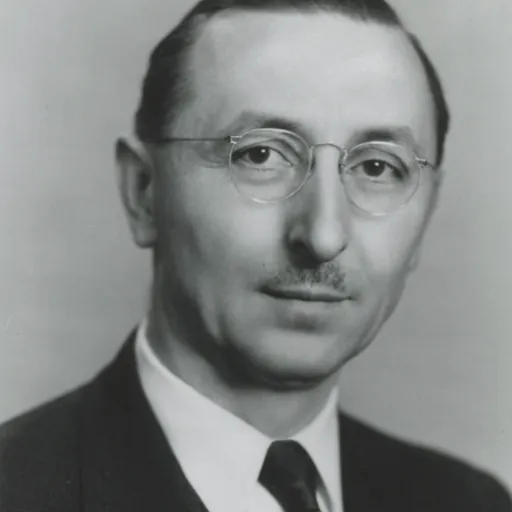
About Maynard Pirsig
Lived 1902 – 1997 (aged 95). Maynard Pirsig was an American lawyer and judge.
Maynard E. Pirsig, LLD, (/ˈpɜːrsɪɡ/; January 9, 1902 - February 7, 1997) was an American legal scholar. He was a professor, and dean, of the University of Minnesota Law School; a Minnesota Supreme Court justice; director of the Minnesota Legal Aid Society, and an advisor for the Indonesian, Puerto Rican, and El Salvadoran legal systems. He defined Legal Ethics in the 1974 Encyclopedia Britannica. His law books were widely used in schools across the country, including his casebook Judicial Administration—which Pirsig used for the United States' first law reform course, early 1930s. Pirsig's research and teaching led to the publication of a book in 1946, Cases and Materials on Judicial Administration, which he taught throughout his career. Judicial Administration gave birth to a new subject in the field of law. Charles W. Wolfram described Pirsig's teaching as aiming to produce "students... equipped with a challenging attitude, a reformer's zeal for ideal solutions, and a full arsenal of possibilities for innovations (who) would continue to confront the judicial system with challenges to ever more humane conduct that alone will guarantee its continuing legitimacy". George K. Gardner said of the book: "Here are a thousand pages on the purpose and problems of our profession which will repay thoughtful study by any student, teacher, or practitioner of the law." Pirsig also taught courses on pleading, ethics and criminal law.
When Pirsig was Dean of the Law School (1948–1955), he recruited ten new faculty members. Most were, or became, pillars in the world of legal scholarship, including Charles Alan Wright, Michael I. Sovern, David Louisell, Jesse Dukeminier, and librarian Leon Liddell. Pirsig managed an expansion of the school, including the library. He developed a training program at the law school, for professionals in juvenile delinquency control which trained police and judges on how to utilize the American Juvenile Justice System - a system Pirsig had been instrumental in introducing to the state. He managed a difficult period of post-war transition and growth at the University of Minnesota Law School, however, according to Robert A. Stein, "traditions of excellence were maintained and the foundation was laid for more productive future years". Pirsig resigned his position as Dean in 1955, and returned to teaching full-time. While Dean of the University of Minnesota Law School, Pirsig publicly urged the university to expel fraternities and sororities that had racial "bias clauses" in their charters or constitutions, 1957.
Mitchell Hamline bestowed an honorary L.L.D. doctorate degree upon Pirsig, 1981.
Pirsig made a donation for the construction of the Warren E. Burger Law Library, housing the Maynard E. Pirsig Study Hall, which contains a vitrine displaying his legal and personal memorabilia—including his 1946 U of M lectures recorded onto SoundScriber vinyl discs.
Minnesota Supreme Court At age 40, Pirsig served as an interim justice on the Minnesota Supreme Court. He was appointed by Governor Harold Stassen. Pirsig served for only a few months, but wrote more than a dozen opinions, several of which later became important legal precedents.
Selected achievements Executive Director of the Mid-Minnesota Legal Aid Society. 1925–30 Secretary of the Minnesota Judicial Council, which studied the organization and procedures of the courts. 1937–52 Chairman, Minnesota State Bar Association committee to study the American Law Institute's Youth Conservation Act University of Minnesota's Mondale Hall houses the Maynard E. Pirsig Lecture Hall, which includes an oil painting of Maynard. Maynard Pirsig Moot Court is named for him. Herbert Lincoln Harley Award from the American Judicature Society, for outstanding contributions to the improvement of the administration of justice, 1973. Honorary doctorate degree (LLD) from William Mitchell College of Law, 1981 Outstanding Achievement Award, University of Minnesota Law School, 1985. At the time, the only father and son (Robert M. Pirsig, awarded 1975) conferred with individual awards. William Mitchell College of Law establishes the Pirsig Distinguished Lecturer Series, 1987 Whitney North Seymour Award
Events of interest
Pirsig helped draft a bill to revise the Minnesota State Criminal Code. Although some officials believed that it was too lenient and hampered law enforcement, it was passed in 1965.
Pirsig's will contained a gift to University of Minnesota Law School, to teach his Judicial Administration course again. It was revived and taught again c. 2001–04.
Minneapolis home, 1932–1995. Here. Maynard and Harriet Sjobeck Pirsig lived and raised their three children, Robert, Jean, and Wanda.
Don’t just read it —
keep it.
Full-length biographies made to live with: read them, listen on the way to work, watch them tonight.
- E-book
- Audio
- Video
Instant download · yours to keep · every purchase keeps this site free
Important facts
People in Maynard Pirsig's life
Named in this biography and alive at the same time




Related people
Same field, nearest in time


Contemporaries
People whose lives overlapped Maynard Pirsig's



Frequently asked questions
Who was Maynard Pirsig?
American judge
When was Maynard Pirsig born?
Maynard Pirsig was born on 9 January 1902 in Kossuth County.
When did Maynard Pirsig die?
Maynard Pirsig died on 7 February 1997.
What was Maynard Pirsig's occupation?
Maynard Pirsig was a lawyer and judge.
What nationality was Maynard Pirsig?
Maynard Pirsig was American.
Sources & further reading
Cite this page
APA: Biography.guide. (2026). Maynard Pirsig. https://biography.guide/maynard-pirsig/
MLA: "Maynard Pirsig." Biography.guide, https://biography.guide/maynard-pirsig/.
Chicago: "Maynard Pirsig." Biography.guide. https://biography.guide/maynard-pirsig/.
Data last updated: 2026-09-24 · Spot an error? Report a correction.
Portrait: Wikimedia Commons · author & licence
Page generated 2026-09-27 05:08 UTC