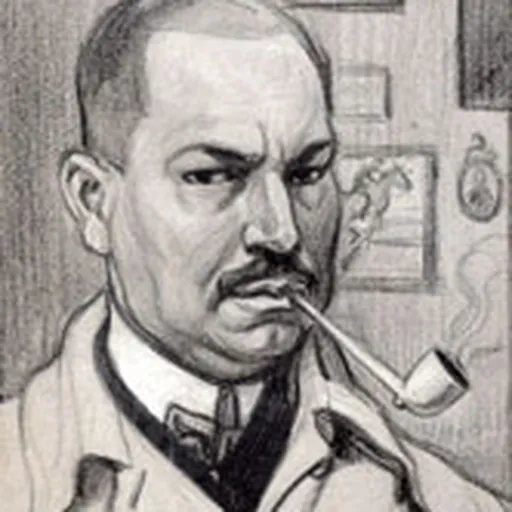
Maximilian Liebenwein
Austrian-German painter, graphic designer and illustrator
About Maximilian Liebenwein
Lived 1869 – 1926 (aged 57). Maximilian Liebenwein was a German and Austrian painter, graphic designer, illustrator, exlibrist, graphic artist and artist.
Maximilian Albert Josef Liebenwein (11 April 1869 – 17 July 1926) was an Austrian-German painter, graphic artist and book illustrator, in the Impressionist and Art Nouveau styles. He spent significant time in Vienna, Munich and Burghausen, Altötting, and took an active part in the artistic community in all three places. He was an important member of the Vienna Secession, becoming its vice-president, and exhibiting with the group many times.
Life
Early life, education and training
Liebenwein was born in Vienna, the second son of Joseph Calasanz Liebenwein (1835-1906) and Magdalena (née Kundrat). His father was a merchant, running a laundry and selling clothes in Vienna and in Lilienfeld. As a boy, Liebenwein spent time in both cities. His mother was the daughter of , the personal valet of and a huntsman and forester for Emperor Franz Joseph, and his uncle was the pathologist and coroner Hans Kundrat. His grandfather kept a large library and a natural science collection, and helped fuel young Liebenwein's interest in poetry, legends and nature. Liebenwein studied at the in Vienna.
Liebenwein's father initially did not support his artistic ambitions, but his uncle helped smooth his path. In 1887 he entered the Academy of Fine Arts, Vienna, but he did not enjoy his studies there; he was keener to study animals at the and cadavers under his uncle's supervision. Julius Victor Berger, Liebenwein's teacher, showed compassion to him, but he left the Academy in 1891. He spent 1891-92 with the 13th Dragoon Regiment, Prince Eugene of Savoy, then in autumn 1892 attended the (Special School for Historical Painting) under Matthias von Trenkwald. Liebenwein's father broke his leg and needed help with the family business, and so Liebenwein could not attend classes regularly; this was a point of contention between von Trenkwald and Liebenwein, and he left the Special School in March 1893, spending several months as a "rider and hunter" on the Lilienfeld estate. His matriculation records list him as a Roman Catholic.
Independent painter in Munich and Burghausen A Field Army Letter, published in in 1896. Poem and illustrations both by Maximilian Liebenwein. From 1897, Liebenwein lived as an independent painter in Munich, and also ran painting classes. The medieval town of Burghausen and its castle impressed them as an appropriate conceptual setting for the romantic-chivalric themes of many of Liebenwein's works. The location had been suggested by Liebenwein's friend Ignatius Taschner, whom he had met in the . Within three days in 1899, Horst-Schulze and Liebenwein painted a frieze inside the tower, so that Liebenwein's bride-to-be would see it on her first visit. The artwork covers three sides of a room and reflects medieval themes, including imagery of Walther von der Vogelweide and Parzival.
It was in this period that Liebenwein discovered his affinity for Art Nouveau; in 1896, some of his illustrations had appeared in the Art Nouveau magazine . He contributed to the Bosnian magazine , from its founding in 1895 until its last issue in 1903. It was an initiative of Béni Kállay. Liebenwein, the magazine's main illustrator Ewald Arndt Čeplin, his brother Leo and its other regular artist Ivana Kobilca formed the obscure 'Sarajevo Painter's Club'. He visited the country in 1900 and 1901.
In 1900, he won a competition held by for designs for a trading card album for the Stollwerck company. Other winners included Fritz Helmuth Ehmcke from Berlin; , Adolf Höfer and from Munich; and from Hamburg. The judges were Emil Doepler, Woldemar Friedrich, Bruno Schmitz and Franz Skarbina from Berlin, in addition to a Stollwerck partner. Liebenwein's theme was Kater Murr.
With the Vienna Secession and other groups
Liebenwein exhibited with the Vienna Secession in spring 1900. His works shown included Percival (1899) and several animal studies. Following the exhibition, he became a full member of the group, and became its vice-president by 1912. He was an active member until his death. Still living in the 'Liebenwein tower' of Burghausen Castle, he married Anna Essigmann (born 1879), from Vienna, in May 1901, with his first son Hans Georg born in 1902 (died 1977). The family were friends with Koloman Moser, who had been on the committee that invited Liebenwein to exhibit with the Vienna Secession. Extracts from his travel diaries from his 1900 trip to Bosnia, together with his own illustrations, were published in Ver Sacrum in 1902. Liebenwein did not follow Gustav Klimt in seceding from the Secession in 1905, even though he was invited to join.
Liebenwein joined the Deutscher Künstlerbund in Weimar in 1904.
Back in Vienna, World War I and afterwards Liebenwein returned to Vienna in 1908-09, and ran a painting school for men and women until 1913, though he still spent summers in Burghausen. In 1910 he adorned a hall of the First International Hunting Exhibition in Vienna with monumental paintings; he was presented to Emperor Franz Joseph I at the exhibition. Sketch of a German 21 cm mortar battery, near Ostrow in 1915.
His second son, Wolfgang Ferdinand, was born in 1911. Liebenwein volunteered for military service in 1914 and he was called up in June 1915; his wife Anna died from breast cancer in that year, in a sanatorium in Gmunden, while he was at the eastern front. Liebenwein served as an ordnance officer for XVII Corps. He was with the army in Poland, Russia, Isonzo and Bukovina, and produced many drawings in 54 sketchbooks. He suffered a stroke in December 1917,
In February 1926, Liebenwein suffered another stroke in Burghausen, and died in July 1926 in Munich. He was buried in Burghausen. He kept humour in his work, as well as excellent technical ability and a deep knowledge of his subject matter.
Selected works
Horsewoman, 1895 (Linz, ), oil on canvas, 75.5 x 99.5 cm Percival, 1899 (private collection), tempera on cardboard, 82.5 x 135 cm (with artist's original frame) St. Genofefa, St. Hubert, St. Margaret, St. Martin's, 1900 (private collection, Vienna Museum, unknown ownership), tempera on cardboard, each 60 x 75 cm partially preserved wall painting cycle, 1899 (Burghausen Castle, Liebenwein tower) painted caesin on plaster furniture for the Liebenwein tower, 1901, privately owned The Goose Girl, fairytale cycle in 9 images, tempera on cardboard, each 75 x 60 cm, lost St. George, a devout Maere, 1904 (private collection), tempera on paper and cardboard, each 89.5 x 69.5 cm Sleeping Beauty fairy tale cycle 7 pictures, 1905, tempera on cardboard, each 75 x 110 cm, lost The Rose Miracle of St. Elizabeth, 1905 (private collection), 74.5 x 59.2 cm King Thrushbeard, fairytale cycle of 7 pictures, 1905/06, tempera on cardboard, each 75 x 75 or 75 x 110 cm, lost The Infamous Pond, 1907 (private collection), 59.5 x 74.8 cm large frieze in the ballroom of Linz savings bank, in 1907/08 mixed media, nine parts, each 94.4 x 94.5 x 174 or 217/219 or 84.5 x 283 cm Giselher engagement in Bechelaren, 1909 (private collection) 3 parts, 135 x 115 or 125 x 282 cm Amazonian hunting cycle, 1910 (Castle Steyregg, private collection), 3 parts, oil on canvas, 257 x 120, 264 x 542 and 264 x 427 cm Roland the Shieldbearer, designs for wall paintings in the great hall of Moosham Castle in Lungau, tempera on paper, each 27.5 x 125 or 160.5 cm Europe, 1913 (private collection), oil tempera on canvas, 191 x 251 cm Eve in Paradise, 1914 (private collection), oil on canvas, 246 x 144.5 cm Life of the Virgin, twelve-panel cycle, 1925 (Convent of the ), tempera on cardboard, each 62 x 77 and 104.5 cm St. Hubertus, three piece cycle, 1926 (private collection), tempera on cardboard, 100 x 75 or 100 x 120 cm
Don’t just read it —
keep it.
Full-length biographies made to live with: read them, listen on the way to work, watch them tonight.
- E-book
- Audio
- Video
Instant download · yours to keep · every purchase keeps this site free
Important facts
People in Maximilian Liebenwein's life
Named in this biography and alive at the same time


Related people
Same field, nearest in time


Contemporaries
People whose lives overlapped Maximilian Liebenwein's



Frequently asked questions
Who was Maximilian Liebenwein?
Austrian-German painter, graphic designer and illustrator (1869-1926)
When was Maximilian Liebenwein born?
Maximilian Liebenwein was born on 11 April 1869 in Vienna.
When did Maximilian Liebenwein die?
Maximilian Liebenwein died on 17 July 1926 in Munich.
What was Maximilian Liebenwein's occupation?
Maximilian Liebenwein was a painter, graphic designer, illustrator, exlibrist, graphic artist and artist.
What nationality was Maximilian Liebenwein?
Maximilian Liebenwein was German and Austrian.
Sources & further reading
· Wikipedia: Maximilian Liebenwein
· DBpedia: Maximilian Liebenwein
Cite this page
APA: Biography.guide. (2026). Maximilian Liebenwein. https://biography.guide/maximilian-liebenwein/
MLA: "Maximilian Liebenwein." Biography.guide, https://biography.guide/maximilian-liebenwein/.
Chicago: "Maximilian Liebenwein." Biography.guide. https://biography.guide/maximilian-liebenwein/.
Data last updated: 2026-09-21 · Spot an error? Report a correction.
Portrait: Wikimedia Commons · author & licence
Page generated 2026-09-27 04:59 UTC