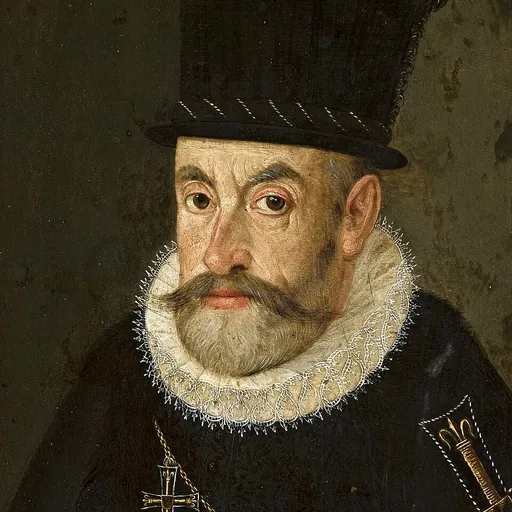
About Maximilian III, Archduke of Austria
Lived 1558 – 1618 (aged 60). Maximilian III, Archduke of Austria was a ruler.
Biography
Anonymous Netherlands, Portrait of Maximilian, Archduke of Austria, 17th century, engravingBorn in Wiener Neustadt, Maximilian was the fourth son of the Emperor Maximilian II and Maria of Spain. He was a grandson of Anna of Bohemia and Hungary, daughter and heiress of Vladislaus II of Bohemia and Hungary, who himself was the eldest son of Casimir IV of Poland from the Jagiellonian dynasty.
In 1585, Maximilian became the Grand Master of the Teutonic Order; thanks to this he was known by the epithet der Deutschmeister ("the German Master") for much of his later life.
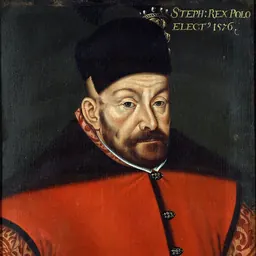
In the 1587 Polish–Lithuanian royal election Maximilian stood as a candidate for the throne of the Polish–Lithuanian Commonwealth, following the death of the previous king, Stephen Báthory. A portion of the Polish nobility supported Maximilian, but the larger faction elected Prince Sigismund of Sweden, grandson of Sigismund I the Old, as Sigismund III Vasa. Maximilian then invaded Poland, starting the War of the Polish Succession (1587–1588). He had considerable support in Poland, but fewer Poles flocked to his army than to that of his rival. In late 1587, he tried and failed to storm Kraków. At Pitschen in Silesia, he met Sigismund's army, commanded by Polish hetman Jan Zamojski. In the Battle of Byczyna (24 January 1588), Maximilian was defeated and captured. He was released a year and half later after the intervention of Pope Sixtus V in the aftermath of the Treaty of Bytom and Będzin. In 1598, he formally renounced his claim to the Polish crown. The inactivity of his brother, Emperor Rudolf II, in this matter contributed to Rudolf's poor reputation.
From 1593 to 1595, Maximilian served as regent for his young cousin, the future Emperor Ferdinand II as Archduke of Inner Austria. In 1595, Maximilian succeeded to the territories of their uncle Ferdinand II, Archduke of Further Austria, including Tyrol, where he proved to be a solid proponent of the Counter-Reformation. He also worked to depose Melchior Khlesl, and to ensure that Ferdinand succeeded as Holy Roman Emperor.
Today, Maximilian is perhaps best remembered for his baroque archducal hat, exhibited in the treasury of the monastery of Klosterneuburg and used for ceremonial purposes as late as 1835.
He died at Vienna in 1618, and is buried in the canopied tomb in Innsbruck Cathedral.
Ancestors
Male-line family tree
Don’t just read it —
keep it.
Full-length biographies made to live with: read them, listen on the way to work, watch them tonight.
- E-book
- Audio
- Video
Instant download · yours to keep · every purchase keeps this site free
Important facts
People in Maximilian III, Archduke of Austria's life
Named in this biography and alive at the same time
Related people
Same field, nearest in time


Contemporaries
People whose lives overlapped Maximilian III, Archduke of Austria's



Frequently asked questions
Who was Maximilian III, Archduke of Austria?
Austrian archduke (1558-1618)
When was Maximilian III, Archduke of Austria born?
Maximilian III, Archduke of Austria was born on 12 October 1558 in Wiener Neustadt.
When did Maximilian III, Archduke of Austria die?
Maximilian III, Archduke of Austria died on 2 November 1618 in Vienna.
What was Maximilian III, Archduke of Austria's occupation?
Maximilian III, Archduke of Austria was a ruler.
Sources & further reading
· Wikipedia: Maximilian III, Archduke of Austria
· DBpedia: Maximilian III of Austria
Cite this page
APA: Biography.guide. (2026). Maximilian III, Archduke of Austria. https://biography.guide/maximilian-iii-archduke-of-austria/
MLA: "Maximilian III, Archduke of Austria." Biography.guide, https://biography.guide/maximilian-iii-archduke-of-austria/.
Chicago: "Maximilian III, Archduke of Austria." Biography.guide. https://biography.guide/maximilian-iii-archduke-of-austria/.
Data last updated: 2026-09-23 · Spot an error? Report a correction.
Portrait: Wikimedia Commons · author & licence
Page generated 2026-09-27 05:07 UTC