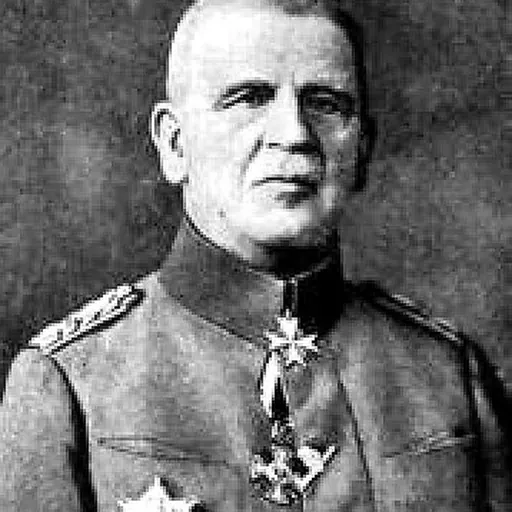
Max von Boehn
Prussian officer involved in the Franco-Prussian War and World War I
About Max von Boehn
Lived 1850 – 1921 (aged 70). Max von Boehn was a German military officer and generaloberst.
Max Ferdinand Karl von Boehn (16 August 1850 − 18 February 1921) was a Prussian and German officer who served in the Franco-Prussian War and World War I. He reached the rank of Generaloberst and held several high commands in World War I. He was decorated with the Pour le Mérite with Oakleaves, Prussia's highest award for military valor.
Life Early life Max von Boehn was born in Bromberg, Kingdom of Prussia (modern Bydgoszcz, Poland) into the Pomeranian noble family von Boehn. He was the son of the later Prussian Lieutenant General Julius Heinrich von Boehn (1820–1893) and his wife Luise Henriette Josepha, née Cords (17 November 1830 Mischwitz at Hohensalza − 19 August 1883 in Berlin). His younger brother, Hans von Boehn (1853–1931) also embarked on a military career, rising to the rank of General der Kavallerie (General of Cavalry). The Prussian General der Infanterie and commanding general of the VI. Army Corps, Oktavio Philipp von Boehn (1824–1899) was their uncle. Boehn attended schools in Thorn, Stolp and Berlin,
Military career Boehn joined the 3rd Regiment of Foot Guards of the Prussian Army as a three-year volunteer on 6 December 1867 at Hanover. Boehn attainted his officer's commission on 15 June and was appointed to Portepeefähnrich on 7 July 1868. Boehn was commissioned a Sekondelieutenant (second lieutenant) on 9 March 1869. On 4 February 1870, he was transferred to Hamburg, with the 8th Company of the (2nd Hanseatic) Infantry Regiment No. 76.
Franco-Prussian War During the Franco-Prussian War of 1870–1871, Boehn participated in the Sieges of Metz, Toul, and Paris as well as the battles at Dreux, Bellême and partially at La Madeleine-Bouvet. He was slightly wounded at the Battle of Loigny by a shot in his right arm and awarded the Prussian Iron Cross 2nd Class and the Mecklenburg-Schwerin Military Merit Cross 2nd Class for his achievements.
Later career From 13 May 1872 to 1 October 1875, Boehn was appointed adjutant of the II. Battalion. A month later, he became an adjutant at the Bezirks-Kommando (military district headquarters) in Hamburg for two years. King Wilhelm II of Württemberg awarded him the Grand Cross of the Friedrich Order in June 1911. On 21 September 1912, Boehn was retired with pension and named à la suite of Infantry Regiment Hamburg (2nd Hanseatic) No. 76. He spent his retirement in Naumburg.
World War I With the mobilization at the outbreak of World War I, Boehn was reactivated as a General of Infantry zur Disposition and appointed the commanding general of the IX Reserve Corps. Called the "North Army," its first duty was protecting the coast in Schleswig-Holstein, as well as the strategically important Kaiser Wilhelm Canal, from a possible invasion, until 22 August 1914. After these initial fears were found groundless, the corps was transferred to Belgium on 23 August. Battles followed near Mechelen and around the Fortress Termonde, until major formations came to the aid of the beleaguered army's right wing from Saint-Quentin. On 14 September, the corps reached Noyon and advanced toward Carlepont. In October 1914, the front stabilized between Roye and Noyon, followed by struggles at Laucourt. Beginning in January 1915, the IX Reserve Corps was deployed for the Battle of Soissons.
From the end of August until 17 September 1915, Boehn also served as acting commander of the 1st Army. Under his command, the detachment fought on the Maas Heights. On 11 March 1917, Boehn was transferred as commanding general to the 7th Army. Under his leadership, the army was deployed to the Winter Battle of Champagne, the position battles on the Aisne and the double battle of the Aisne and Champagne. After heavy fighting on the Chemin des Dames and repeatedly foiling attempts by French forces to break through, Boehn was decorated on 20 May 1917 with the Oakleaves to the Pour le Mérite. Later in the year, the army was involved in the north of the Ailette and in October at the Battle of Malmaison. The Kaiser also honored him with the award of the Grand Cross of the Order of the Red Eagle with Oakleaves and Swords.
On 22 March 1918, at the beginning of German spring offensive or Kaiserschlacht in France, Boehn was promoted to Generaloberst (Colonel General). During the German offensive, the army penetrated to the west but had ceased their advance on 6 April. On 27 May, he was able to proceed aggressively again, overcoming the Chemin des Dames, the Aisne-Marne Canal, the Aisne and the Vesle. Boehn further managed to conquer the forts on the West Front of Reims. Within days, Boehn's units had achieved territorial gains of depth, captured 60,000 prisoners of war and seized 830 artillery pieces and 2,000 machine guns. For these achievements, Wilhelm II appointed him Chief of the Schleswig-Holstein Infantry Regiment No. 163 on 30 May 1918. Six days later, in Fressancourt, Boehn welcomed his regiment, which had been transferred from the 4th to the 7th Army. Boehn was also decorated with the Order of the Black Eagle. on 12 August 1918 from the 2nd, 9th, and 18th Armies to defend the Siegfried Line (Hindenburg Line) in the southern Artois between Oise and Somme. It was the last of its kind in this war. When the superiority of the Allies forced the surrender of the Army Group, it was dissolved on 8 October 1918. Boehn received at his request on 31 October 1918 the command of the 7th Army. After fighting in the Antwerp–Meuse position, the cease fire ending the war was proclaimed on 11 November 1918 at Compiègne. Boehn's units were demobilized on 18 January and he was decommissioned on 27 January 1919. After his retirement, he lived in Charlottenburg. The local "Association of Officers of the former Kaiser Alexander Garde Grenadier Regiment No. 1" appointed him its honorary chairman. Boehn died at age 70 in Sommerfeld and was interred at the Invalids' Cemetery in Berlin. His burial place, like that of his father, has not been preserved.
Family Boehn married Martha Elsner (born 2 March 1854 in Groß Rosenburg Castle in Sommerfeld) on 25 September 1873 in Groß Rosenburg. Four children were born: Volkhart (born 23 June 1874 in Hamburg; died 7 January 1937 in Potsdam), German Major Wanda (born 14 November 1878 in Schwerin; died 16 November 1971 in Berlin) Josepha (born 26 May 1883 in Berlin, died 20 September 1946 in Coburg) Armgard (born 4 December 1885 in Berlin, died 22 April 1971 in Munich)
Boehn Barracks After the First World War, the Treaty of Versailles reduced the German army and caused the city of Hamburg to be demilitarized for nearly 15 years. The old military barracks in the city were then mostly used for social purposes. This would change in 1935 with the expansion of the Wehrmacht under the Third Reich. Hamburg soon became a major garrison city within the Reich.
In 1936, a new barracks complex began construction in Hamburg-Rahlstedt. The barracks were named the (Boehn Barracks) and upon completion in March 1938 assigned to the Wehrmacht's Infantry Regiment 76, which carried the same number as the older Infantry Regiment Hamburg (2nd Hanseatic) No. 76 that Boehn had commanded from 1897 to 1901. During World War II, the barracks, besides its military uses, also housed a hospital for the civilian population of Hamburg. After the war, the barracks complex were used by the British Army and as a displaced persons camp, before returning to German army use with the formation of the Bundeswehr. From 1959 to 1993, the Boehn-Kaserne was headquarters of . The Boehn-Kaserne was closed on 30 September 1993.
After plans to convert the Boehn-Kaserne into a police barracks were abandoned, the complex was used to house refugees and asylum seekers and was later converted to private housing. Only the monument at Dammtor, a memorial stone in the Boehn-Kaserne opposite the former headquarters building of Panzergrenadierbrigade 17, and a bronze relief on the officer's home, remain to commemorate Infantry Regiment No. 76. In addition, the building contains a stone relief depicting Max von Boehn.
Decorations and awards Kingdom of Prussia: Order Pour le Mérite (24 August 1916) with Oakleaves (20 May 1917) Order of the Black Eagle 04.08.1918 Order of the Red Eagle, Grand Cross with Oakleaves and Swords. Royal House Order of Hohenzollern, Cross and Star of a Commander with Swords Iron Cross 2nd Class (1870) with 25th anniversary oakleaves Iron Cross 1st Class (7 September 1914) Service Decoration Cross for 25 years' service War Commemorative Medal of 1870–1871 Kaiser Wilhelm I. Memorial Medal (Centenary Medal) Grand Duchy of Baden: Order of Berthold the First, Grand Cross with Swords (9 January 1918) Kingdom of Bavaria: Military Merit Order, 1st Class with Swords (26 January 1917) Free and Hanseatic City of Bremen: Hanseatic Cross Grand Duchy of Mecklenburg-Schwerin: Military Merit Cross, 2nd Class (1870) Military Merit Cross, 1st Class (24 December 1914) Grand Duchy of Mecklenburg-Strelitz: Cross 1st Class for Distinction in War Grand Duchy of Oldenburg: House and Merit Order of Peter Frederick Louis, Grand Cross (October 1905) Friedrich August Cross, 2nd Class Kingdom of Württemberg: Friedrich Order, Grand Cross (June 1911) Austria-Hungary: Order of the Iron Crown, 3rd Class Kingdom of Belgium: Order of Leopold, Commander Kingdom of Italy: Order of Saints Maurice and Lazarus, Officer Russian Empire: Order of Saint Anna, 2nd Class Kingdom of Siam: Order of the White Elephant, Commander
Don’t just read it —
keep it.
Full-length biographies made to live with: read them, listen on the way to work, watch them tonight.
- E-book
- Audio
- Video
Instant download · yours to keep · every purchase keeps this site free
Important facts
People in Max von Boehn's life
Named in this biography and alive at the same time

Related people
Same field, nearest in time





Contemporaries
People whose lives overlapped Max von Boehn's





Frequently asked questions
Who was Max von Boehn?
Prussian officer involved in the Franco-Prussian War and World War I
When was Max von Boehn born?
Max von Boehn was born on 16 August 1850 in Bydgoszcz.
When did Max von Boehn die?
Max von Boehn died on 18 February 1921 in Lubsko.
What was Max von Boehn's occupation?
Max von Boehn was a military officer and generaloberst.
What nationality was Max von Boehn?
Max von Boehn was German.
Sources & further reading
· DBpedia: Max von Boehn (general)
Cite this page
APA: Biography.guide. (2026). Max von Boehn. https://biography.guide/max-von-boehn/
MLA: "Max von Boehn." Biography.guide, https://biography.guide/max-von-boehn/.
Chicago: "Max von Boehn." Biography.guide. https://biography.guide/max-von-boehn/.
Data last updated: 2026-09-21 · Spot an error? Report a correction.
Portrait: Wikimedia Commons · author & licence
Page generated 2026-09-27 05:01 UTC