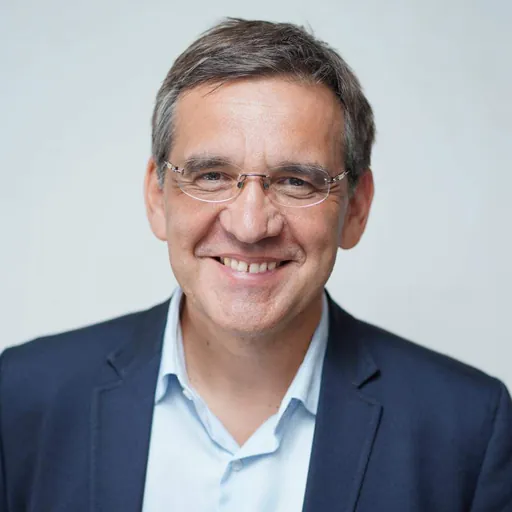
About Max Vityk
Max Vityk was an American painter, geologist and manager.
Max Vityk (born May 27, 1964 in Lviv, Ukraine) is a Ukrainian-American geologist, senior executive, and artist. Renowned for his expertise in geological sciences and operational leadership, Vityk has also gained recognition for his innovative art inspired by geology and mythology.
Early life, education and geology career Born in Lviv, Ukraine, in 1964, Vityk was surrounded by culture from a young age particularly since his father was an opera singer. A close family friend mineralogy professor Volodymyr Kalyuznyi introduced the youngster to geology, describing the origins of life in the strata of rock and leading Vityk to his future profession. From 1982-1989, Vityk received MS degree in geology at University of Lviv and a PhD degree in geochemistry from the Institute of Geology and Geochemistry, also in Lviv. Following graduate school, from 1989 to 1997 he conducted post-doctoral studies and faculty work first at the Department of Physics and Astronomy of Calgary University and later at the Geology Department of Virginia Polytechnic Institute in Blacksburg, Virginia. During this time Vityk publishes a series of scientific articles in leading international professional journals: Contributions to Mineralogy and Petrology; American Mineralogist; Economic Geology; Tectonophysics. From 1997 to 2005 Vityk worked as geologist at ExxonMobil (mostly in the USA), from 2005 to 2019 he worked at Shell PLC (globally) and from 2020 he is employed by Naftogaz Group in Ukraine. In 2019 Vityk also took position of adjunct professor at Virginia Polytechnic Institute.
Geology career
ExxonMobil (1997-2005) Vityk began his career with ExxonMobil in Houston, where he specialized in research and business development. He contributed to large-scale global exploration projects, employing geochemistry, seismic analysis and advanced geophysical technologies to locate and develop hydrocarbon resources. His work at ExxonMobil provided him with extensive technical experience in global energy research and operations.
Shell (2005-2019) At Shell, Vityk progressed to leadership roles in exploration and production, managing projects in Ukraine, former Soviet Union, across Europe, North America, Brazil and the North Africa. In Egypt he led onshore exploration in Western Desert, making several big discoveries.
Naftogaz of Ukraine (2020-present) As a senior executive at Ukrgazvydobuvannya (UGV) of Naftogaz of Ukraine, Vityk in 2020 took on position as Director of Strategic Projects, and later in 2021 as Director for Exploration and Development. He led efforts to modernize exploration and production capabilities of the company, and delivered record-breaking results in exploration and development drilling during the Russian-Ukrainian war to increase gas production four times compared to pre-war. His work demonstrated that Ukraine still offers significant opportunities for increasing gas production, provided modern technologies, approaches, and professional personnel are utilized. Moreover, the increase gas production during the war served as a symbol of national resilience and sovereignty.
Art career
Houston (1997-2005) Vityk started painting during late nineties to explore both figurative and abstract art, inspired by American expressionism and his geological knowledge. Vityk’s first art studio was settled in the garage of his house in the suburb of Houston where he lived from 1997 until 2005. Artists that were inspirational for Vityk - Paul Klee, Piet Mondrian, Yves Klein, Barnet Newman and Willem de Kooning - but it was Jackson Pollock who captured him most. Vityk traveled to New York to visit the NYC Museum of Modern Art’s Pollock collection after seeing Ed Harris’s film Pollock. Seeing the work at MOMA was vital for Vityk, who says he began to seriously paint under Pollock’s influence. One of Vityk's earliest Houston series (2001-2003) shows the strong influence of early Pollock in their crude graphic line. The works combine decorative folk pattern and the bright color of Ukrainian traditional craft.
Vityk admits to a life-long interest in art. As a self-taught painter, he experiments freely, moving back and forth between figurative work, which he began with, and later abstraction. Even in the earliest works, small format oil paintings of landscapes and flowers, he worked in heavily texture layers: betraying the geologist’s vision in the complexity and layers of surface patterns. Vityk received no formal artistic training, but during his international geological assignments, he showed interest in the culture of the nation where he lived and worked, visiting art galleries and museums and interacting with local artists.
Ukraine (2005-2012) In 2005 Max Vityk moved back to Ukraine where he lived and worked until 2012. In Ukraine he purchased a lake house with art studio in Zasupoyivka village located 100 km east from capital Kyiv, where several important Ukrainian artists have studios. Since declaring independence in 1991, Ukraine has struggled to develop an identity independent of Russia and the Soviet Union. Artists, writers, musicians and others found the ancient symbols of Ukrainian folk art powerful as metaphors for reclaiming their history. Folklore, embroidery, native song and dance, and regional arts have grown immensely in popularity
In 2007 he had his first solo show entitled “Geology of Painting” at the Da Vinchy gallery in Kyiv. The earlier Vityk’s works show a strong folk Ukrainian influence, most clearly in the small series done in 2011 titled Hutsul, which was painted in Zasupoyivka. Vityk references the Hutsul decorative patterns of embroidery produced in the Carpathian Mountains which are traditionally geometric and brightly colored.
In the series Sin City (2006-2011), Transformers (2010) and Hallucination in Zasupoyivka series (2009-2020) Vityk returns to archaic symbols in a highly urban way, reminiscent of the graffiti along with Vityk’s signature heavy surface textures so suggestive of cave paintings. The works explore the clash of the modern world and that of Ukrainian traditional crafts and legends handed down from generation to generation. The figurative work shares the craggy, cracked surfaces and sense of three-dimensionality that becomes highly abstract over time. In 2009, “Triptych” Kyiv gallery exhibited an extremely exquisite set of minimalistic paintings from “Silver & Black” series painted in Zasupoyivka - Vityk’s personal journey to explore color and texture.
The “Hallucinations in Zasupoyivka” series - one of the most important Vityk’s body of works, emerged at the beginning of the 2010s from the artist’s enchantment with a mystical beauty of central Ukraine, which also made an impression and influenced the paintings of Ukrainian artist important to Vityk – Anatoliy Kryvolap. Selected paintings from the “Hallucination” series were first exhibited at Art Kyiv in 2011, and later followed by solo shows at the Harry F. Sinclair House of the Ukrainian Art Institute in New York (2014), ArtsMart Gallery in Cairo (2016), National Museum Kyiv Art Gallery Selected painting of Warriors of Light were first displayed at Scope Art Show in Basel (2014) and Cairo Biennale (2015). First exhibition of the entire series took place at the ArtMarts Gallery in Cairo (2016), followed by solo shows at the Harry F. Sinclair House at the Ukrainian Art Institute in New York (2017)
In the Netherlands Vityk started another set of large canvases entitled “The FL” series. These large flower paintings were inspired by the surreal emotions of the iconic bon fires that guarded Revolutionary Euromaidan in Kyiv. In the Netherlands Vityk also created a small series of paintings from 2014-2015, Fragments. Appearing like primitive archeologic finds, these are painted on cardboard, a material that warps and disintegrates in a cycle reminiscent of geologic processes.
In the Netherlands Vityk started in depth exploring geology based abstract painting. In the “Lava” series (2013-2014), and from 2021 until present is on display in the headquoters of Naftogas of Ukraine in Kyiv.
Cairo (2015 - 2018) In 2015 Vityk moved to Cairo, Egypt where he lived and worked until 2018. Geology based abstract paintings The Outcrops In The Outcrops, Vityk charts the entire geologic timescale of the Earth using his “outcropping” technique of foam and enamel paint. This combination of different materials creates textures reminiscent of living rock formations. As one of the new generation of abstractionists, Vityk brings a thematic focus to the scale and layered paint of the New York School painters. His color system creates a symbolic layering of geologic time, from the white of ice ages to the blues and greens of life emerging from the seas and moving on to land.
Selected painting from The Outcrops were first exhibited Art Context in New York (2017), followed by solo shows at the Harry F. Sinclair House at the Ukrainian Art Institute in New York (2017), shortly followed by a solo entitled “Earth Spirit” at the Sheptyckyi Art Center of the Ukrainian Catholic University in Lviv (2023). A week later, on October 10 Russian army launched a massive missile attack on the main cultural institutions of Ukraine. The building of the National Museum Kyiv Art Gallery and Vityk’s exhibition were damaged. The exhibition was reopened in April 2023 after museum reconstruction.
Starting 2023 Vityk’s exhibitions are traveling around the country with 7 solo and 4 group shows at Ukrainian museums, galleries and universities. In September 2023 University of Lviv opens a major show of Vityk works along with large charity event to support the Ukrainian army. At the exhibition opening Maksym Kozytskyi, head of Lviv Regional State/Military Administration said: "Every individual who is now protecting our territorial integrity and the entire generations who have done this long before us - are also the Warriors of Light. We must remember who made it possible for us to live and attend such events. It is our duty to honor everyone we have lost and to support those who are now at the front lines”.
Selected solo exhibitions
Mirage and Reality, Museum of Ukrainian Diaspora, Kyiv, Ukraine. 2023-2024 Max Vityk: Warriors of Light, Lviv National University. 2023-2024 Max Vityk: Spirt of the Earth, Sheptyckyi Art Center of Ukrainian Catholic University, Lviv, Ukraine. 2023 The Warriors of Light, Poltava Art Museum, Poltava, Ukraine. 2023 The Warriors of Light at Pidhirtsi Castle, Museum of Pidhoreckyi Castle, Ukraine. 2023 History of Planet Earth, Poltava Polytechnic University, Poltava, Ukraine. 2023 The Warriors of Light, National Museum Kyiv Art Gallery, Ukraine. 2022-2023 Max Vityk: Paintings, Ukrainian Institute of America, New York, USA. 2021 The Outcrops, International Museum of Art and Science, McAllen, USA. 2018 Max Vityk: Warriors Of Light/The Outcrops, Ukrainian Institute of America, New York, USA. 2017 Max Vityk: Retrospective, ArtsMart Gallery, Cairo, Egypt. 2016 A Journey, Ukrainian Institute of America, New York, USA. 2014 Energy Project, Shell Headquarters, The Hague, The Netherlands. 2013 Max Vityk: The Retrospective, Contemporary Art Center M17, Kyiv, Ukraine. 2012 Max Vityk: Retrospective, Lviv Municipal Art Center, Lviv, Ukraine. 2010 Silver and Black, Triptich Gallery, Kyiv, Ukraine. 2009 Max Vityk: Paintings, Bottega Gallery, Kyiv, Ukraine. 2008 Geology of Painting, Da Vinci Gallery, Kyiv, Ukraine. 2007
Illustrations
Don’t just read it —
keep it.
Full-length biographies made to live with: read them, listen on the way to work, watch them tonight.
- E-book
- Audio
- Video
Instant download · yours to keep · every purchase keeps this site free
Important facts
Related people
Same field, nearest in time



Frequently asked questions
Who was Max Vityk?
American painter
What was Max Vityk's occupation?
Max Vityk was a painter, geologist and manager.
What nationality was Max Vityk?
Max Vityk was American.
Sources & further reading
Cite this page
APA: Biography.guide. (2026). Max Vityk. https://biography.guide/max-vityk/
MLA: "Max Vityk." Biography.guide, https://biography.guide/max-vityk/.
Chicago: "Max Vityk." Biography.guide. https://biography.guide/max-vityk/.
Data last updated: 2026-09-23 · Spot an error? Report a correction.
Portrait: Wikimedia Commons · author & licence
Page generated 2026-09-27 05:05 UTC