
About Max (Mordechai) Farbmann
Lived 1886 – 1950 (aged 64). Max (Mordechai) Farbmann was an Israeli sculptor.
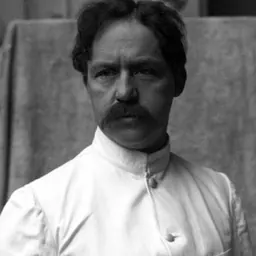
Max (Mordechai) Farbmann (1 April 1886 – 20 April 1950) was a Lithuanian Jewish sculptor who achieved prominence in Europe, particularly Vienna, Austria, during the early 20th century. He was responsible for designing the Lithuanian Independence Monument in his native Salakas.
Biography
Max (Mordechai) Farbmann was born in 1886 in Salakas (Solok) in present-day Lithuania, and moved to Vienna at the age of 20 to study sculpture. There, he earned a reputation, leading the Vienna Arts Academy to purchase one of his works – a noted achievement for a Jewish artist. Among his works were commissioned sculpted busts of prominent European figures, including many leading statesmen, as well as the Lithuanian Independence Monument, which was erected in his hometown of Solok in 1930. Farbmann was a versatile sculptor who worked in multiple mediums, including bronze, wood, stone, and ivory. His carvings focused primarily on detail and atmosphere, revealing an intimate knowledge of and appreciation for the subjects.
In 1933, Farbmann settled in Tel Aviv, Israel at the invitation of the mayor of the city. In an interview by the South African Jewish Times in 1952, his daughter Ruth stated that due to a pre-existing taboo against making images in the Jewish culture caused by the Biblical commandment "thou shalt not make images", "my father [M. Farbmann] was a simple teacher [at the Balfour College in Tel Aviv] in his last years because he could not make a living as a sculptor". Nevertheless, Farbmann continued to create sculptures, focusing more on Jewish themes in his later career. He died in Israel in 1950, aged 64.
Since 2015, a collection of artist's portrait photographs and letters from Farbmann's estate is found today at the Information Center for Israeli Art in the Israel Museum, Jerusalem. His works can be found in museums in Israel and Austria.
Gallery
Don’t just read it —
keep it.
Full-length biographies made to live with: read them, listen on the way to work, watch them tonight.
- E-book
- Audio
- Video
Instant download · yours to keep · every purchase keeps this site free
Important facts
Related people
Same field, nearest in time



Contemporaries
People whose lives overlapped Max (Mordechai) Farbmann's


Frequently asked questions
Who was Max (Mordechai) Farbmann?
Israeli sculptor (1886-1950)
When was Max (Mordechai) Farbmann born?
Max (Mordechai) Farbmann was born on 1 April 1886 in Salakas.
When did Max (Mordechai) Farbmann die?
Max (Mordechai) Farbmann died on 20 April 1950 in Israel.
What was Max (Mordechai) Farbmann's occupation?
Max (Mordechai) Farbmann was a sculptor.
What nationality was Max (Mordechai) Farbmann?
Max (Mordechai) Farbmann was Israeli.
Sources & further reading
· Wikipedia: Max (Mordechai) Farbmann
· DBpedia: Max (Mordechai) Farbmann
Cite this page
APA: Biography.guide. (2026). Max (Mordechai) Farbmann. https://biography.guide/max-mordechai-farbmann/
MLA: "Max (Mordechai) Farbmann." Biography.guide, https://biography.guide/max-mordechai-farbmann/.
Chicago: "Max (Mordechai) Farbmann." Biography.guide. https://biography.guide/max-mordechai-farbmann/.
Data last updated: 2026-09-20 · Spot an error? Report a correction.
Page generated 2026-09-27 05:24 UTC