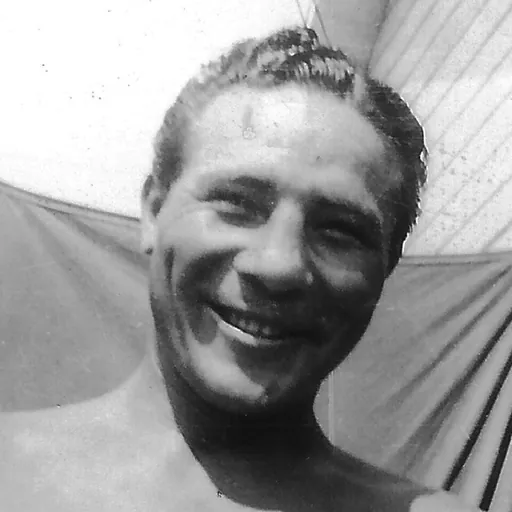
About Max Baer
Lived 1909 – 1959 (aged 50). Max Baer was an American actor, boxer, film actor and athlete.
Maximilian Adelbert Baer Sr. (February 11, 1909 – November 21, 1959) was an American professional boxer and the world heavyweight champion from June 14, 1934, to June 13, 1935. He was known in his time as the Livermore Larupper and Madcap Maxie. Two of his fights (a 1933 win over Max Schmeling and a 1935 loss to James J. Braddock) were rated Fight of the Year by The Ring magazine. Baer was also a boxing referee, and had occasional roles in film and television. He was the brother of heavyweight boxing contender Buddy Baer and father of actor Max Baer Jr. Baer is rated #22 on The Ring magazine's list of 100 greatest punchers of all time.
Early life Baer was born on February 11, 1909, in Omaha, Nebraska, to Jacob Baer (1875–1938) and Dora Bales (1877–1938). His father was the son of Jewish immigrants from Alsace-Lorraine and his mother was of Scottish descent. His elder sister was Frances May Baer (1905–1991), his younger sister was Bernice Jeanette Baer (1911–1987), his younger brother was boxer-turned-actor Jacob Henry Baer, better known as Buddy Baer (1915–1986), and his adopted brother was August "Augie" Baer.
Baer moved to Livermore, California, with his family as a child. He attended high school only one year, quitting to work in his father's butcher shop. Livermore was ranch and cowboy country, surrounded by tens of thousands of acres of open land on which large cattle herds grazed and provided fresh meat to the local area. In 1928, Jacob leased the Twin Oaks Ranch in Murray Township, where he raised more than 2,000 hogs and worked with daughter Frances' husband, Louis Santucci. By age eighteen, Baer stood 6 feet tall and weighed 190 pounds.
At noon the next day, with a lit candle laced between his crossed fingers, and his wife and mother beside him, Frankie Campbell was pronounced dead. Upon the surgeon's announcement of Campbell's death, Baer broke down and sobbed inconsolably. Brain specialist Dr. Tilton E. Tillman "declared death had been caused by a succession of blows on the jaw and not by any struck on the rear of the head" and that Campbell's brain had been "knocked completely loose from his skull" by Baer's blows.
In 1930, Baer was charged with manslaughter. He was ultimately cleared of criminal charges, but the California State Athletic Commission suspended him from boxing in the state for one year. Following Campbell's death, Baer stepped away from boxing for several months. Upon returning, he lost four of his next six bouts, in part due to a hesitancy to press the attack. One of those victories came at the hands of future Hall of Famer Tommy Loughran, who observed that Baer was looping and telegraphing his punches. Former heavyweight champion Jack Dempsey later worked with Baer to shorten his punches and remained interested in his development throughout the rest of his career.
Ernie Schaaf The Campbell incident earned Baer the reputation as a "killer" in the ring. This publicity was further sensationalized by Baer's return bout with Ernie Schaaf, on August 31, 1932. Schaaf had bested Baer in a decision during Max's Eastern debut bout at Madison Square Garden on September 19, 1930.
An Associated Press article in the September 9, 1932, sports section of the New York Times describes the end of the return bout as follows:Two seconds before the fight ended Schaaf was knocked flat on his face, completely knocked out. He was dragged to his corner and his seconds worked on him for three minutes before restoring him to his senses... Baer smashed a heavy right to the jaw that shook Schaaf to his heels, to start the last round, then walked into the Boston fighter, throwing both hands to the head and body. Baer drove three hard rights to the jaw that staggered Schaaf. Baer beat Schaaf around the ring and into the ropes with a savage attack to the head and body. Just before the round ended Baer dropped Schaaf to the canvas, but the bell sounded as Schaaf hit the floor. Schaaf complained frequently of headaches after that bout. Five months after the Baer fight, on February 11, 1933, Schaaf died in the ring after taking a left jab from the Italian fighter Primo Carnera. The majority of sports editors noted, however, that an autopsy later revealed Schaaf had meningitis, a swelling of the brain, and was still recovering from a severe case of influenza when he touched gloves with Carnera. Schaaf's obituary stated that "just before his bout with Carnera, Schaaf went into reclusion in a religious retreat near Boston to recuperate from an attack of influenza" which produced the meningitis.
The death of Campbell and accusations over Schaaf's demise profoundly affected Baer, even though he was ostensibly indestructible and remained a devastating force in the ring. According to his son, actor/director Max Baer Jr. (who was born seven years after the incident):My father cried about what happened to Frankie Campbell. He had nightmares. In reality, my father was one of the kindest and most gentle men you could ever hope to meet. He treated boxing the way today's professional wrestlers do wrestling: part sport, mostly showmanship. He never deliberately hurt anyone.
Max Schmeling
On June 8, 1933, Baer fought and defeated German heavyweight and former world champion Max Schmeling at Yankee Stadium, by technical knockout. Schmeling was favored to win and was Adolf Hitler's favorite boxer. The Nazi tabloid Der Stürmer publicly attacked Schmeling for fighting a non-Aryan, as Baer's father was Jewish, calling it a "racial and cultural disgrace."
Although the Great Depression, then in full force, had lowered the income of most citizens, sixty thousand people attended the boxing match. wore trunks which displayed a large Star of David, He wore this symbol in all his future bouts. During the match, he dominated the rugged Schmeling into the tenth round, when Baer knocked Schmeling down and the referee stopped the match. Columnist Westbrook Pegler wrote about Schmeling's loss, "That wasn't a defeat, that was a disaster", while journalist David Margolick claimed that Baer's victory would come to "symbolize Jewry's struggle against the Nazis."
Film star Greta Garbo considered Baer's defeat of Schmeling to be a "mini victory" over Nazism, and she invited Baer to visit her while she was filming Queen Christina in Hollywood. However, Baer's presence on the set was considered a "sacrilege" in Hollywood, as even MGM studio's head, Louis B. Mayer, wasn't allowed on Garbo's set, since she demanded total privacy while acting. Their friendship led to a romance, which lasted until he returned to New York to train for his next match against Primo Carnera. Despite this dominant performance over Carnera, Baer would hold the world heavyweight title for just 364 days.
James J. Braddock On June 13, 1935, one of the greatest upsets in boxing history occurred at the Madison Square Garden Bowl, as Baer fought down-and-out boxer James J. Braddock in the so-called Cinderella Man bout. Baer hardly trained for the bout. Braddock, on the other hand, trained hard. "I'm training for a fight, not a boxing contest or a clownin' contest or a dance," he said. "Whether it goes one round or three rounds or ten rounds, it will be a fight and a fight all the way. When you've been through what I've had to face in the last two years, a Max Baer or a Bengal tiger looks like a house pet. He might come at me with a cannon and a blackjack and he would still be a picnic compared to what I've had to face." Baer, ever the showman, "brought gales of laughter from the crowd with his antics" the night he stepped between the ropes to meet Braddock. As Braddock "slipped the blue bathrobe from his pink back, he was the sentimental favorite of a Bowl crowd of 30,000, most of whom had bet their money 8-to-1 against him." Braddock took heavy hits from Baer but kept coming at him until he wore Max down. At the end of 15 rounds Braddock emerged the victor in a unanimous decision, outpointing Baer 8 rounds to 6 in the "most astounding upset since John L. Sullivan went down before the thrusts of Gentleman Jim Corbett back in the nineties." It was learned weeks later that Baer fought Louis with a broken right hand that never healed from his fight with James J. Braddock. Max was virtually helpless without his big right hand in the Louis fight. In the first televised heavyweight prizefight, Baer lost to Lou Nova on June 1, 1939, on WNBT-TV in New York.
White Heavyweight Champ Baer was awarded a belt declaring him the "White Heavyweight Champion of the World" after he scored a first-round TKO over Pat Cominsky in a bout at Roosevelt Stadium in Jersey City, New Jersey, on September 26, 1940, but it was a publicity stunt. The fight was not promoted as being for the white heavyweight championship, and Cominsky would not have won the belt had he beaten Baer.
The belt was a publicity stunt dreamed up by boxing promoters who were trying to pressure promoter Mike Jacobs into giving the ex-world heavyweight champion a rematch with current champ Joe Louis. Jacobs did not give Baer another bout with Louis. Baer retired after his next fight, on April 4, 1941, when he lost to Lou Nova on a TKO in the eighth round of a scheduled 10-rounder at Madison Square Garden. Nova did get a shot at Joe Louis, losing to the champion by TKO in the sixth round of a scheduled fifteen-round bout held at the Polo Grounds in New York.
Career statistics Baer boxed in 84 professional fights from 1929 to 1941. In all, his record was 71–13. Fifty-three of those wins were knockouts, making him a member of the exclusive group of boxers to have won 50 or more bouts by knockout. Baer defeated the likes of Ernie Schaaf, Walter Cobb, Kingfish Levinsky, Max Schmeling, Tony Galento, Ben Foord and Tommy Farr. He was Heavyweight Champion of the World from June 14, 1934, to June 13, 1935.
Baer was a 1968 inductee into The Ring magazine's Boxing Hall of Fame (disbanded in 1987) and was inducted to the International Boxing Hall of Fame in 1995. He was inducted to the International Jewish Sports Hall of Fame in 2009. The 1998 Holiday Issue of Ring ranked Baer #20 in "The 50 Greatest Heavyweights of All Time". In Ring Magazine's 100 Greatest Punchers (published in 2003), Baer is ranked number 22.
Boxing style Baer was known as for his aggressive, charismatic and clowning style. However, it is widely considered that he became less aggressive after he was charged with manslaughter when Frankie Campbell died in a bout with Baer.
He was a slugger with significant knockout power. also used by future heavyweight sluggers such as George Foreman.
Acting
Baer's motion picture debut was in The Prizefighter and the Lady (1933) opposite Myrna Loy and Walter Huston. In this MGM movie he played Steven "Steve" Morgan, a bartender that the Professor, played by Huston, begins training for the ring. Steve wins a fight, then marries Belle Mercer, played by Loy. He starts seriously training, but it turns out he has a huge ego and an eye for women. Featured were Baer's upcoming opponent, Primo Carnera, as himself, whom Steve challenges for the championship, and Jack Dempsey, as himself, former heavyweight champion, acting as the referee.
On March 29, 1934, The Prizefighter and the Lady was officially banned in Germany at the behest of Joseph Goebbels, Adolf Hitler's Minister of Propaganda and Public Entertainment, even though it received favorable reviews in local newspapers as well as in Nazi publications. When contacted for comment at Lake Tahoe, Baer said, "They didn't ban the picture because I have Jewish blood. They banned it because I knocked out Max Schmeling." Baer, along with his brother Buddy, enlisted in the U.S. Army Air Force when World War II began.
Baer acted in almost 20 movies, including Africa Screams (1949) with Abbott and Costello, and made several television guest appearances. A clown in and out of the ring, Baer also appeared in a vaudeville act and on his own TV variety show. Baer appeared in Humphrey Bogart's final movie, The Harder They Fall (1956), opposite Mike Lane as Toro Moreno, a Hollywood version of Primo Carnera, whom Baer defeated for his heavyweight title. Budd Schulberg, who wrote the book on which the movie was based, portrayed the Baer character, "Buddy Brannen", as bloodthirsty, and the unfounded characterization was reprised in the movie Cinderella Man.
In 1950, Baer teamed up with another titleholder, friend and Light Heavyweight champion (1929–34) and boxer-turned actor/comedian, Maxie Rosenbloom. Together, the two starred in four slapstick comedy shorts for Columbia Pictures (produced by the makers of the Three Stooges comedies) and one feature film, Skipalong Rosenbloom (written by Rosenbloom, uncredited). The team embarked on a comedy tour, billed as "The Two Maxie's". Baer would also take the stage at Rosenbloom's comedy club on Wilshire Blvd, Slapsy Maxie's, which was featured in the film Gangster Squad. Baer and Rosenbloom remained friends until Baer's death in 1959.
Baer checked into the Hollywood Roosevelt Hotel upon his arrival on November 19. Hotel employees said he looked fit but complained of a cold. As he was shaving on the morning of November 21, he experienced chest pains. He called the front desk and asked for a doctor. The desk clerk said that "a house doctor would be right up." "A house doctor?" he replied jokingly, "No, dummy, I need a people doctor".
A doctor gave Baer medicine, and a fire department rescue squad administered oxygen. His chest pains subsided and he was showing signs of recovery when he was stricken with a second heart attack. Just a moment before, he was joking with the doctor, declaring he had come through two similar but lighter attacks earlier in Sacramento, California. Then he slumped on his left side, turned blue and died within a matter of minutes. His last words reportedly were, "Oh God, here I go." unless otherwise stated.
Official record
All newspaper decisions are officially regarded as "no decision" bouts and are not counted in the win/loss/draw column.
Unofficial record
Record with the inclusion of newspaper decisions in the win/loss/draw column.
Titles in boxing Major world titles NYSAC heavyweight champion (200+ lbs) NBA (WBA) heavyweight champion (200+ lbs)
The Ring magazine titles The Ring heavyweight champion (200+ lbs)
Undisputed titles Undisputed heavyweight champion
Don’t just read it —
keep it.
Full-length biographies made to live with: read them, listen on the way to work, watch them tonight.
- E-book
- Audio
- Video
Instant download · yours to keep · every purchase keeps this site free
Important facts
People in Max Baer's life
Named in this biography and alive at the same time




Related people
Same field, nearest in time



Contemporaries
People whose lives overlapped Max Baer's


Frequently asked questions
Who was Max Baer?
American boxer (1909–1959)
When was Max Baer born?
Max Baer was born on 11 February 1909 in Omaha.
When did Max Baer die?
Max Baer died on 21 November 1959 in Hollywood.
What was Max Baer's occupation?
Max Baer was an actor, boxer, film actor and athlete.
What nationality was Max Baer?
Max Baer was American.
Sources & further reading
Cite this page
APA: Biography.guide. (2026). Max Baer. https://biography.guide/max-baer/
MLA: "Max Baer." Biography.guide, https://biography.guide/max-baer/.
Chicago: "Max Baer." Biography.guide. https://biography.guide/max-baer/.
Data last updated: 2026-09-20 · Spot an error? Report a correction.
Portrait: Wikimedia Commons · author & licence
Page generated 2026-09-27 04:57 UTC