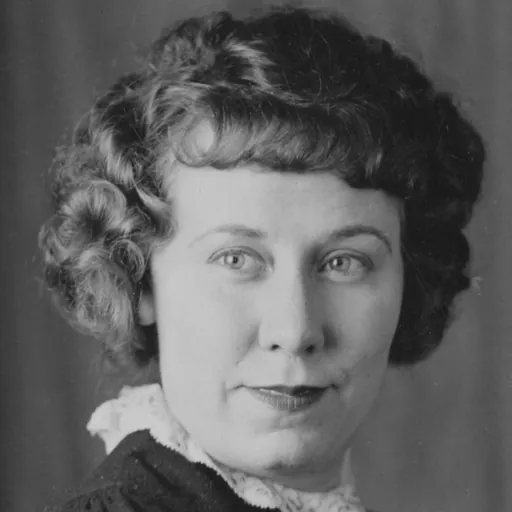
About Maurine Whipple
Lived 1903 – 1992 (aged 89). Maurine Whipple was a writer.
Maurine Whipple (January 20, 1903 – April 12, 1992) was an American novelist and short story writer best known for her novel The Giant Joshua. The book is lauded as one of the most important Mormon novels, vividly depicting pioneer and polygamous life in the 19th century.
Whipple grew up in St. George, Utah. She attended Dixie College, then graduated from the University of Utah with honors. She taught high school for several years in both Utah and Idaho. After attending the 1937 Rocky Mountain Writer's conference, she made connections that led to her publish The Giant Joshua with Houghton Mifflin. Afterwards, she made plans to make The Giant Joshua into a trilogy, but the two additional volumes, along with two other novels, remained unfinished at the time of her death. Although she never published any additional longer works, she published essays, short stories, and articles in various journals and periodicals.
Early life and education Maurine Whipple was born to Charles and Annie Lenzi (McAllister) Whipple on January 20, 1903, in St. George, Utah, the oldest of six children. Her parents were both children of parents in polygamous relationships. Charlie left the church during Whipple's childhood. Whipple's maternal grandmother, Cornelia Lenzi McAllister, and her fellow sister wives told Whipple stories about their lives when she was young. When she was twelve years old in 1915, Maurine's mother gave birth to her brother George and had a nervous breakdown. Maurine stayed home from school to help raise George, who suffered from eczema and other ailments and needed constant care.
In 1906, alongside his lumber yard and ice house businesses, Charlie and some business associates ran a movie theater in town. When she was old enough, Whipple worked in the theater as a janitor and popcorn girl until it closed in the Great Depression. Historian Juanita Brooks, who taught at Maurine's school when she was a senior, described her as precocious and recalled that she was the editor of the school newspaper and yearbook. As a teenager, she taught Sunday School in the Church of Jesus Christ of Latter-day Saints (LDS Church). She considered herself an active member until the 1930s.
Whipple began her higher education at Dixie College and then transferred to the University of Utah in 1923. She stayed with family during her sophomore and junior years. Whipple boarded at the Beehive House during her senior year. She wrote short stories for her English classes and completed her student teaching, probably at Stewart Junior High. She graduated in 1926 with honors.
Teaching After graduating, Whipple taught at four different schools throughout Utah and Idaho.
In 1945, Whipple published a travel guide for tourists called This is the Place: Utah. In the guide, she criticized the LDS Church's use of tithing to build an expensive office building, among other things. In his review in the Saturday Review of Literature, Dale Morgan praised her skepticism and interest in people, but criticized her unattributed use of information from Utah Guide. Literary critic Harry Hansen titled his review "Mormons are Peculiar: Maurine Whipple Whips Up More About Them and Their Country." A reviewer in the Boston Herald said the book was unexpectedly entertaining. A review in The Salt Lake Tribune described Whipple as sympathetic yet objective, combining humor and logic. A review in The Chicago Sun called the book a "sales promotion" and questioned whether or not Mormons should want to be completely American. Whipple's friends praised the book to her and Elvitta Phillips, regional editor of the Spokane Daily Column told her that the book had sold out in Spokane.
Also in 1945, Whipple employed a new agent, Max Becker, who sold the still unwritten sequel to The Giant Joshua to Simon and Schuster. Becker arranged for the publisher to advance Whipple 150 dollars a month for a year while she wrote the book. Whipple planned for and wrote 200 pages of the sequel entitled Cleave the Wood. Ill health and psychological discomfort made it difficult for Whipple to settle into writing the entire book. At one point in 1947, Whipple destroyed the first one hundred pages. Whipple reports that the manuscript she wrote afterwards was stolen in 1970 when her house was robbed. She wrote sample chapters for two other novels and numerous short stories, some vehemently anti-war. Publishers declined her queries for publishing. In 1947, she wrote about Utah for Life with photographers Loomis Dean and Grant Allen. Life editor Roy Craft encouraged her work. Life approved her to work with Dean on a piece about homesteader Josie Bassett Morris; Dean sent Whipple home after arriving and finished the story without her. Due to several misunderstandings, Life stopped working with Whipple. In 1948, she spent much time and energy writing a piece on Harry Goulding for Bert MacBride to possibly publish in Reader's Digest. MacBride did not accept the piece, but sent her some money for her efforts. Whipple asked friends to write to MacBride and ask him to reconsider, which MacBride considered unprofessional. She wrote to Paul Gallico, the president of the Authors' Guild, who sent her some money to pay for living expenses. Whipple sent Gallico her piece on Goulding and her correspondence with MacBride, and Goulding advised her to improve her writing. She published articles in several other periodicals, including The Saturday Evening Post and Collier's.
Personal life Curtis Taylor admired Whipple's writing and described her personality as "vastly childlike, deeply, anciently childlike." Veda Hale, Whipple's biographer and friend, describes her personality as "paradoxical", being emotionally needy and idealistic yet distant from her family; writing voluminously, yet rarely publishing.
Whipple's father Charlie openly had affairs with other women in town, much to her mother Annie's embarrassment. Even though the 1890 Manifesto had halted new polygamous marriages, children who grew up in polygamous families felt its influence. Hale, speculates that Charlie's own father, who married a younger second wife, influenced Charlie's taking a mistress.
Whipple was frequently ill with respiratory infections. Although she suffered many real health problems, according to Hale, "almost certainly" some of her health complaints were psychosomatic.
Romantic relationships and trauma Whipple frequently had unrequited crushes on men. She attributed her lack of romantic success to tragic accidents, war, misunderstanding, or fate. One of these crushes started in 1923 after her first year attending classes at the University of Utah. Whipple's brother Ralph had a ruptured appendix and peritonitis. Whipple acted as the doctor's assistant for the surgery. The young doctor, Clare Woodbury, was in St. George for his father's funeral, whose practice he inherited. Whipple stated that their relationship was never physically intimate. Whipple later fictionalized her meeting with Woodbury in "Confessions of a She Devil," imagining him as an "experienced seducer of young girls." The experience reappears in another short story, showing, according to Hale, her "deep sexual vulnerability" which informed her writing in The Giant Joshua. Whipple had other relationships with men, but they were not successful.
Whipple was married briefly. Around 1931, Whipple renewed her friendship with Lillian McQuarrie, who was doing research for a historical novel set in 1860s Utah. McQuarrie encouraged Whipple to "settle" for marriage, and Whipple married the recently divorced Emil de Neuf on September 14, 1932. They were divorced after four months. In 1935, she was raped during the time she taught in Latuda, Utah and subsequently had an abortion.
Legacy Appreciation for The Giant Joshua rose in the 1970s, with the beginnings of the academic study of Mormon literature. Mormon scholars such as Eugene England, Richard Cracroft, Bruce Jorgensen, Neal E. Lambert, Mary Lythgoe Bradford, and Edward A. Geary began celebrating Whipple as one of Mormonism's great novelists, and a key member of the "Mormon Lost Generation". The Giant Joshua came to be regularly taught in the curriculum of Mormon literature courses at Brigham Young University. Just before her death, two of her older stories were published in the journals Dialogue: A Journal of Mormon Thought and Sunstone Magazine. The Association for Mormon Letters awarded Whipple with a lifetime achievement award and a lifetime honorary membership in 1991, the year before her death. In 2020, many of Whipple's previously published short pieces and her unpublished writings, including the completed chapters of "Cleave the Wood", were published as A Craving for Beauty: The Collected Writings of Maurine Whipple.
Publications A Dress for Christmas - first published in 1925 issue of Pen, the University of Utah's literary magazine. Revised in 1939 and published in the October 1991 Sunstone. “Quicksand”. The University Pen (University of Utah), June 1926. The Giant Joshua (1941) “Meet the Mormons”. Look, March 10, 1942. This is the Place: Utah (1945). "They Did Go forth" (short story written in 1943, published in Dialogue (journal)) Winter 1991. “A Mormon Family has a Reunion”. Life, October 27, 1947. "Josie, Queen of the Cattle Rustlers". Life, January 5, 1948. “Anybody’s Gold Mine”. Saturday Evening Post, October 1, 1949. “Arizona Strip--‘America’s Tibet’”. Collier’s, May 24, 1952. “The Return of St. Thomas-on-the-Muddy,“ Collier's September 20, 1952. “Why I Have Five Wives: A Mormon Fundamentalist Tells His Story,” Collier's, November 13, 1953. Review of The Francher Train by Amelia Bean. Utah Historical Quarterly, October 1959. “Panguitch--Big Fish“. Western Gateways: Magazine of the Golden Circle, March 1969. “The Overcoat”. Irreantum, 17.1. October 2020. “Mormon Drama”. Dialogue: A Journal of Mormon Thought, Winter 2020.
Don’t just read it —
keep it.
Full-length biographies made to live with: read them, listen on the way to work, watch them tonight.
- E-book
- Audio
- Video
Instant download · yours to keep · every purchase keeps this site free
Important facts
People in Maurine Whipple's life
Named in this biography and alive at the same time





Related people
Same field, nearest in time





Contemporaries
People whose lives overlapped Maurine Whipple's
Frequently asked questions
Who was Maurine Whipple?
writer
When was Maurine Whipple born?
Maurine Whipple was born on 20 January 1903 in St. George.
When did Maurine Whipple die?
Maurine Whipple died on 12 April 1992.
What was Maurine Whipple's occupation?
Maurine Whipple was a writer.
Sources & further reading
Cite this page
APA: Biography.guide. (2026). Maurine Whipple. https://biography.guide/maurine-whipple/
MLA: "Maurine Whipple." Biography.guide, https://biography.guide/maurine-whipple/.
Chicago: "Maurine Whipple." Biography.guide. https://biography.guide/maurine-whipple/.
Data last updated: 2026-09-22 · Spot an error? Report a correction.
Portrait: Wikimedia Commons · author & licence
Page generated 2026-09-27 05:03 UTC