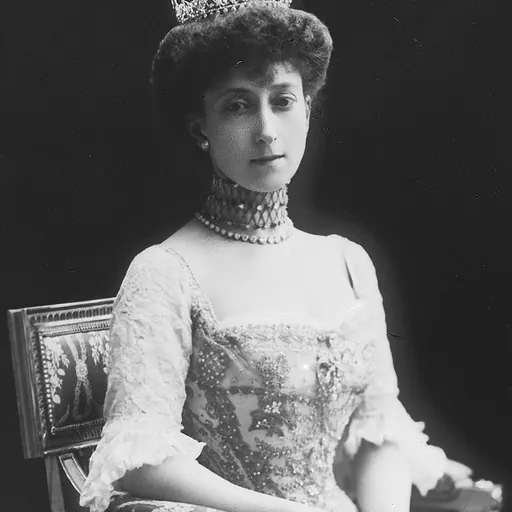
Maud of Wales
British princess (1869–1938), Queen consort of Norway from 1905 to 1938
About Maud of Wales
Lived 1869 – 1938 (aged 68). Maud of Wales was a British and Norwegian consort and royalty.
Maud of Wales (Maud Charlotte Mary Victoria; 26 November 1869 – 20 November 1938) was Queen of Norway from 18 November 1905 until her death in 1938 as the wife of King Haakon VII.
Maud was born during the reign of her paternal grandmother, Queen Victoria, as the third daughter and youngest surviving child of the Prince and Princess of Wales (later King Edward VII and Queen Alexandra). In 1896, she married her first cousin Prince Carl of Denmark. Following the dissolution of the union between Sweden and Norway in November 1905, Carl was elected King of Norway, taking the name Haakon VII. Maud thus became queen consort of Norway. She and her husband quickly adapted to their new roles and Norwegian identity, including her appreciation for the country's winter sports. Maud maintained strong connections to her native England, visiting every year and serving as a link between the British and Norwegian monarchies. Maud died in London on 20 November 1938.
Early life and education
Maud was born at 12:20 am on 26 November 1869 at Marlborough House, London. She was the third daughter and fifth child of Albert Edward, Prince of Wales, and Alexandra, Princess of Wales. Albert Edward was the eldest son of Queen Victoria, and Alexandra was the eldest daughter of Christian IX of Denmark. Maud was christened "Maud Charlotte Mary Victoria" at Marlborough House by John Jackson, Bishop of London, on 24 December. Her godparents were her paternal uncle Prince Leopold, for whom the Duke of Cambridge stood proxy; Prince Frederick William of Hesse-Kassel, for whom Prince Francis of Teck stood proxy; Count Gleichen; the Duchess of Nassau, for whom Princess Francis of Teck stood proxy; Charles XV of Sweden, for whom Swedish minister Baron Hochschild stood proxy; Princess Marie of Leiningen, for whom Princess Claudine of Teck stood proxy; her maternal aunt the Tsarevna of Russia for whom Baroness de Brunnow stood proxy; Crown Princess Louise of Denmark, for whom Madame de Bülow, wife of the Danish minister, stood proxy; and her great-great-aunt the Duchess of Inverness.
Growing up, Maud had a love for all outdoor sports. She was described as having a 'kind and cheerful disposition.' Of her sisters, she was the most attractive. 'She did look so pretty and fresh,' wrote the Empress Frederick of Maud in 1895, 'like a little rose, with her bright eyes and dear intelligent expression.' Maud with her sisters Louise and Victoria. Painting by Sydney Prior Hall, 1883The tomboyish Maud was known as "Harry" to the royal family, after Edward VII's friend Admiral Henry Keppel, whose conduct in the Crimean War was considered particularly courageous at the time. Maud took part in almost all the annual visits to the Princess of Wales's family gatherings in Denmark and later accompanied her mother and sisters on cruises to Norway and the Mediterranean. She was a bridesmaid at the 1885 wedding of her paternal aunt Beatrice to Prince Henry of Battenberg, and at the wedding of her brother George to Mary of Teck in 1893.
Maud, along with her sisters, Victoria and Louise, received the Imperial Order of the Crown of India from their grandmother Queen Victoria on 6 August 1887. Like her sisters, she also held the Royal Order of Victoria and Albert (First Class) and was a Dame Grand Cross of the Order of the Hospital of St. John of Jerusalem.
Princess of Denmark
Maud married relatively late, waiting until her late twenties to find a husband.
While in Denmark, Maud was often homesick and preferred her native English customs; her talk, interests, and pursuits were those of English county society. She was never happier than when gardening, riding, bicycling, or driving a wagonette. Although her Copenhagen home, a suite of twelve rooms in what was known as Bernstorff Mansion beside the Amalienborg Palace, was furnished 'to reflect English taste', she was still dissatisfied. However, she divided her time between her little mansion in Copenhagen and Appleton House, her adored English country home. The responsibilities of marriage and motherhood had made very little difference to Maud's looks, personality, or way of life. With her piled coiffure, her high collars, and her small, slim-waisted figure, she was still like an echo of her mother.
Carl served as an officer in the Royal Danish Navy, and he and his family lived mainly in Denmark until 1905. In June 1905, the Norwegian Storting dissolved Norway's 91-year-old union with Sweden and voted to offer the throne to Prince Carl of Denmark. Maud's membership in the British royal house played some part in why Carl was chosen. Following a plebiscite in November, Prince Carl accepted the Norwegian throne as King Haakon VII, while his young son was renamed Olav. King Haakon VII and Queen Maud were crowned at Nidaros Cathedral in Trondheim on 22 June 1906; there has not been a coronation in Scandinavia since.
Queen of Norway
Queen Maud quickly adapted to her new country and duties as a queen consort. A court was formed, and Marie Magdalena Rustad was appointed her principal lady-in-waiting. Maud played a strong and dominant role within the court and family, but a discreet role in public.
During her first years in Norway, she and her husband were photographed in Norwegian folk costumes, and enjoying winter sports such as skiing, to give them a Norwegian appearance in the eyes of the public.
Maud continued to regard England as her true home even after she arrived in Norway, and visited every year. She did, however, also appreciate some aspects of Norway, such as the winter sports. She supported bringing up her son as a Norwegian. She learned to ski and arranged for English gardens at Kongsseteren, the royal lodge overlooking Oslo, and at the summer residence at Bygdøy. She is described as reserved as a public person but energetic and with a taste for practical jokes as a private person.
Maud's last public appearance in Britain was at the coronation of King George VI and Queen Elizabeth in May 1937 at Westminster Abbey.
Maud also acquired a reputation for dressing in fashionable chic. An exhibition of numerous items from her elegant wardrobe was held at the Victoria and Albert Museum in 2005 and published in the catalogue Style and Splendour: Queen Maud of Norway's Wardrobe 1896–1938.
Death and legacy
Maud visited England in October 1938. Initially, she stayed at Sandringham, but then moved into a hotel in London's West End. She became seriously ill and was taken to a nursing home at 18 Bentinck Street, Marylebone, London, where an abdominal operation was performed on 16 November 1938, during which advanced cancer was discovered. According to Norwegian author and biographer Tor Bomann-Larsen, Queen Maud's primary tumour was located in the ovary, with secondary spread throughout the abdomen. King Haakon immediately travelled from Norway to her bedside. Although she survived the surgery, Maud died unexpectedly of heart failure on 20 November 1938, Norwegian newspapers were allowed to break the law forbidding publication on Sundays to notify the Norwegian public of her death. King Haakon returned Appleton House to the British royal family. Her body was moved to a small church in Oslo before the burial. Her will was sealed in London in 1939. Her estate in England and Wales was valued at £7,941 (or £362,400 in 2022 when adjusted for inflation).
Queen Maud Land and Queen Maud Mountains in Antarctica; Queen Maud Secondary School in Hong Kong; and Queen Maud Gulf (including Queen Maud Gulf Migratory Bird Sanctuary) in Nunavut, Canada, are named after Maud. The ship Maud, designed to the specifications of Roald Amundsen for service in the Arctic Ocean and launched in 1916 to traverse and explore the Northeast Passage, was christened in honour of Maud of Wales. The replenishment ship HNoMS Maud of the Royal Norwegian Navy has also been named for her. The Queen Maud fromage (a sweet dessert) is named after her.
Titles, styles, and arms
Titles and styles 26 November 1869 – 22 July 1896: Her Royal Highness Princess Maud of Wales 22 July 1896 – 18 November 1905: Her Royal Highness Princess Charles of Denmark 18 November 1905 – 20 November 1938: Her Majesty The Queen of Norway
Arms Upon her marriage, Maud was granted the use of a personal coat of arms, being those of the kingdom, with an inescutcheon of the shield of Saxony, differenced with a label argent of five points, the outer pair and centre bearing hearts gules, the inner pair crosses gules. The inescutcheon was dropped by royal warrant in 1917.
Ancestry
Don’t just read it —
keep it.
Full-length biographies made to live with: read them, listen on the way to work, watch them tonight.
- E-book
- Audio
- Video
Instant download · yours to keep · every purchase keeps this site free
Important facts
more
Maud Charlotte Mary Victoria Queen of Norway Princess Maud of Wales, Maud of Walesy, MalltFamily & relationships
People in Maud of Wales's life
Named in this biography and alive at the same time





Related people
Same field, nearest in time



Contemporaries
People whose lives overlapped Maud of Wales's



Frequently asked questions
Who was Maud of Wales?
British princess (1869–1938), Queen consort of Norway from 1905 to 1938
When was Maud of Wales born?
Maud of Wales was born on 26 November 1869 in Marlborough House.
When did Maud of Wales die?
Maud of Wales died on 20 November 1938 in Sandringham House.
What was Maud of Wales's occupation?
Maud of Wales was a consort and royalty.
What nationality was Maud of Wales?
Maud of Wales was British and Norwegian.
Sources & further reading
Cite this page
APA: Biography.guide. (2026). Maud of Wales. https://biography.guide/maud-of-wales/
MLA: "Maud of Wales." Biography.guide, https://biography.guide/maud-of-wales/.
Chicago: "Maud of Wales." Biography.guide. https://biography.guide/maud-of-wales/.
Data last updated: 2026-09-23 · Spot an error? Report a correction.
Portrait: Wikimedia Commons · author & licence
Page generated 2026-09-27 05:05 UTC