Maud Bruce
British forewoman and centenarian
About Maud Bruce
Lived 1894 – 1995 (aged 100). Maud Bruce was a British.
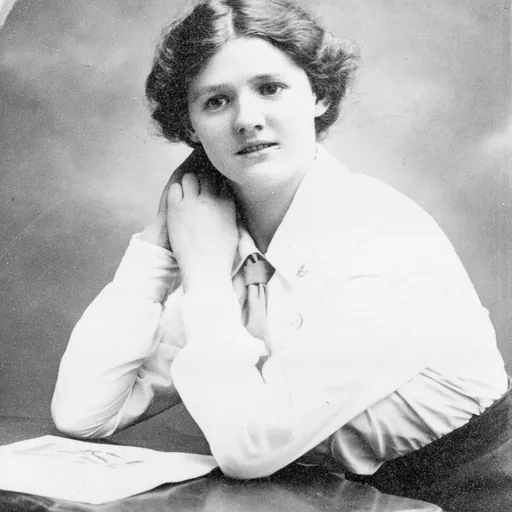
Maud Bruce pictured in the Dumfries and Galloway Standard on 29th August 1917, after she was awarded the OBE.
Maud Ellen Bruce (20 December 1894 — 8 January 1995) was a forewoman and a member of the fire brigade at H.M. Factory Gretna during World War I. In World War Two she worked at ROF Aycliffe, where during an accident with some ammunition, she was severely burnt. She lived to be 100 years old and was one of the first women in Britain to receive plastic surgery. This new wartime industry meant a dramatic increase in the local population as people migrated to the area to work. The Gretna Girls was a collective nickname given to women munition workers at HM Factory Gretna in World War One. One of these workers was Maud Bruce. She arrived at H.M. Factory Gretna in late 1916 to work as a forewoman of the cotton drying house in the Dornock section. Maud was billeted at Grenville Hostel, Eastriggs.
She was a member of the fire brigade and in charge of thirty girls. Maud was described as having ‘gained rapid promotion’ during her time at Gretna, and as being ‘exceedingly popular’ with her staff and superiors. The first occurred around April 1917, when a fire broke out at night in the cotton drying machine. Maud used a hose to subdue the flames, and then the fire brigade put out the fire.
This event was held at the central offices of the factory in front of a number of staff. It was stated that ‘each of the recipients of the medal stepped forward, and was cordially shaken hands with by the Duke, who pinned on the medals, and as he did so there were cordial cheers from the assembly.’
Maud was awarded the OBE in August 1917 "for admirable behaviour in charge of the women’s fire brigade at a fire at an explosive factory." Thomas served in the Royal Irish Regiment during World War I and was discharged due to disability in 1917. Thomas was awarded the British War Medal and the Victory Medal during his service in World War One. In 1920, the couple welcomed their first child, Raymond, and they had their second son, John, in 1922.
Work at ROF Aycliffe during World War II During World War II, Maud again worked in munitions. She had to carry an identity card upon entry and exit to the factory. As at H.M. Factory Gretna, the munition workers at Aycliffe were working with dangerous chemicals and many suffered adverse effects on their health. Later in life Bruce would have to wear "specially tinted spectacles" and have the morning newspaper read out to her because of the damage done to her eyesight. She began working at the factory when it opened in 1941. She later commented, "I loved the work until the accident. I was in hospital over five months." This accident happened in 1943, when "some ammunition exploded, and she was very severely burned on her face, arms, hands and chest. She spent six months in Darlington Hospital and then returned to the factory until the end of the war."
To recover from this injury, Bruce had plastic surgery—still a relatively new procedure mostly performed on servicemen who suffered awful injuries in the course of their duties. Later in life, she would have a distinctive mark from these injuries; "Mrs Nunn had had some plastic surgery on her face – she’d put her hands up to shield her face in the explosion. I think she was one of the first people to have it and her skin was kind of wrinkle free in those areas."
Later life and death After the war ended, Bruce worked as a school dinner lady. Her husband took his life in 1954, and her eldest son, Raymond, predeceased her by 11 years. Bruce lived to be a 100. She celebrated with her family and friends at the nursing home in which she lived, and received a letter from the Queen. Her big birthday was reported in the local press and Bruce spoke to reporters about her long life. "I didn’t want to reach 100, I think it is too long to live, but I am now looking forward to my birthday." She also recalled the moment she was awarded the OBE, saying: "the OBE was the most memorable experience of my life. It was a great honour and I am very proud of the award." Maud Bruce died in 1995.
Don’t just read it —
keep it.
Full-length biographies made to live with: read them, listen on the way to work, watch them tonight.
- E-book
- Audio
- Video
Instant download · yours to keep · every purchase keeps this site free
Important facts
People in Maud Bruce's life
Named in this biography and alive at the same time

Contemporaries
People whose lives overlapped Maud Bruce's


Frequently asked questions
Who was Maud Bruce?
British forewoman and centenarian (1894-1995)
When was Maud Bruce born?
Maud Bruce was born on 20 December 1894 in Coundon.
When did Maud Bruce die?
Maud Bruce died on 8 January 1995 in Shildon.
What nationality was Maud Bruce?
Maud Bruce was British.
Sources & further reading
Cite this page
APA: Biography.guide. (2026). Maud Bruce. https://biography.guide/maud-bruce/
MLA: "Maud Bruce." Biography.guide, https://biography.guide/maud-bruce/.
Chicago: "Maud Bruce." Biography.guide. https://biography.guide/maud-bruce/.
Data last updated: 2026-09-22 · Spot an error? Report a correction.
Portrait: Wikimedia Commons · author & licence
Page generated 2026-09-27 05:01 UTC