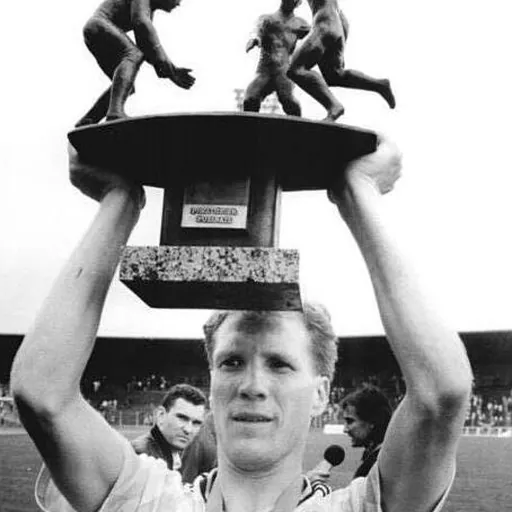
Matthias Sammer
German association football player, coach and executive (born 1967)
About Matthias Sammer
Born 1967. Matthias Sammer is a German association football player and association football coach.
Matthias Sammer (; born 5 September 1967) is a German football official and former player and coach. He played as a defensive midfielder and later in his career as a sweeper.
With Borussia Dortmund as a player, Sammer won the Bundesliga and DFB-Supercup in 1995, the Bundesliga, DFB-Supercup, and European Footballer of the Year in 1996, and the UEFA Champions League and Intercontinental Cup in 1997. Germany won the UEFA Euro 1996 with Sammer as a player, where he was named the tournament's best player, and was subsequently awarded the Ballon d'Or later that year. Sammer retired with 74 total caps, 23 for East Germany and 51 for the unified side. Known for his exceptional defensive skills, including his ability to read the game, make interceptions, and tackle effectively, Sammer is regarded as one of the greatest defenders of all time.
With Sammer as a manager, Borussia Dortmund won the Bundesliga in 2002.
Club career
Dynamo Dresden
Sammer started his career at Dynamo Dresden when he joined the club's youth team as a nine-year-old in 1976. He made his debut for the senior team under the management of his father, Klaus Sammer, in the 1985–86 season. Playing as a striker, he scored eight goals in his first season as Dynamo finished fifth in the DDR-Oberliga. After being moved to the left wing the following season by new manager Eduard Geyer, he eventually found his place in central midfield during the 1987–88 season.
In the 1988–89 season, Sammer was part of the Dynamo Dresden team which won the East German championship. The same season the club also reached the semi-final of the UEFA Cup where they were knocked out by West German club VfB Stuttgart. The following year Dynamo won the league and cup double, defending the DDR-Oberliga title and also winning the 1990 FDGB-Pokal.
Sammer was formally an officer of the Volkspolizei, as a player of Dynamo Dresden. He enrolled into the Felix Dzerzhinsky Guards Regiment as a 19-year-old. Many players of Dynamo Dresden were assigned to the regiment for their military service. Sammer then served as a non-commissioned officer in the Guards Regiment for three years from 1987, holding the rank of sergeant in the Stasi. The President of SV Dynamo was the head of the Stasi Erich Mielke. Sammer has explained that he would not have been able to continue to play football for Dynamo Dresden if he had refused to serve with the Guards Regiment and that he never saw any weapon or took part in any military exercise. He has described his employment with the Guard Regiment as an alibi to play football to Dynamo Dresden.
In addition to the two Bundesliga titles and one Champions League, Sammer also led Dortmund to two DFB-Supercups, in 1995 and 1996. Sammer himself was named Footballer of the Year (Germany) in both 1995 and 1996 and was named European Footballer of the Year in 1996, making him the first defender to win the Ballon d'Or since Franz Beckenbauer in 1976.
International career
East Germany
Sammer represented the GDR at every age group, from 1982 to 1990. He was part of the East German squads which won the 1986 UEFA European Under-18 Football Championship and finished third at the 1987 FIFA World Youth Championship.
In November 1986, he made his debut for the full East Germany national football team in a UEFA Euro 1988 qualifier against France at Zentralstadion in Leipzig.
On 12 September 1990, Sammer captained East Germany in its final match. He scored both goals as the GDR beat Belgium 2–0 in Brussels.
Germany
On 19 December 1990, Sammer debuted for the newly formed unified Germany national football team, which was mostly made up of the West Germany team that had won the 1990 FIFA World Cup. The match was played at his home stadium in Stuttgart and Germany ran out 4–0 winners against Switzerland.
Sammer was a member of the German squad for UEFA Euro 1992, where the team was beaten in the final by Denmark. He was also selected for the 1994 FIFA World Cup, as Germany was surprisingly knocked out by the underdog Bulgaria at the quarter-final stage.
In UEFA Euro 1996, Sammer played in the libero role he had been converted to at Borussia Dortmund. He scored the opening goal in Germany's second group match against Russia and the winning goal against Croatia in the quarter-final. After Germany defeated the Czech Republic in the final, Sammer was named Player of the Tournament.
On 7 June 1997, Sammer played his final match for Germany in a 1998 FIFA World Cup qualifier against Ukraine in Kyiv. He did not take part at the 1998 FIFA World Cup due to injury.
Style of play Sammer usually played as a sweeper during the height of his career, in particular in later years, although he was also capable of playing in several midfield and offensive roles; indeed, he was often deployed further up the pitch earlier in his career, including in a holding role, as an attacking midfielder, as a central midfielder, as a left winger, as a deep-lying playmaker, or even as a striker on occasion, courtesy of his technique, stamina, passing ability, and vision. Although he was not the most physically gifted defender, due to his slender frame, he was regarded as a world class player in his position, in particular due to his intelligence and positional sense, while he was also able to improve his tackling ability as his career progressed. Despite his more defensive playing role, he was also a talented and energetic player, who was known for his eye for goal, athleticism, elegance, finesse, and offensive capabilities, and had a penchant for undertaking individual forward runs with the ball towards the opposing penalty area. Beyond his skills as a footballer, he was also known as an influential player and a commanding presence on the pitch, who stood out for his charismatic leadership qualities, determination, bravery, and composure under pressure. Despite his ability and reputation as one of the greatest sweepers of all time, however, he was also known to be prone to injuries, which ultimately forced him to retire from professional football at the age of 31.
Coaching and management career Borussia Dortmund After retirement, Sammer first served as an assistant to Udo Lattek, and later became head coach of Borussia Dortmund on 1 July 2000. Sammer led Borussia Dortmund to another Bundesliga title in 2002. His team reached the 2001–02 UEFA Cup final the same year but lost 2–3 against Feyenoord. Sammer was sacked at the end of the 2003–04 season after Dortmund finished in sixth place.
VfB Stuttgart Sammer returned to VfB Stuttgart as head coach for the 2004–05 season. Despite finishing one point off a Champions League qualifying position, Sammer left the club on 3 June 2005.
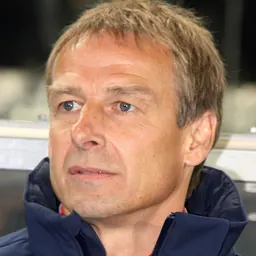
German Football Association On 1 April 2006, he was appointed technical director of German Football Association (DFB), on a five-year contract. The position was new in the DFB at the time and had been initiated by national coach Jürgen Klinsmann, who undertook major structural reforms in the DFB during his short time of two years as a coach, with an impact lasting much longer than his actual term. The position included responsibility for the national youth teams, focusing on young talents between the ages of eleven and eighteen, as well as incorporating the latest developments in sports science into the DFB's training theories. Sammer was also expected to work on a tactical system for all of Germany's national sides in close co-operation with national coach Joachim Löw. He is credited of having led the declining quality of German football from its worst era at the beginning of the 2000s to new success through several talented players developed in the restructured youth system.
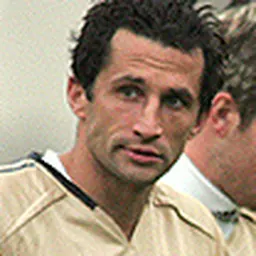
Bayern Munich On 2 July 2012, he took over as sporting director of Bayern Munich and replaced Christian Nerlinger, who had been released following Bayern's treble losses in Bundesliga, German Cup and Champions League and because of his strained relationship with the club. As Sporting Director, Sammer was a member of the management board responsible for the professional playing staff of the club. and had to take a break from his work. During his recovery, he gained a new perspective on his work and family life and asked FC Bayern to release him from his position as sporting director which they granted on July 10, 2016. Afterwards, Bayern Munich continued working without any sporting director for a year before they presented Hasan Salihamidžić as his replacement.
Following this he effectively retired, initially working as a pundit for Eurosport for a while but ruling out to continue this in the future. In 2018, he started to work part-time as an adviser for Borussia Dortmund, meeting with the club for talks every two weeks, and is regularly seen sitting next to Dortmund's management during matches.
Personal life Sammer is married and has three children, Sarah, Marvin, and Leon. He lives in Munich, Germany. He is the son of Klaus Sammer, a former player and manager of Dynamo Dresden.
Career statistics Club
International East Germany
International goals Scores and results table. Germany's goal tally first: Date Venue Opponent Score Result Competition 1. 31 August 1988 Friedrich-Ludwig-Jahn-Sportpark, East Berlin, East Germany 1–0 1–0 Friendly 2. 6 September 1989 Laugardalsvöllur, Reykjavík, Iceland 1–0 3–0 1990 FIFA World Cup qualifying 3. 8 October 1989 Stadion an der Gellertstraße, Karl-Marx-Stadt, East Germany 2–1 2–1 1990 FIFA World Cup qualifying 4. 11 April 1990 Stadion an der Gellertstraße, Karl-Marx-Stadt, East Germany 2–0 2–0 Friendly 5. 12 September 1990 Constant Vanden Stock Stadium, Brussels, Belgium 1–0 2–0 Friendly 6. 2–0
Germany
International goals Date Venue Opponent Score Result Competition 1. 16 December 1992 Estádio Olímpico Monumental, Porto Alegre, Brazil 1–2 1–3 Friendly 2. 2 June 1994 Ernst-Happel-Stadion, Vienna, Austria 1–0 5–1 Friendly 3. 8 June 1994 Varsity Stadium, Toronto, Canada 1–0 2–0 Friendly 4. 8 October 1995 Ulrich-Haberland-Stadion, Leverkusen, Germany 3–0 6–1 UEFA Euro 1996 qualifying 5. 6–0 6. 4 June 1996 Carl-Benz-Stadion, Mannheim, Germany 5–0 9–1 Friendly 7. 16 June 1996 Old Trafford, Manchester, England 1–0 3–0 UEFA Euro 1996 8. 23 June 1996 Old Trafford, Manchester, England 2–1 2–1 UEFA Euro 1996
Coaching statistics
Team From ToRecord Borussia Dortmund 1 July 2000 VfB Stuttgart 1 July 2004 Total—
Honours Player Dynamo Dresden DDR-Oberliga: 1988–89, 1989–90 FDGB-Pokal: 1989–90
VfB Stuttgart Bundesliga: 1991–92
Borussia Dortmund Bundesliga: 1994–95, 1995–96 DFB-Supercup: 1995, 1996 UEFA Champions League: 1996–97 Intercontinental Cup: 1997
Germany UEFA European Championship: 1996; runner-up: 1992 U.S. Cup: 1993
Individual Ballon d'Or: 1996 kicker Bundesliga Team of the Season: 1990–91, 1994–95 ESM Team of the Year: 1994–95 Footballer of the Year in Germany: 1995, 1996 kicker Bundesliga-best libero: 1995, 1996 kicker Bundesliga-best midfielder: 1993 UEFA European Championship Player of the Tournament: 1996 UEFA European Championship Team of the Tournament: 1996 Onze de Bronze: 1996 World Soccer: The 100 Greatest Footballers of All Time
Manager Borussia Dortmund Bundesliga: 2001–02 DFB-Ligapokal runner-up: 2003 UEFA Cup runner-up: 2001–02
Don’t just read it —
keep it.
Full-length biographies made to live with: read them, listen on the way to work, watch them tonight.
- E-book
- Audio
- Video
Instant download · yours to keep · every purchase keeps this site free
Important facts
People in Matthias Sammer's life
Named in this biography and alive at the same time


Related people
Same field, nearest in time


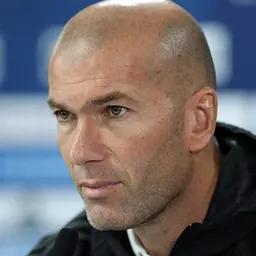

Contemporaries
People whose lives overlapped Matthias Sammer's



Frequently asked questions
Who is Matthias Sammer?
German association football player, coach and executive (born 1967)
When was Matthias Sammer born?
Matthias Sammer was born on 5 September 1967 in Dresden.
What is Matthias Sammer's occupation?
Matthias Sammer is an association football player and association football coach.
What nationality is Matthias Sammer?
Matthias Sammer is German.
Sources & further reading
Cite this page
APA: Biography.guide. (2026). Matthias Sammer. https://biography.guide/matthias-sammer/
MLA: "Matthias Sammer." Biography.guide, https://biography.guide/matthias-sammer/.
Chicago: "Matthias Sammer." Biography.guide. https://biography.guide/matthias-sammer/.
Data last updated: 2026-09-20 · Spot an error? Report a correction.
Portrait: Wikimedia Commons · author & licence
Page generated 2026-09-27 04:58 UTC