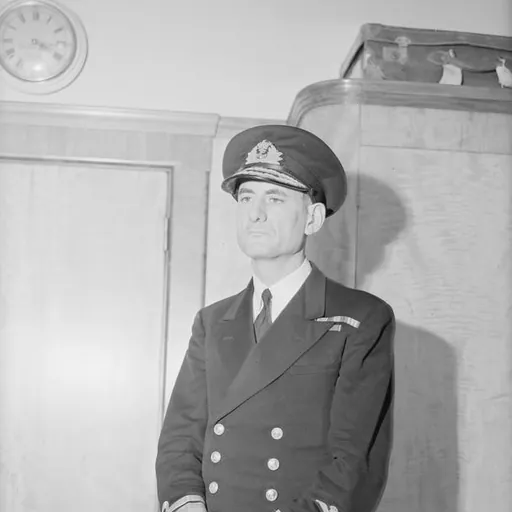
Matthew Slattery
British naval officer and businessman
About Matthew Slattery
Lived 1902 – 1990 (aged 87). Matthew Slattery was a British businessperson, naval officer and banker.
Rear-Admiral Sir Matthew Sausse Slattery, (12 May 1902 – 16 March 1990) was a British naval officer, military aviator and businessman. He was the managing director and chairman of Short Brothers and Harland, chairman of British Overseas Airways Corporation and latterly served as chairman of Hawthorn Leslie and Company. He was also a board member of Bristol Aeroplane Company and The National Bank.
Early life
Slattery was born in Bromley, London on 12 May 1902. His father was Henry Francis Slattery and his mother was Agnes Slattery (née Cuddon). His father served as the chairman of The National Bank from 1888 to his death in 1911, and had other business interests, serving as the chairman of the Brecon and Merthyr Tydfil Junction Railway, and as a director of several other railways and a number of insurance companies.
Slattery was privately educated at Stonyhurst College before joining the Royal Navy on 15 January 1916, aged 13. He would continue his education at the Royal Naval College, Osborne, then the Royal Naval College, Dartmouth.
Military career
Slattery was commissioned as a sub-lieutenant on 30 September 1923, then promoted to lieutenant on 19 June 1924. His early assignments included service aboard the monitor ship , and service with the Fleet Air Arm (at the time, part of the Royal Air Force). Slattery was one of a small number of naval officers who took the first Fleet Air Arm training course in 1924, qualifying as a pilot at Netheravon Airfield.
He was promoted to lieutenant commander on 30 September 1931, after eight years service. His service as a lieutenant commander included service as the flight commander for 450 (Fleet Reconnaissance) Flight on the aircraft carrier , and attachment to the Admiralty. Slattery was an early proponent of deck landings aboard ships thanks to his involvement with the Fleet Air Arm, and would remain heavily involved with carrier borne aircraft for the remainder of his naval career. He was re-attached to the Royal Air Force in 1934, and held the rank of squadron leader.
He was promoted to commander at the end of 1934 whilst still attached to the Royal Air Force, shortly after, he was given his first command - the destroyer . He would also command the heavy cruiser before moving to the Admiralty.
Slattery was promoted to captain at the end of 1938, whilst still attached to the Royal Air Force, and was, at the time, the Royal Navy's youngest captain. He would be assigned the role Director of Air Material and then Director-General of Naval Aircraft Development and Production, Ministry of Aircraft Production. He was joined at Short Brothers and Harland by the naval aviator Captain Henry St John Fancourt, who served under Slattery as the Deputy Chief Naval Representative, Ministry of Aircraft Production.
Slattery led Short Brothers and Harland at a time when they developed a number of experimental aircraft designs, though none would see significant production. The Short SC.1 was one of a number of experimental designs produced by Shorts, and is notable for being Britain's first vertical take-off and landing (VTOL) aircraft. The SC.1 pre-dated (and aided in the development of) the Hawker Siddeley Harrier.
Slattery was elected to the board of Bristol, and appointed chairman of Bristol's aircraft manufacturing subsidiary, the Bristol Airplane Company in 1957. The Britannic 1 was developed into the Britannic 3A (entering service as the Shorts Belfast) and had far less in common with the Britannia.
Slattery took over as chairman of the state owned carrier BOAC on 29 July 1960, after Gerard d'Erlanger stood down from the role to return to his other business interests. Slattery served as chairman on a full-time basis unlike d'Erlanger, who held the position on a part-time basis. The appointment to BOAC ended Slattery's 12 years with Shorts, he was replaced as chairman by his predecessor as Bristol Aircraft chairman, Cyril Uwins. Slattery also joined the Airworthiness Requirements Board around the time of his appointment with BOAC.
The downturn in the aviation sector and fraught relations between Julian Amery, the new Minister of Aviation and BOAC concerning writing off debt (much of it incurred buying and troubleshooting new British aircraft) resulted in a further deterioration in relations between the airline and government. Amery commissioned an independent report into the financial performance of BOAC, undertaken by John Corbett. The ongoing disagreement about the funding arrangements for BOAC and the need for new Vickers VC10 aircraft would eventually be resolved in late 1963, when Slattery formally retired as chairman, though this was widely seen as a resignation; Slattery commented in 1964 that he had effectively been sacked.
Giles Guthrie, a respected aviator, merchant banker and director of British European Airways took over from Slattery as chairman. He credited the Slattery and Smallpeice management team for BOAC's return to profitability in 1964.
Slattery returned to The National Bank, retaking his seat on the board of directors after leaving BOAC.
His next significant position was at the shipbuilder Hawthorn Leslie and Company, joining the board in 1964 and taking the role of chairman in 1966. The British shipbuilding industry at the time was in a period of significant upheaval, with changes in the shipping industry (particularly containerisation, which was being pioneered by Basil Smallpeice at Cunard) reducing demand for the traditional types of ship built in Britain. The Geddes Report broadly encouraged rationalisation of the British shipbuilding industry, and Hawthorn Leslie would merge their shipbuilding assets with those of Swan Hunter, John Readhead & Sons and the River Tyne assets of Vickers-Armstrongs to form Swan Hunter Group in 1968.
Hawthorn Leslie would take a 16.36% stake in the combined Swan Hunter Group (formally Swan Hunter Shipbuilders Limited), holding this until 1977 when the entire shipbuilding industry was nationalised to form British Shipbuilders. Slattery served as a director of the Swan Hunter Group from the time of the merger in 1968 through to 1973, when he retired from Hawthorn Leslie and Company.
Slattery's final role before retirement was with the Air Registration Board, having joined in 1960, he retired from the ARB in May 1974. He was first appointed to the ARB as an operators representative (and was succeeded in this role on the board by Giles Guthrie). He remained on the board after leaving BOAC, and took over from the late John Moore-Brabazon, 1st Baron Brabazon of Tara as an independent representative.
Personal life
Slattery was married once, to Mica Mary Swain, daughter of Colonel DG Swain. They married in 1925 and had three children, two sons and one daughter. Mica survived her husband and died in 1998.
Slattery was honoured several times during his career. He was then knighted (as a Knight Bachelor) in the 1955 New Year Honours for his work with Shotts and Harland. He was subsequently appointed a Knight Commander of the Most Excellent Order of the British Empire in the 1960 New Year Honours for his work advising the government on the transport of oil from the Middle East.
The United States of America honoured Slattery with the Legion of Merit (Degree of Commander) in 1945, whilst in 1954, Queen's University Belfast awarded him an honorary Doctor of Science degree. He was appointed as a Fellow of the Royal Aeronautical Society in 1946, a significant honour for those involved in the aviation industry.
Slattery listed his hobbies as "country pursuits" in his Who's Who entry.
Don’t just read it —
keep it.
Full-length biographies made to live with: read them, listen on the way to work, watch them tonight.
- E-book
- Audio
- Video
Instant download · yours to keep · every purchase keeps this site free
Important facts
People in Matthew Slattery's life
Named in this biography and alive at the same time




Related people
Same field, nearest in time
Contemporaries
People whose lives overlapped Matthew Slattery's




Frequently asked questions
Who was Matthew Slattery?
British naval officer and businessman
When was Matthew Slattery born?
Matthew Slattery was born on 12 May 1902 in Bromley.
When did Matthew Slattery die?
Matthew Slattery died on 16 March 1990 in Warninglid.
What was Matthew Slattery's occupation?
Matthew Slattery was a businessperson, naval officer and banker.
What nationality was Matthew Slattery?
Matthew Slattery was British.
Sources & further reading
Cite this page
APA: Biography.guide. (2026). Matthew Slattery. https://biography.guide/matthew-slattery/
MLA: "Matthew Slattery." Biography.guide, https://biography.guide/matthew-slattery/.
Chicago: "Matthew Slattery." Biography.guide. https://biography.guide/matthew-slattery/.
Data last updated: 2026-09-22 · Spot an error? Report a correction.
Portrait: Wikimedia Commons · author & licence
Page generated 2026-09-27 04:59 UTC